Intro to Synthesis
Foundations · The Classic Voice · Breaking the Paradigm
Timbre · Pitch · Rhythm
Foundations · The Classic Voice · Breaking the Paradigm
Timbre · Pitch · Rhythm
Part 1 · Overview
Synthesis means building sound from scratch using electrical signals.
In this workshop we focus on subtractive synthesis - start with a harmonically rich signal and sculpt it by removing what you don't want.
Think of a sculptor starting with a block of marble. The raw oscillator is the block. The filter is the chisel.
Start full. Carve away. Shape what remains.
Part 1 · Overview
What does it sound like?
VCF · Envelope · LFO
What note?
VCO · Sequencer · Keyboard
When does it happen?
Clock · Sequencer · Gate
Part 1 · Foundations
How big the signal is. Measured in volts peak-to-peak.
How fast the signal repeats. 1Hz = one cycle per second.
The shape of the voltage change. Shape determines harmonic content.
Part 1 · Key Insight
There is no electrical difference between an audio signal and a control signal.
They're all just voltages changing over time. The only difference is speed and intent.
Audio: fast -20 Hz to 20 kHz
Control: slow -0.1 Hz to ~30 Hz
This is what makes modular synthesis powerful: anything can control anything.
Part 1 · Timbre
Same fundamental pitch - different harmonic recipes - different timbre.
A single frequency. No overtones. The purest possible tone - the building block of all other waveforms.
Part 1 · Timbre · Pitch
Time Domain
Spectral View
The fundamental - a single frequency. The note you hear as "the pitch."
Part 1 · Timbre
The VCF removes frequencies from a signal. Cutoff sets where; resonance emphasizes the edge.
Sweep the cutoff to hear harmonics disappear. Crank resonance to hear the filter sing.
Part 1 · Pitch
Pitch is frequency. 440 Hz = A4. Double the frequency = up one octave. Halve it = down one octave.
Part 1 · Pitch
Noise has no pitch - all frequencies at once. Filter it and patterns emerge: rumble, hiss, wind, surf.
White noise: equal energy at every frequency - pure randomness.
Part 1 · Pitch
Most synthesizers use voltage to control pitch. The standard: each additional volt doubles the frequency, up one octave.
The oscillator's tune knob sets the base pitch at 0V. From there, every +1V is one octave up. Every semitone is 1/12V (~0.083V).
1V/oct is the standard that lets modules from different makers talk to each other.
Part 1 · Pitch
Discrete notes. Each key sends a voltage. The Minimoog way.
Programmed pattern. Each step sends a pitch CV in a loop.
Grabs a random voltage on each clock tick. Generative melodies.
Part 1 · Rhythm
A gate is a voltage that stays high as long as a key is held. A trigger is a brief pulse - just a click to say "now."
Gate: on while held, off on release
Trigger: short pulse (~1–10 ms)
Hold the gate to hear the raw on/off. Tap trigger for a short pulse.
A gate turns sound on and off - but real instruments don't work that way.
Part 1 · Rhythm
An envelope shapes how a value changes over the life of a note.
Press to trigger the envelope. Hold for sustain, release to hear the release stage.
Part 1 · Dynamics
A Voltage Controlled Amplifier scales one signal by another. It's a volume knob that other modules can turn.
The envelope generates a shape - the VCA applies it. Without a VCA, there's no way to start and stop notes.
The VCA is the invisible instrument - it turns voltage into expression.
Part 1 · Modulation
A Low Frequency Oscillator is too slow to hear, but it can wiggle any parameter: pitch (vibrato), filter (wah), amplitude (tremolo).
Part 1 · Modulation
An envelope fires once per note - it shapes a gesture. Route it to different targets to hear the difference.
Envelope sweeps filter cutoff - brightness rises and falls with each trigger.
In modular, an envelope can go anywhere.
Part 2 · Signal Path
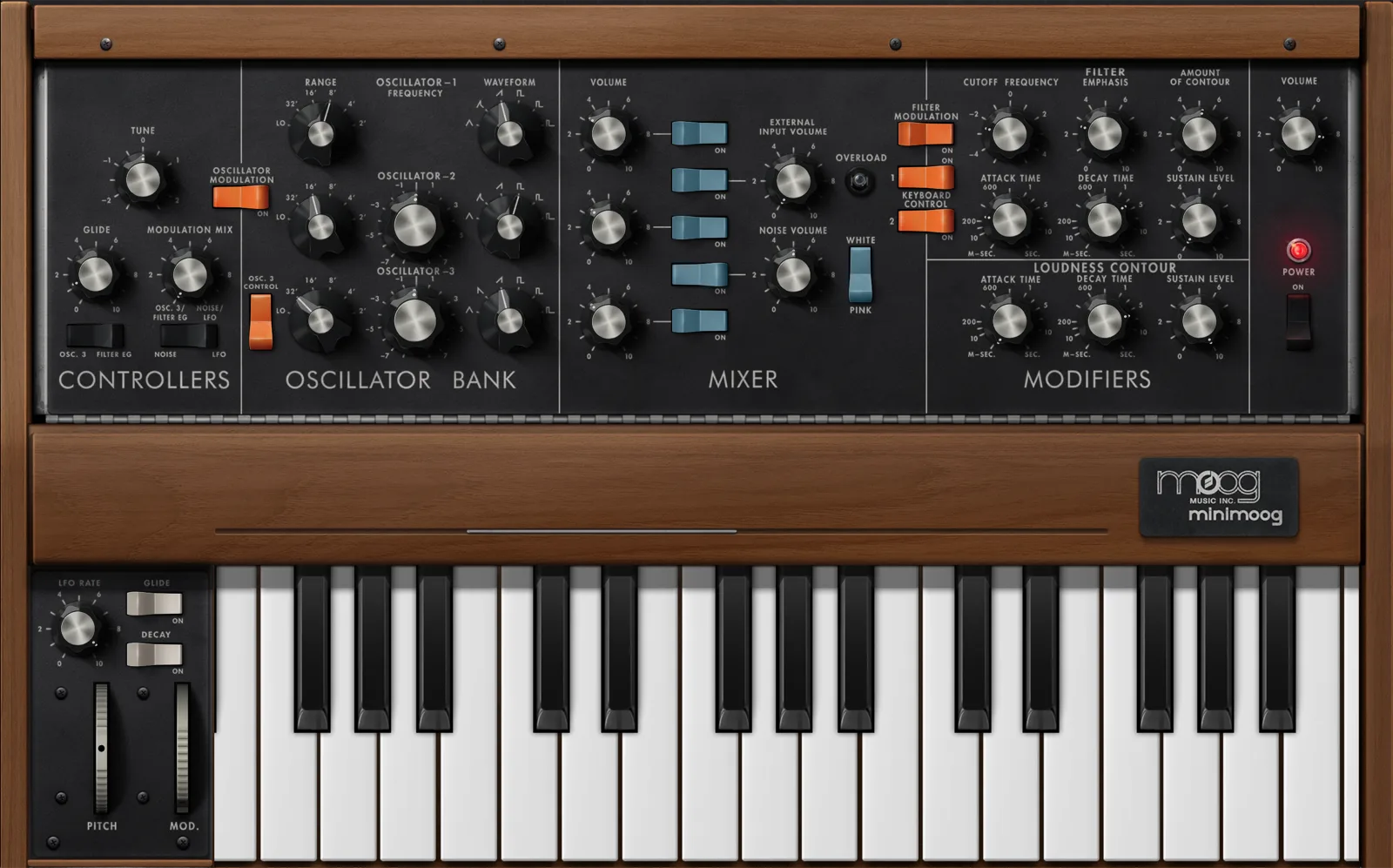
Released in 1970, the Minimoog defined the architecture of the synthesizer. Nearly every synth since follows this template.
We'll recreate this signal path in VCV Rack, then break it apart to explore what modular makes possible.
First: the fixed path. Then: what happens when you remove the limits.
Part 3 · Modular
Modular
Timbre
FM, ring mod, waveshaping, self-oscillating filters
.
Pitch
Sequencers, LFOs, noise, other oscillators
.
Rhythm
Clocks, dividers, generative feedback loops