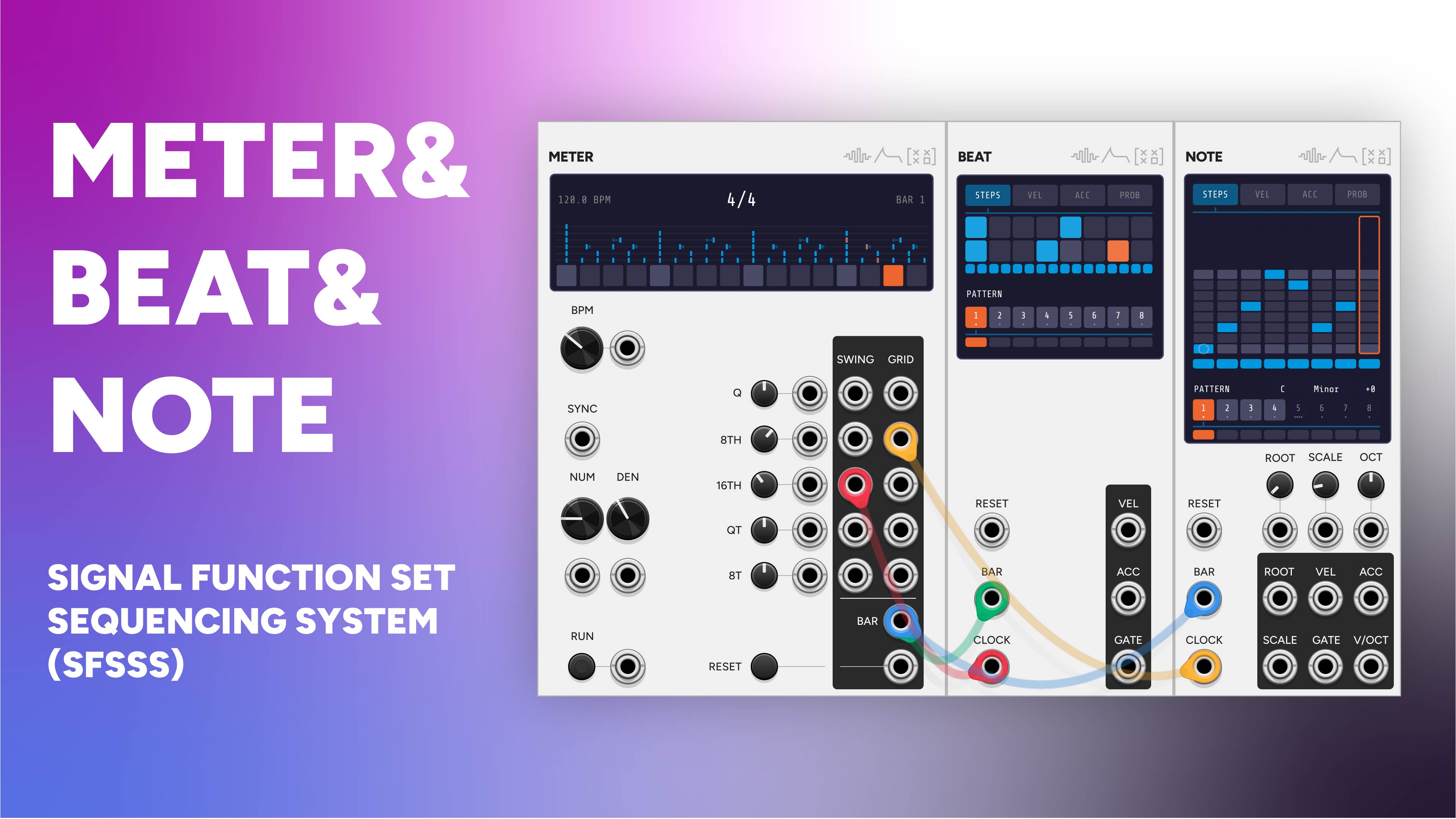
A three-module rhythm system for VCV Rack. Meter is a time-signature-aware master clock with per-subdivision swing. Beat is a single-voice drum sequencer. Note is the pitched cousin of Beat with 17 scales including just-intonation harmonics and Indonesian Gamelan tunings.
Each module is its own thing, but they’re designed to work together: one Meter drives a rig of Beats and Notes, all sharing bar boundaries, swing, and reset behavior. Each Beat or Note is intentionally a single voice: to build a kit, you instantiate as many as you need, and each holds its own independent pattern bank, length, and feel.
Meter: the master clock
Most VCV clocks are subdivision dividers: they emit evenly-spaced pulses at fixed ratios. Meter understands the musical structure of those pulses: bars, beats, swing, and time signatures with CV control.
18 HP.
Six musical subdivisions
Each output runs at the rate implied by the current time signature:
- BAR: one pulse at the start of every bar
- QUARTER: quarter notes
- EIGHTH: eighth notes
- SIXTEENTH: sixteenth notes
- QUARTER TRIPLET: three pulses per quarter
- EIGHTH TRIPLET: three pulses per eighth
Time signature with CV
Both the numerator (1–16) and denominator (1, 2, 4, 8, 16, 32) are knobs with CV inputs. Time signature changes are queued for the next bar boundary by default, so the current bar plays to completion. A context menu option lets you apply changes immediately if you want unmusical glitching.
Swing per output
Each subdivision (except BAR) has its own swing trimpot (-50% to +50%) and matching CV input. Positive swing delays the off-beats for a shuffle feel; negative swing fires them early for a rushed feel.
For each swingable subdivision, Meter provides two output jacks: SWG (swung) and GRD (grid). You can patch the swung eighth into the hat and the grid eighth into a synth bass, mixing straight and grooved feels from the same Meter.
Swing values are latched per bar to prevent mid-period glitches.
External clock sync
Patch a clock pulse train into EXT CLOCK and Meter measures the inter-pulse interval to derive BPM. PPQN is selectable (1, 2, 4, 8, 12, 16, 24). When external clock is patched, the BPM knob is overridden and a sync indicator flashes on each external pulse.
Display
Top status line shows BPM, time signature (with → 7/8 style pending-change indicator), and a bar counter. Below it, six per-output hit-indicator rows visualize each output’s pulses across the bar: bright tick at each fire position, ghost ticks at the un-swung positions with connector lines to the swung position. The tick that just fired flashes blue → orange and decays over ~100ms. A position tracker at the bottom shows the current sixteenth-note position in the bar.
Beat: drum voice sequencer
Beat is a single-voice pattern sequencer paired with Meter or any source of clock + bar pulses. One Beat instance equals one drum voice. Eight patterns × sixteen steps each, with per-step velocity, accent, and probability.
10 HP.
Patterns and steps
Each Beat instance holds 8 patterns × 16 steps. Each step has four properties: on/off, velocity, accent, and probability. Each pattern has its own length (1–16) and repeat count (1–8 bars). Patterns can be marked active or inactive: inactive patterns are skipped in the rotation, so you can chain a subset without manually editing each one.
When the playhead reaches the last active step, on the next CLOCK pulse it wraps back to step 0: even mid-bar. A 5-step pattern clocked at 16th notes will keep cycling against the underlying meter, producing built-in cross-rhythm.
Display modes
The display is the primary editing surface. Four mode tabs: STEPS, VEL, ACC, PROB.
- STEPS: click cells to toggle on/off, drag to paint
- VEL: click-and-drag vertically to set per-step velocity (0–10V S&H output)
- ACC: click to toggle accent flag (1ms pulse on the ACC output)
- PROB: click-and-drag vertically to set per-step probability (0–100% chance of firing)
Below the grid: length dots, pattern selector with repeat-count indicators, and a repeats bar. Click, drag, scroll-wheel, and double-click all do useful things.
Inputs and outputs
| I/O | Function |
|---|---|
| CLOCK | Advances the step counter |
| BAR | Advances to the next active pattern |
| RESET | Returns to first active pattern, step 0 |
| GATE | 1ms 10V pulse on each fired step |
| VEL | 0–10V sample-and-hold velocity |
| ACC | 1ms 10V pulse on accented hits |
Note: pitched sequencer
Note is the pitched (CV/gate) cousin of Beat. Same architecture for clock/bar/repeat behavior (eight patterns, per-step velocity/accent/probability, the four edit modes), but each step also carries a pitch quantized to a selectable scale and root.
10 HP. 8 steps per pattern.
Pitch matrix
The display matrix is 8 columns (steps) × 13 rows (pitches). The bottom row is the scale’s root pitch; rows above are successive scale degrees, with the root + 1 octave always shown at the top so the scale octave is visible regardless of scale size. Out-of-scale rows are dim and not clickable.
Click a cell in STEPS mode to set that step’s pitch; click again to clear (rest). Drag-paint paints the same row across columns.
17 scales, including non-12-TET
The standard suspects are all here (Major, Minor, Dorian, Phrygian, Lydian, Mixolydian, Harmonic Minor, the pentatonics, Blues, Whole-tone, Hijaz, Hirajoshi). Note also includes three scales that produce pitches you can’t get from a chromatic quantizer:
- Harmonic: just-intonation harmonics 1 through 12. The V/OCT output gives precise just-intonation ratios.
- Pelog: 7-tone Indonesian Gamelan scale, Surakarta tuning
- Slendro: 5-equal Indonesian Gamelan scale
These three sound noticeably “off-grid” against equal-tempered instruments: by design.
Root, scale, octave: chainable
ROOT, SCALE, and OCT each have a knob, a CV input, and an OUT jack that relays the current value. Patch one Note’s ROOT OUT into another Note’s ROOT CV and changing the bass key transposes the arp automatically.
Inputs and outputs
| I/O | Function |
|---|---|
| CLOCK / BAR / RESET | Same as Beat |
| ROOT / SCALE / OCT CV | 1V/oct semitones, 1V per scale, 1V per octave |
| GATE | 1ms 10V pulse on each fired step |
| V/OCT | 1V/oct pitch (sample-and-hold) |
| VEL / ACC | Velocity CV and accent pulse |
| ROOT / SCALE OUT | Relays current values for chaining |
Patch ideas
3-piece drum kit driven by Meter: Three Beats (kick, snare, hat). Meter QUARTER → kick clock, Meter EIGHTH (swung) → snare clock, Meter SIXTEENTH (swung) → hat clock. All three BAR inputs fed from Meter BAR. All three RESET inputs from Meter RESET. Each Beat holds its own pattern bank for its drum, and you can dial swing per voice from the master.
Cross-rhythm playground: Patch Meter QUARTER TRIPLET into one Beat and Meter EIGHTH into another. The triplet fires 3-against-2 against the eighth, producing classic polyrhythms.
Bass + arp from one Meter: Two Notes share one Meter’s clock and bar pulses. Note 1 (bass) on a pentatonic, low octave, 4-step pattern. Note 2 (arp) on the same scale, +1 octave, 8-step pattern with all-on steps. Patch Note 1’s ROOT and SCALE OUT into Note 2’s ROOT and SCALE CV: changing the bass key transposes the arp automatically.
Gamelan ensemble: Four Notes on the Slendro scale, all sharing root via SCALE OUT chaining. Each at a different octave. Different pattern lengths (5, 7, 8, 11) for shifting polyrhythmic feel. Patch each into a Tine for metallic resonator timbre: instant inharmonic gamelan.
Just-intonation drone: Note with scale = Harmonic, single sustained note on row 0 (root), velocity max. The V/OCT output gives precise just-intonation harmonics 1 through 12. Step through them as a sweep through the harmonic series.
Sequenced time signatures: Patch a slow LFO or sequencer into Meter’s NUM CV and DEN CV to morph the time signature mid-piece. Pending changes apply at the next bar boundary by default, keeping the music musical.
External tempo follow: Patch a hardware MIDI clock or a Clk module into Meter’s EXT CLOCK at 24 PPQN. Meter follows the external tempo while still emitting its own subdivisions, swing, and bar boundaries.