
Introduction to Sound Synthesis Shaping control signals
Slew
A slew limiter limits how fast a signal can change. A step at its input comes out as a ramp, so a stepped pitch line comes out as notes that glide into each other, and a random signal that jumps between values comes out as a smooth line.
Many of the control signals in this guide change in steps: a sequencer jumps from one pitch to the next, a sample and hold jumps to a new random value on each tick, and a gate jumps between low and high. A slew limiter sits between such a source and its destination and limits the slew rate, the speed at which its output can change. A step at the input comes out as a ramp, and in the common linear design a large step makes a longer ramp than a small one. On a modular synthesiser it is a module of its own, sometimes called a lag processor. Keyboard synthesisers and software instruments build the same function into the pitch signal path and label it glide or portamento.
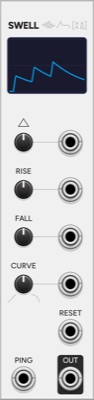
The tool below sends one of three stepped sources through a slew limiter to an oscillator's pitch. The plot shows the source in grey and the slewed output in blue over the last four seconds.
A slew limiter
A sequence, a random source or a square wave passes through a slew limiter to an oscillator's pitch. Rise and fall times are set separately, and the limiter can move at a constant rate or exponentially.
Listen for With both times at zero the pitch jumps. Raise them and each note glides into the next, with larger intervals taking longer in linear mode. A long rise and a short fall give notes that slide up and snap down. On the random source, a long slew turns the jumps into a slow wandering line.
Rise and fall
Many slew limiters have separate controls for rising and falling. With both equal, upward and downward changes are smoothed at the same rate. With a long rise and a short fall, the output climbs slowly and drops quickly, so a melody slides up into high notes and falls almost at once to low ones. In this tool the rise and fall times are the time the output takes to move one octave in linear mode, and the time constant of the curve in exponential mode.
Constant rate, constant time and exponential
A linear slew limiter moves at a constant rate, so an octave takes twice as long as a tritone, which is half the distance. Some synthesisers offer a constant-time glide instead, where every glide takes the same time whatever the interval. An exponential slew limiter, also called a lag, moves fast at the start and slows as it nears the target, the way a capacitor charges through a resistor. It needs only a resistor and a capacitor, and many analogue portamento circuits work this way, which gives their glides a quick start and a slow settle into the note.
Other uses
Slew works on any control signal. On a stepped random signal it gives a smooth random line, a common source of slow drifting modulation. On a gate it gives an attack and release envelope: the output rises over the rise time when the gate goes high and falls over the fall time when it goes low. On a square wave it gives a trapezoid, and with long enough times a triangle. Function generators such as Make Noise's Maths are built around a slew circuit for this reason, and with their output fed back to trigger themselves they become the looping envelopes of patches that drive themselves.
Common questions
What is a slew limiter?
A slew limiter is a processor that limits how fast a signal can change. A sudden step at its input comes out as a ramp, so a stepped pitch sequence comes out as notes that glide into each other. Many slew limiters have separate controls for rising and falling.
What is the difference between slew and portamento?
Portamento, or glide, is the effect: a pitch sliding from one note to the next. A slew limiter on the pitch signal is the usual way of producing it, and it can do the same to any other control signal, such as a filter cutoff or a level.
What is the difference between linear and exponential slew?
Linear slew moves at a constant rate, so a large step takes longer than a small one and the output travels in a straight line. Exponential slew, also called a lag, moves quickly at first and slows as it approaches the target, like a capacitor charging through a resistor.
Can a slew limiter be used as an envelope?
Yes. A gate sent through a slew limiter rises over the rise time when the gate goes high and falls over the fall time when it goes low, which is an attack and release envelope. Function generators such as Make Noise's Maths are built around this idea.
Related modules
Published Glossary