
Introduction to Sound Synthesis Pitch
Where pitch comes from
An oscillator's pitch is set by a control signal: a voltage in analogue hardware, a note number over MIDI, a value in software. Anything that produces that signal can play the oscillator, and the tools below send three common sources to the same one.
The earlier chapters dealt with one note at a time. In the three tools below the oscillator and its settings stay the same, and only the source of its pitch signal changes. Almost every synthesiser keeps that separation between the part that makes the sound and the part that sets the notes. On a modular system it is visible as a cable: the keyboard, the sequencer and the random source each plug into the same pitch input. On a keyboard synthesiser or in software the connection is internal, but the arrangement is the same, which is how an arpeggiator or a built-in sequencer can take over from the keys without the oscillator changing at all.
A keyboard
Each key sets a pitch signal that holds until you press another key, and plays a short note at that pitch. The plot underneath records the pitch signal your playing produced.
Listen for Each note starts at its own pitch, with no slide from the note before. The plot shows the pitch signal as a staircase, holding each value until the next key is pressed.
A keyboard is the pitch source most people meet first, and it produces a new pitch only when someone presses a key. The sequencer and the sample and hold below run on their own once they are started, moving to a new pitch on each pulse of a clock.
A sequencer
The sequencer has eight steps, each holding a note. Click any cell to change a step, and the playhead shows which step is sounding.
Listen for The pattern repeats exactly. Change a cell while it runs and the new note is heard the next time the playhead reaches that step, and the other steps stay as they were.
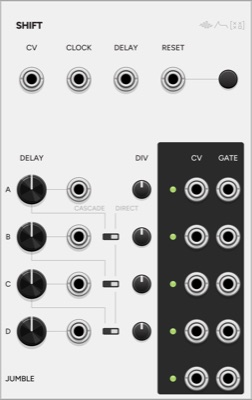
The sequencer keeps playing with nobody at the keys. Each step sends two signals: a pitch that sets the note, and a gate that marks when the note starts. In these tools each new pitch also starts a short note that fades out within a third of a second, so that the steps can be heard separately. Shaping a note from the gate is the job of envelopes and the VCA, which have chapters of their own later in the guide.
Sample and hold
The sample and hold takes a random value on every clock tick and holds it until the next tick. Quantize moves each value to the nearest note of C major.
Listen for Unquantized, the sample and hold lands on any pitch within an octave, most of them outside the C major scale. With quantize on, the notes are just as unpredictable and every one is in C major.
Quantizing
With quantize off, the sample and hold sends a new random value on each tick, and the oscillator plays exactly the pitch it receives. That can be any frequency in the range, including frequencies between the twelve equal-tempered pitches, so most of the notes fall outside any particular scale, including the scale of any other part being played.
A quantizer sits between the random source and the oscillator and moves every value to the nearest note of a chosen scale. The sequence stays unpredictable, because the quantizer only rounds each value and has no effect on which value comes next, and every note it produces belongs to the scale. Random sources constrained to a scale are common in generative patches.
Three sources, one oscillator
All three tools above produce a pitch signal that changes over time, and the oscillator responds to each of them in the same way. The sources can therefore be swapped, and other signals can set pitch as well. An envelope sent to pitch makes the fast downward sweep of a synthesised kick drum, and an LFO sent to pitch makes vibrato. Both work because a pitch input responds to the level of the signal it receives, whatever produced it, which is the subject of control signals and audio signals. The start and end of each note are carried by a separate signal, the gate, and the timing of the gates usually comes from a clock, which is the subject of the chapter on clocks.
Common questions
What sets the note a synthesiser oscillator plays?
A pitch control signal. On an analogue or modular synthesiser it is a voltage, over MIDI it is a note number, and inside a software synthesiser it is a value passed to the oscillator. Anything that produces that signal can set the pitch: a keyboard when you press a key, a sequencer stepping through notes set in advance, or a sample and hold taking a random value on every clock tick. The oscillator responds to the signal in the same way whichever of these produced it, which is why they are interchangeable.
What is a sample and hold?
A sample and hold takes the value at its input each time it receives a clock pulse and holds that value steady until the next pulse. Fed with noise, it produces a new random value on every tick, a common way to make unpredictable melodic lines. Many synthesisers without patch cables offer the same thing as a random or sample-and-hold shape on their LFO.
What does a quantizer do?
A quantizer moves a continuous pitch signal to the nearest note of a chosen scale. A random signal sent straight to an oscillator can land on any pitch in its range, most of them outside any particular scale. Sent through a quantizer set to C major, every value becomes one of the seven notes of C major, so the line stays random and stays in that key.
Why does a keyboard produce a staircase?
The pitch a keyboard sends holds steady while a key is down and jumps when you press another, rather than sliding between them. Plotted over time that is a staircase. An envelope or an LFO produces a smooth shape instead.
Related modules
Published Updated Glossary