
Introduction to Sound Synthesis Time and dynamics
The VCA
A VCA, or voltage-controlled amplifier, passes a signal through at a level set by a second signal on its control input, which is a voltage on analogue hardware and a value in software. With an envelope on that input, the level of the sound follows the shape of the envelope.
An oscillator runs the whole time a synthesiser is switched on. It never stops between notes, so a pitch source on its own can change the note but cannot put silence between one note and the next. The tools in where pitch comes from added a short fade to each note for that reason. The VCA comes after the oscillator and sets how much of the oscillator's signal gets through at each moment.
Arithmetically a VCA is a multiplication. Its output is the input multiplied by the signal on its control input, scaled so that full control passes the input through unchanged and zero control silences it. The three rows in the tool below show that multiplication: the audio going in, the control signal, and their product coming out.
A VCA
A sawtooth plays through a VCA whose control input comes either from a level setting or from envelopes fired by a clock. The rows show the audio going in, the control voltage, and the audio coming out.
Listen for On Manual the VCA acts as a volume control, and the oscillator plays continuously at the level you set. On Envelope each beat fires an envelope that rises from zero and falls back to zero, so the continuous tone becomes separate notes with silence between them. Raise the initial level and the VCA never fully closes, so a quieter continuous tone plays underneath the notes.
An envelope into a VCA
Sending an envelope to the VCA's control input is the standard connection in a subtractive synthesiser, and many synthesisers make it internally so that there is nothing to patch. The gate starts the envelope, the envelope raises and lowers the VCA's gain, and the oscillator is heard only for as long as the envelope is above zero. On a synthesiser with its own envelope section, the envelope connected this way is the one labelled amplitude envelope or amp envelope.
The level knob
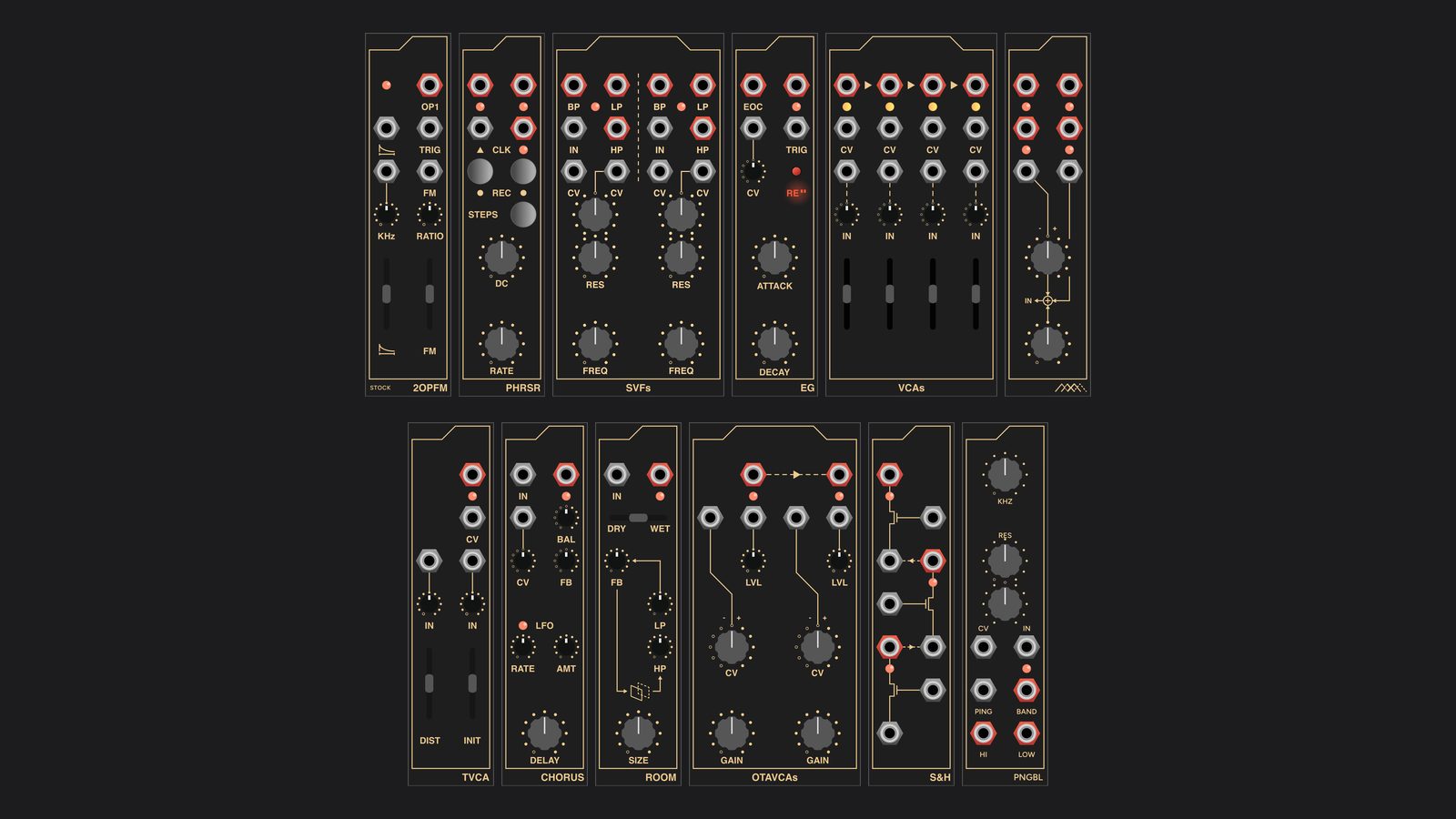
Many VCAs have a knob, labelled level, initial gain or offset, that adds a fixed amount to the control voltage. It is useful for drones and for using a VCA as a plain volume control. It is also the usual reason a modular patch plays a continuous tone between its notes: with the knob up, the VCA never closes completely, so the oscillator can still be heard after each envelope has fallen to zero. In the tool above, the Initial level slider does the same job in Envelope mode.
Linear and exponential response
The control voltage falls from full to zero over two seconds, through a VCA that responds either linearly or exponentially.
Listen for The linear fade stays loud for most of its length and then drops away quickly at the end. The exponential one sounds like an even fade from start to finish, although on the plot it falls away fast at first.
Linear and exponential
A linear VCA multiplies directly, so half the control voltage gives half the amplitude. An exponential VCA maps the control voltage to decibels instead, so equal steps of control voltage give equal steps of loudness as the ear hears it. Hearing works on a roughly logarithmic scale, which is why the linear fade above sounds as if it stays loud and then drops away at the end, while the exponential one sounds like an even fade.
An exponential response is the usual choice for audio fades and amplitude envelopes, because its fades sound even. A linear response is more useful on control voltages, where the arithmetic has to stay exact: a linear VCA set to half passes half the modulation, so the result is a predictable fraction of the signal going in. Many VCA modules offer both, or a knob that blends between them.
VCAs on control voltages
A VCA multiplies whatever signal arrives at its input, audio or control. Put an LFO through one instead of an oscillator and the control input sets how much of the LFO reaches its destination. That is how modulation depth is controlled on a modular system, and how a modulation can be made to fade in over the course of a note. It works because, in the circuit, a control voltage and an audio signal are the same kind of signal, a voltage that changes over time, which is the subject of control signals and audio signals.
Common questions
What does a VCA do?
A VCA, or voltage-controlled amplifier, passes a signal through at a level set by a second signal on its control input. Its output is the input multiplied by the control signal: with the control at zero the output is silent, and at the top of the control range the input comes out at full level. On analogue hardware the control is a voltage. In software and digital synthesisers an amplifier whose gain is set by a control value does the same job.
Why does my modular patch drone instead of playing notes?
The usual cause is a VCA that never fully closes. Either nothing is connected to its control input, so its level knob is holding it open, or the level or offset knob is turned up, which adds a fixed amount to whatever the envelope sends. Turn the knob down to zero and the VCA only opens when the envelope does.
What is the difference between a linear and an exponential VCA?
A linear VCA multiplies directly, so half the control voltage gives half the amplitude. An exponential VCA maps the control voltage to decibels, so equal steps of control voltage give equal steps of loudness as the ear hears it. An exponential response is the usual choice for audio fades and amplitude envelopes, because its fades sound even. A linear response is more useful for scaling one control signal by another, because the result stays an exact fraction of the input.
Can a VCA be used on control voltages as well as audio?
Yes. A VCA multiplies audio and control signals in the same way. Put an LFO through one and the VCA's control input sets how much of the LFO reaches its destination, which is how modulation depth is usually controlled on a modular system.
Related modules
Published Updated Glossary