A hands-on workshop at Synth Library Portland on the fundamentals of subtractive synthesis. We start from nothing, build a classic synthesizer voice in VCV Rack, then take it apart.
Nearly every slide has live Web Audio: a clickable keyboard, a click-to-set sequencer, filter sweeps that redraw the spectrum as you drag, envelopes you can hold and release. You hear each idea instead of reading about it.
Start Slideshow Looks best at 16:9
What we covered
Every synthesizer answers three questions: what does it sound like (timbre), what note is it (pitch), and when does it happen (rhythm). Every module belongs to one of them. Control voltage and audio are the same thing at different speeds, which is why anything in a modular can control anything else.
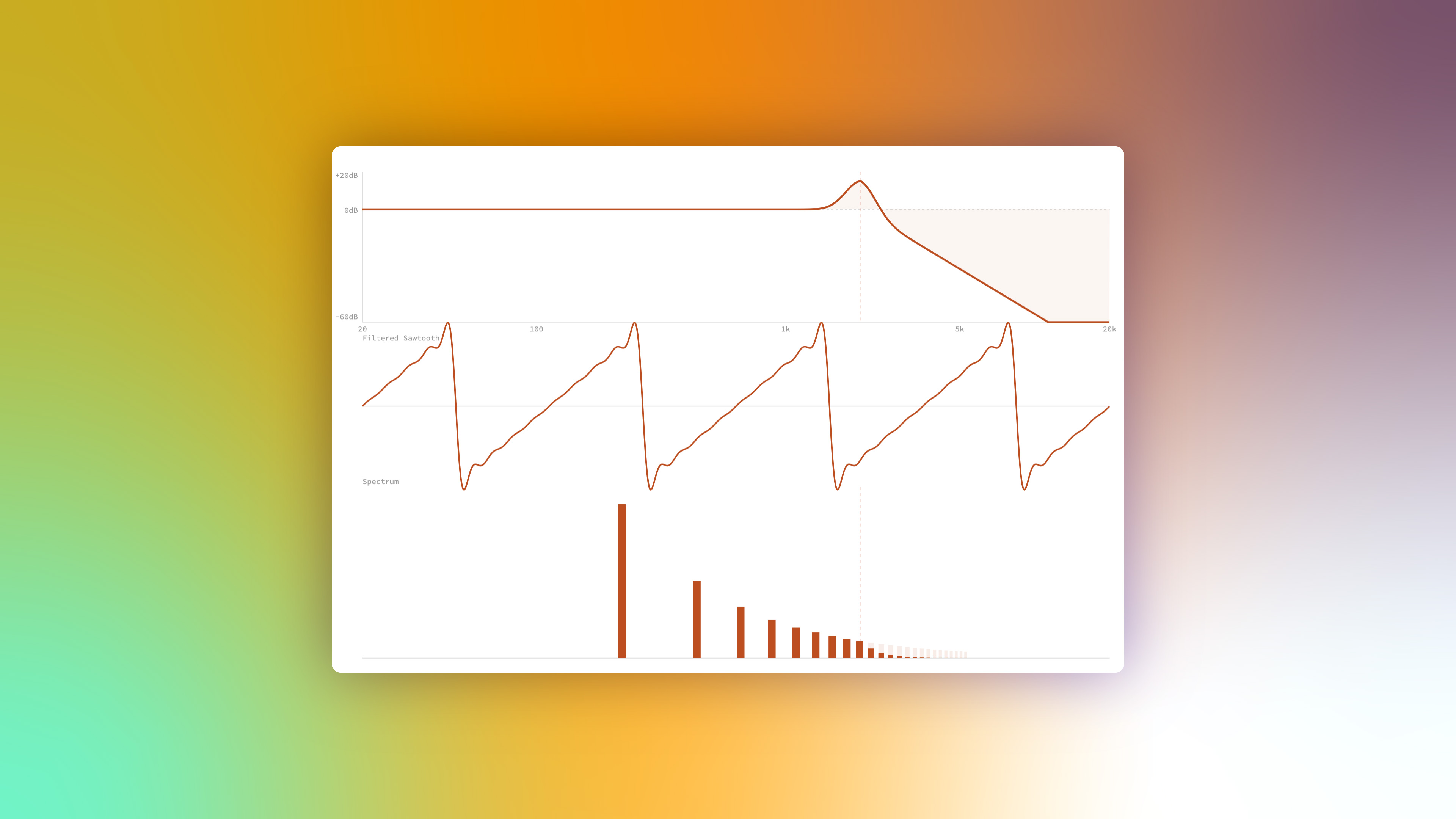
Timbre is the oscillator and the filter: the four waveforms, how a sine grows into a sawtooth as you stack overtones, and cutoff, resonance, and slope. Subtractive means starting with more harmonics than you want and taking some away, so the patches start bright.
Pitch is frequency and the octave, noise, the 1V/oct standard, and three ways to drive pitch side by side: a keyboard, a sequencer, and a sample and hold.
Rhythm and dynamics is gates and triggers, ADSR envelopes, the VCA, and the LFO. One LFO pointed at pitch, filter, or amplitude is vibrato, wah, or tremolo.
Building the voice
Then we build it, seven steps with audio at every stage: oscillator, filter, pitch source, envelope, VCA, LFO, and a second envelope on the cutoff. This is the architecture Moog settled in 1970 with the Minimoog, and most synths since are a variation on it.
Step four is the one I like teaching. You add the envelope and nothing happens, because it is only a shape and isn’t driving anything yet. The VCA arrives in step five and four steps of droning turn into notes. That is when the VCA clicks for people.
The patch files ship with the modules laid out and no cables. You don’t learn patching by watching someone else patch.
Breaking it apart
The classic voice is a starting point. The last stretch rewires it: the LFO sped past audio rate into the filter, the pitch source swapped for an envelope, the sequencer clocked from its own output. Same blocks, different cables.
Materials and next steps
For more on how a waveform’s shape sets its timbre, the interactive How wavetables work guide picks up where the oscillator section leaves off, and The Harmonic Series covers overtones in depth.
VCV Rack is free, and Befaco, Mutable Instruments, 4ms, ALM, Bastl, and Erica Synths all publish modules to its library, so you can try one before buying hardware. For reading: Welsh’s Synthesizer Cookbook, Allen Strange, and Omri Cohen for VCV.
- Interactive slide deck: one file, any modern browser, works offline. Source on GitHub.
- VCV Rack patches: six starting racks in the repo under
/Patches, unpatched, with each exercise’s brief on a Notes module inside.
Thanks to Synth Library Portland for hosting.