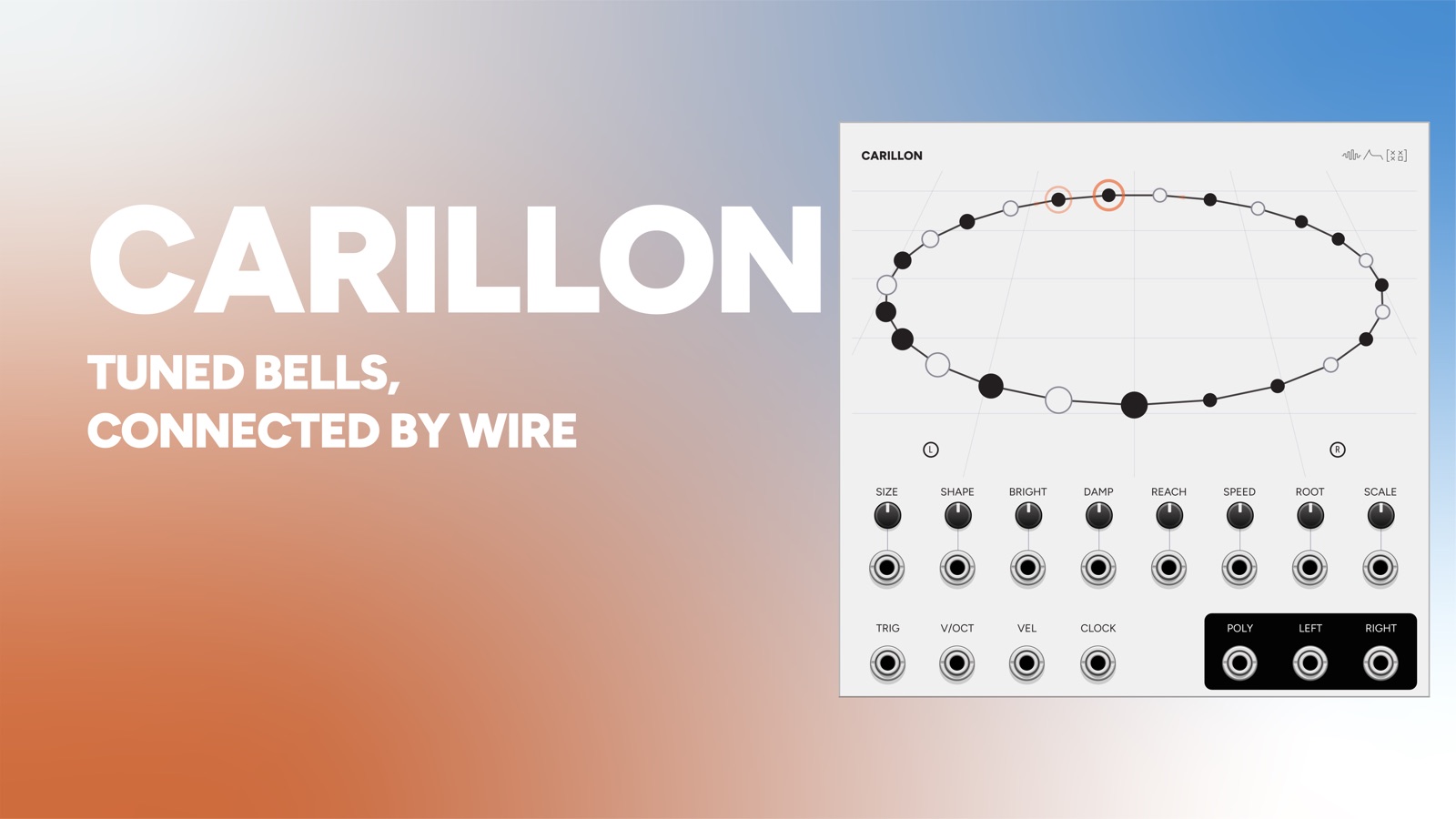
Carillon is twenty-five tuned bells, one for every semitone of two octaves around the root, joined by rods you draw between them.
Strike a bell and its energy travels down the rods to whatever it is joined to, and on from there, losing some at every crossing. How hard you strike it and how much REACH lets through decide how far that ripple goes: one bell, a neighbour or two, or the whole set.
A bell is a note
V/OCT strikes the bell of that note, folded by octaves into the two octaves on the panel, so a sequencer plays exactly the notes it sends. The Register menu moves the set between C2 to C4, C3 to C5 and C4 to C6.
ROOT and SCALE felt the bells, they do not retune them. A bell outside the key is struck quietly and dies fast, but it still passes energy along to its neighbours.
Drawing the rods
Drag from one bell to another to join them. Drag again to cut it. Rods are stored by note, so they survive a change of layout, and the menu has presets that lay a chain, neighbours, a star, octaves or fifths.
A rod’s length is its travel time. A crossing takes SPEED per neighbour spacing of rod, so a long rod is a long wait. Patch CLOCK and a crossing takes one pulse per neighbour spacing instead, which turns the layout itself into a rhythm.
A rod carries the partials its two bells share. A bell a fifth away answers far louder than one a semitone away, so the tuning decides what every rod sounds like.
Five layouts: ring, grid, keyboard, spiral and scatter, each with a tuning order along it, by pitch, by fifths or shuffled. The picture fits itself to the panel whichever you pick.
The bells
Seventeen partials taken from carillon bell data, including the minor third that makes a bell sound like a bell, and pairs of partials a few cents apart that beat against each other.
| Control | What it does |
|---|---|
| SIZE | The weight of the bells: how long they ring and how heavy the clapper is. |
| SHAPE | Crossfades the bell toward a metal bar. |
| BRIGHT | How much of the strike’s high end gets in. |
| DAMP | From a hand on every bell to four times the natural ring, for bell plates. |
| REACH | How much energy a rod passes on. |
| SPEED | How long a crossing takes. |
| ROOT, SCALE | Which bells are in the key. |
Two microphones you drag on the plane give the stereo image, from each bell’s distance and the time its sound takes to arrive.
Inputs and outputs
Inputs: TRIG, V/OCT and VEL, all polyphonic, plus CLOCK and a CV for every control.
Outputs: POLY carries the sixteen loudest bells, with LEFT and RIGHT for the stereo mix.
Context menu
Layout, tuning order, register, lift the felts, rod presets, reset mic positions.
Patch ideas
One bell at a time. REACH at the bottom and a sequencer into V/OCT. It plays as written, with no ripple.
The layout as a rhythm. Patch a clock into CLOCK, lay a chain preset, and strike one end. The strike walks down the chain a beat per rod.
A whole tower. REACH high, velocity high, the star preset. One note wakes everything.
In and out of key. Leave a scale on SCALE and sweep ROOT. The felts move around the set, so the same pattern keeps changing which bells answer.
Pair with
-
 Kit
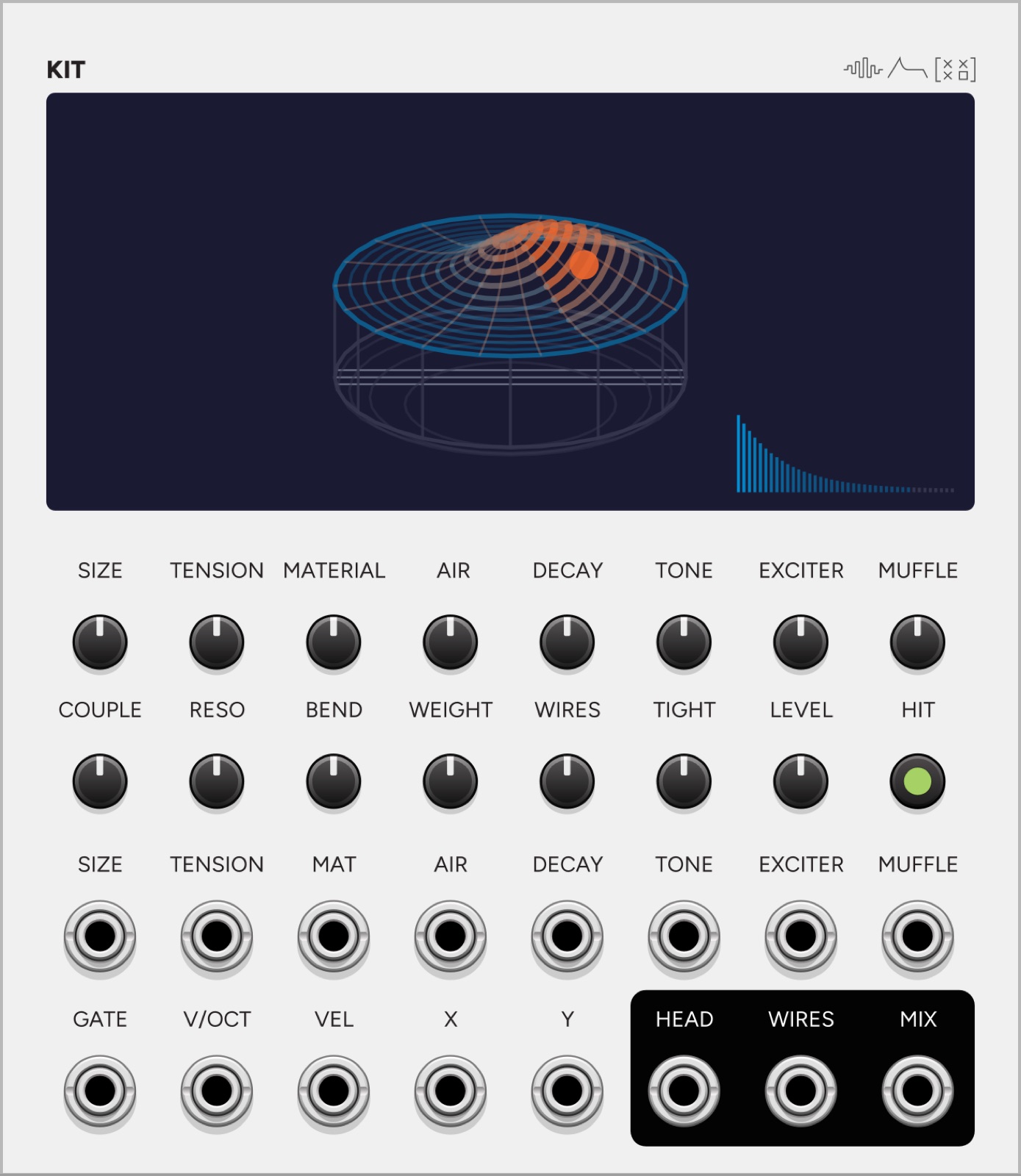
KitBoth are struck physical models. Kit solves a membrane mode by mode, Carillon a set of bells joined to each other.
-
 Key
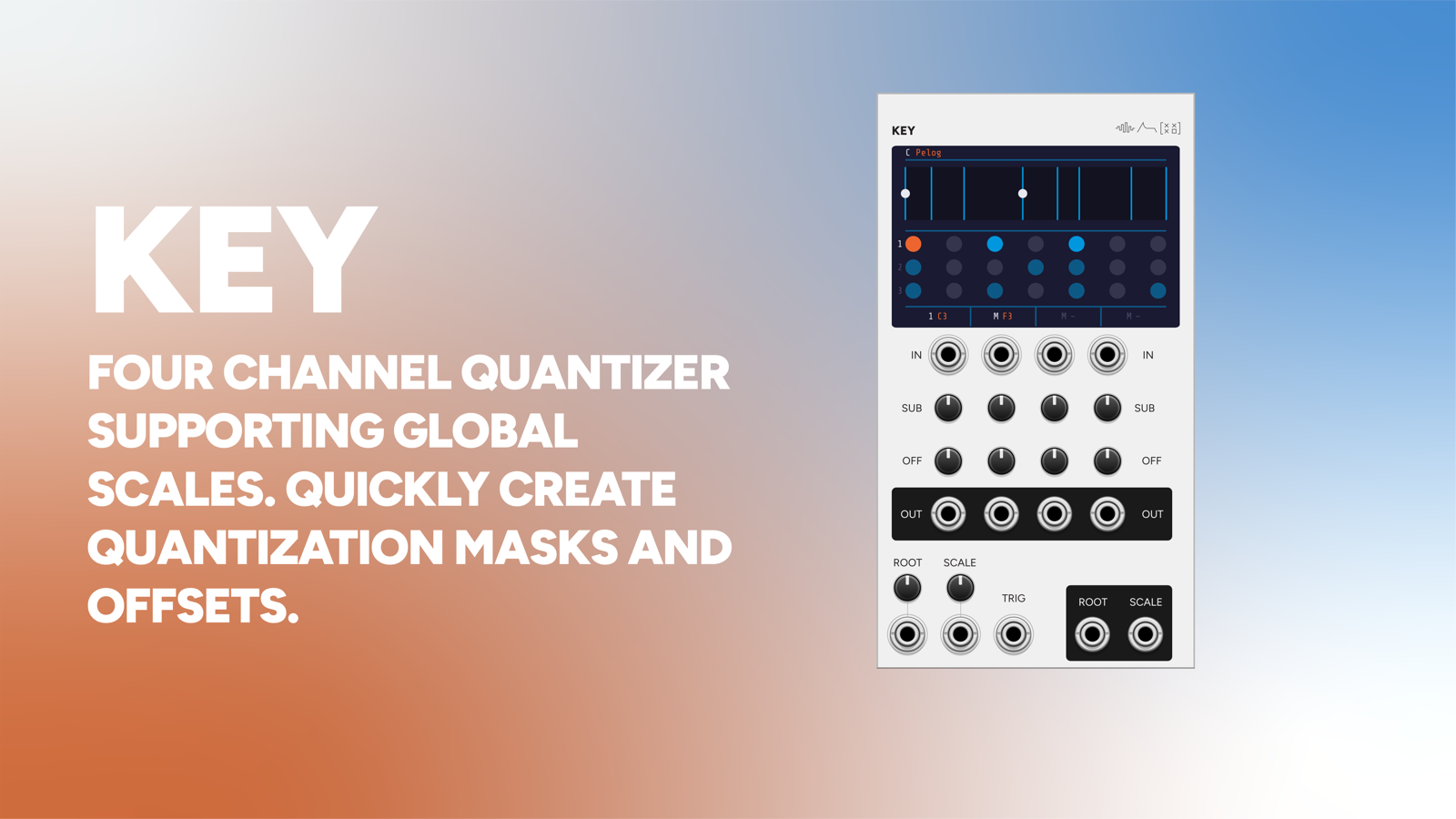
KeyROOT and SCALE felt the bells that are out of key rather than retuning them, and Key hands both out.
-
 Canon
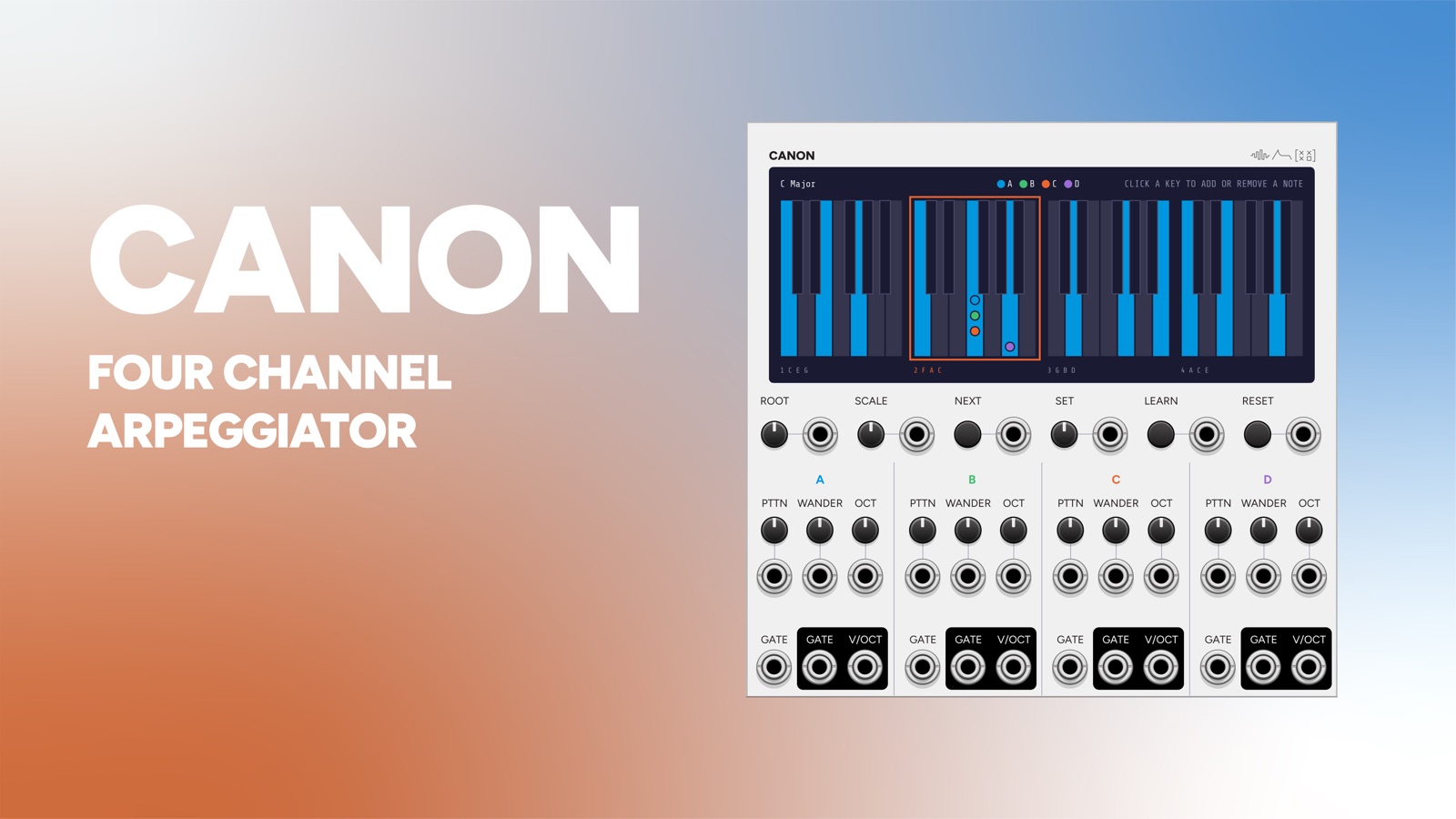
CanonCanon's four channels into Carillon's poly TRIG gives four arpeggios striking one set of bells.
-
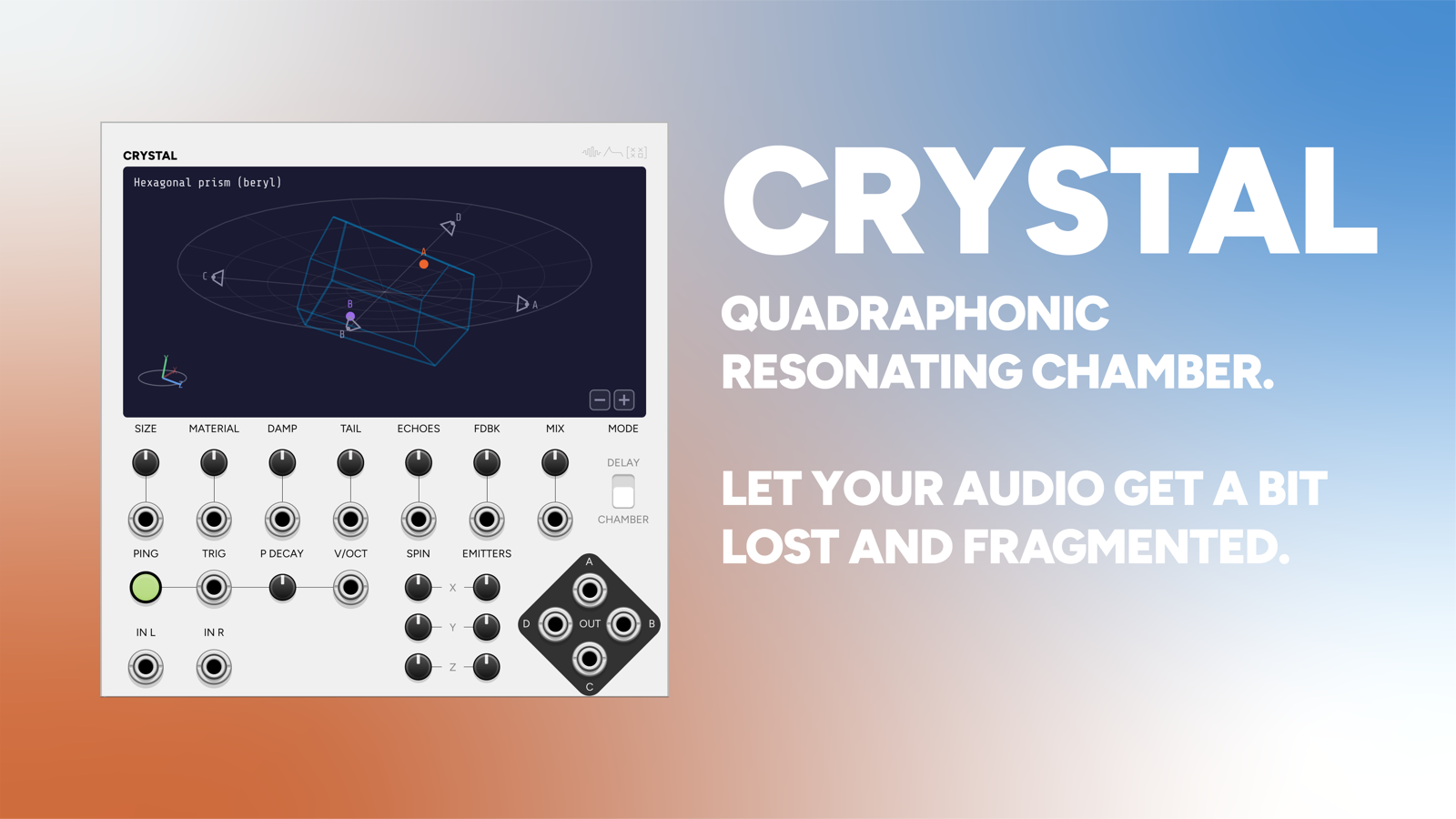 Crystal
A bell wants a room. Crystal gives it one shaped like a real crystal habit.