
Chance is a generative melodic sequencer built on a single idea: a melody is a walk.
You don’t program notes. You set a key, a window, and a few probabilities, and Chance walks a line through the scale for you. What makes it more than a random note generator is that every decision it makes is seeded: a pattern is a fixed, repeatable melody, not a stream of noise. It plays the same way every time it comes around, and every knob you turn changes it audibly.
The name is the concept. Each cycle the walk reaches a node and takes a branch, a garden of forking paths, but the paths are laid out ahead of time, not rolled fresh each bar.
26 HP. Chance runs on an external clock.
Core and branch
Chance keeps two lines running at once:
- The core: a deterministic skeleton melody built from the pattern’s seed and shaped by GRAV and DRIFT. It’s rebuilt the same way every cycle, so it never wanders off.
- The stray: a deviation from the core. At each step, BRANCH decides whether to play the core note or stray to a neighbour.
The important detail is that strays are non-cascading: taking one doesn’t shift the notes that follow it. That’s what lets the core show through no matter how far you push BRANCH. You always hear the same tune, wearing a different coat.
- BRANCH at 0 gives the pure, repeating core.
- BRANCH up gives more wandering, still recognisably the same melody.
This is the thing that took three attempts to get right. A fully seeded walk never surprises you; a fully live random walk has no identity. Core-plus-controlled-deviation is the version that sounds like music.
The walk is musical, not a coin flip
Note choice runs on hand-authored first-order Markov tables: a note’s next note is weighted by what actually works in that scale.
- Seven-note scales share a diatonic table: chord-tone gravity on the 1/3/5, the leading tone pulling to the tonic, the subdominant leaning to the 3rd and 5th, the dominant resolving home.
- Pentatonic and blues get their own tables.
- Everything else (whole tone, chromatic, the harmonic series) falls back to a stepwise-plus-tonic formula.
Strays voice-lead from the previously played note, so even a deviation moves sensibly rather than leaping somewhere unrelated.
GRAV biases direction (centre is an even coin-flip up or down). DRIFT sets move size, from strictly stepwise 2nds out to octave leaps. A move always moves. There’s no hidden “stay” in DRIFT; a note only repeats via a tie or the ratchet.
Shaping the line
Five probabilities, each with its own CV input:
- REST: the step goes silent; the walk continues underneath.
- HOLD: the step spans 2 to 4 clocks instead of one.
- LEAP: a ±octave jump.
- RATCHET: the step retriggers as 2 or 3 short bursts inside the step. The note keeps its own pitch; it just fires a burst. It never extends the pattern.
- GLIDE: portamento between notes.
Plus GATE LEN for gate length as a fraction of the step.
The pattern bank
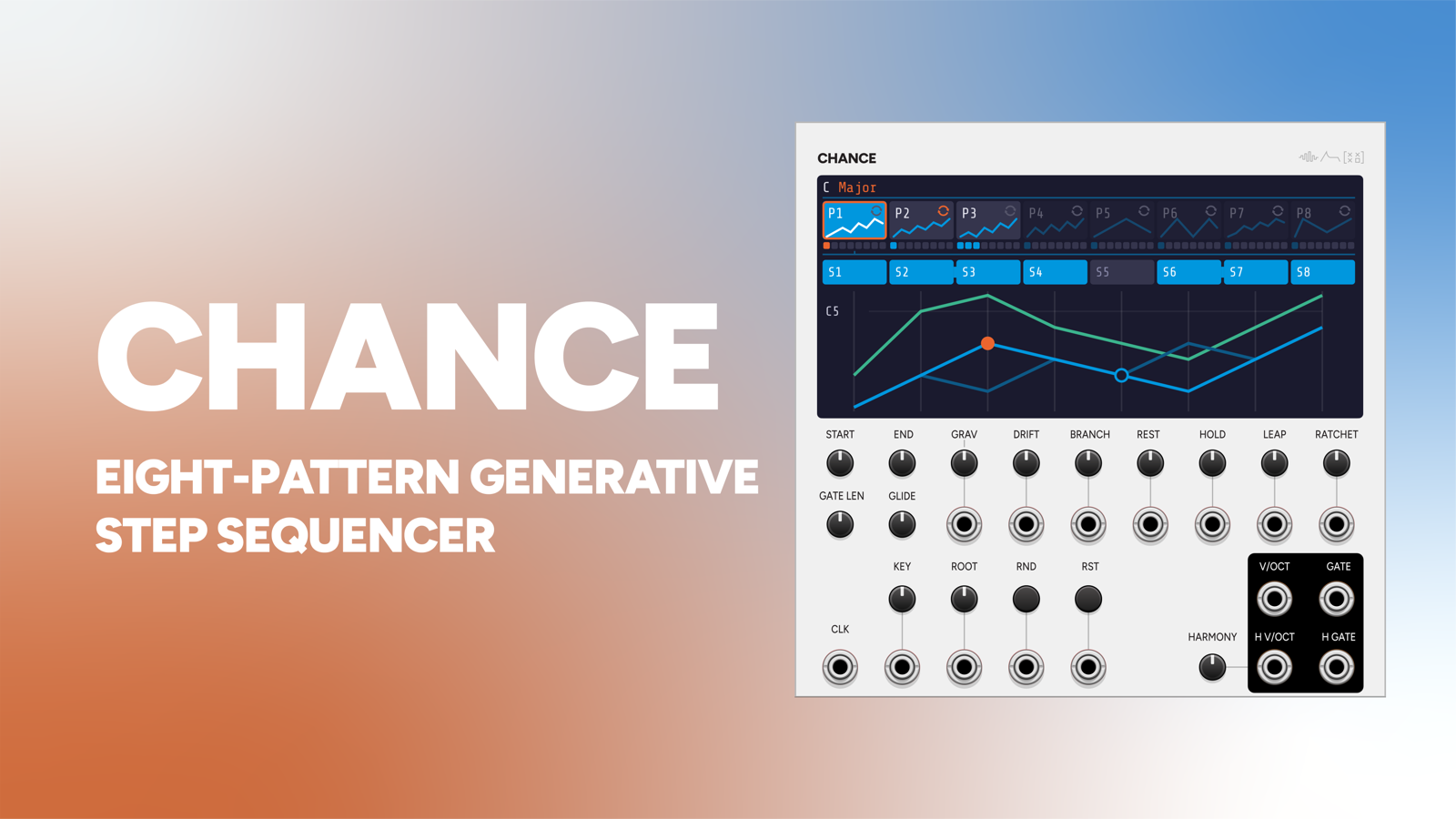
Eight slots, each showing its melody as a micro-waveform, rotating at the cycle level: a pattern plays its repeat count, then hands off to the next active slot. This is the macro structure: eight melodies cycling as a song section.
- Click a pattern to focus it. While stopped, the focused pattern loads into the big walk below, so you can see what you’re editing.
- Double-click to toggle it active. Inactive slots are skipped.
- Repeat boxes under each slot: click box N to play that pattern N times before moving on.
- The recycle icon sets the slot’s mode: normal (a fixed seeded melody, identical every visit) or reseed (a fresh variation each time the rotation lands on it, though its repeats still replay identically within the visit).
Step gates
The S1 to S8 row edits the focused pattern’s per-step gate:
- Click to enable or disable. A disabled step is a forced rest regardless of the REST knob. This is the usual explanation for an unexpected gap.
- Shift-click to tie: hold the previous note through this step with no retrigger, shown as a connector bar back to the previous step.
Gate edits take effect immediately, mid-cycle, not at the next loop.
The display
The walk itself, with C-octave axis labels. The dark line is the core skeleton, the bright line is what’s actually played, and the teal line is the harmony voice when it’s enabled. The orange dot is the playhead; a hollow circle is a rest.
The second voice
HARMONY adds a counter-line with its own H V/OCT and H GATE outputs. The fixed modes track the main voice at a diatonic 3rd, 5th, or octave, up or down. Varied is the interesting one: it picks a seeded consonant interval per step from a set of 3rds, 5ths, 6ths, and octaves, some in contrary motion, giving a weaving counter-melody that’s stable per pattern instead of a rigid parallel harmony.
Sharing a key with the rest of the patch
KEY and ROOT have CV inputs using the plugin-wide convention: 1V per scale, and 1V/oct semitone-quantized for the root. Those voltages are interchangeable with Note, Fugue, and Arrange, Muse, and MetaFugue. Patch one source into all of them and they stay in agreement. Chance draws from the same 19-scale list, including the just-intonation harmonic series and the Gamelan tunings.
Patch ideas
A melody that evolves but stays itself. BRANCH around 0.3, a single pattern, repeats at 4. The tune comes back every cycle wearing different ornaments.
A song section. Activate P1 to P4 with repeats 2/2/4/8 and set P4 to reseed. Three fixed phrases and a variable tail, rotating forever.
Two-part invention. HARMONY on Varied, with H V/OCT and H GATE into a second voice. The counter-line weaves instead of tracking in parallel.
Keyed to the song. Feed Arrange’s ROOT and SCALE outputs into Chance. The melody follows the arrangement’s key changes on its own.
Percussive bursts. RATCHET up, GATE LEN short, into a plucky or percussive voice. The ratchets land inside the step, so the groove never shifts.
Ask for a tune, then keep it. Hold RND until you hear a core you like, then leave it. The seed is saved with the patch: that melody is yours permanently.
Pair with
-
 Signal Function Set Sequencer System
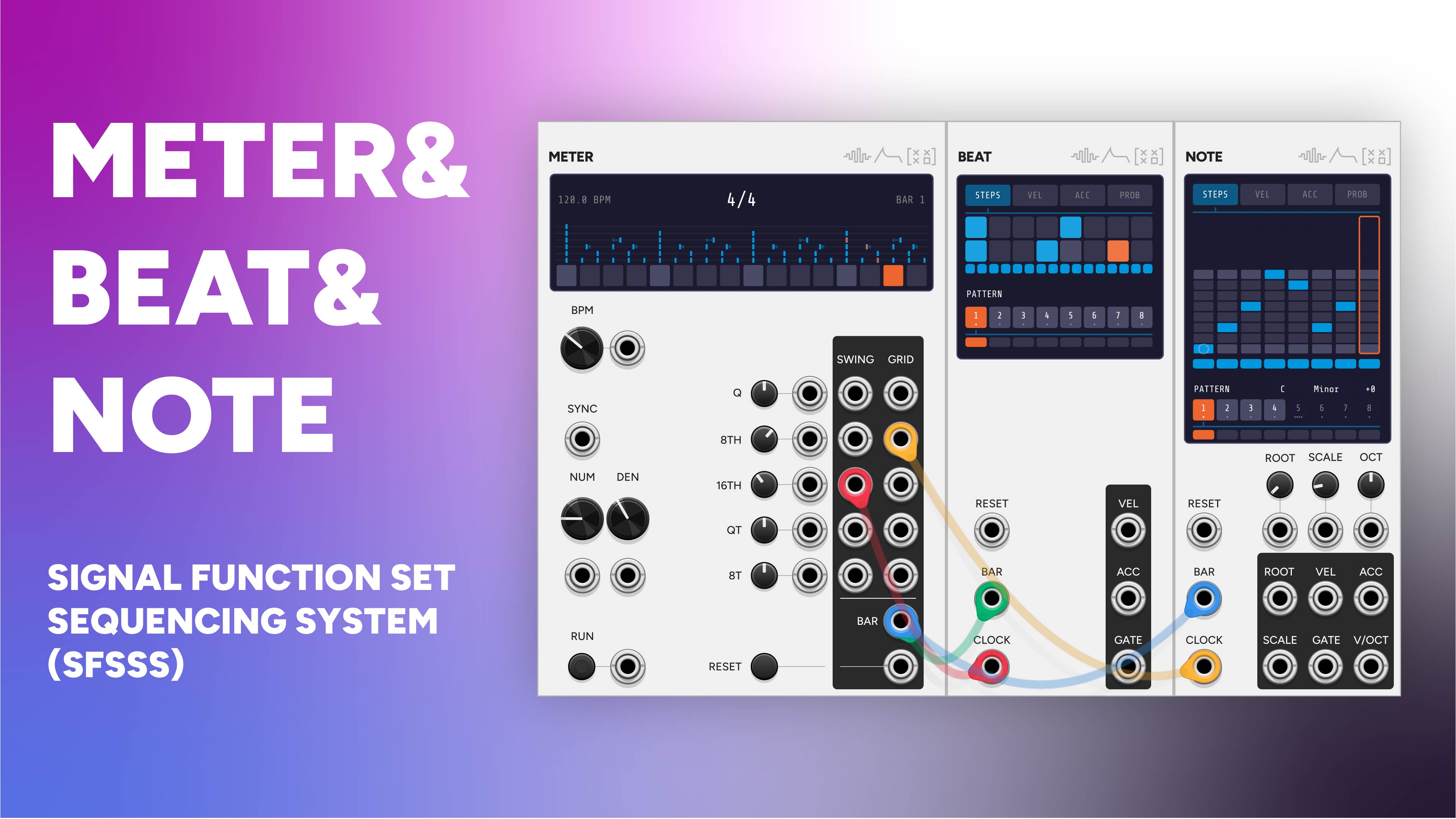
Clock Chance from Meter and let Arrange drive its ROOT and SCALE inputs: the melody follows the song's key changes automatically while Beat holds the groove.
-
 Fugue
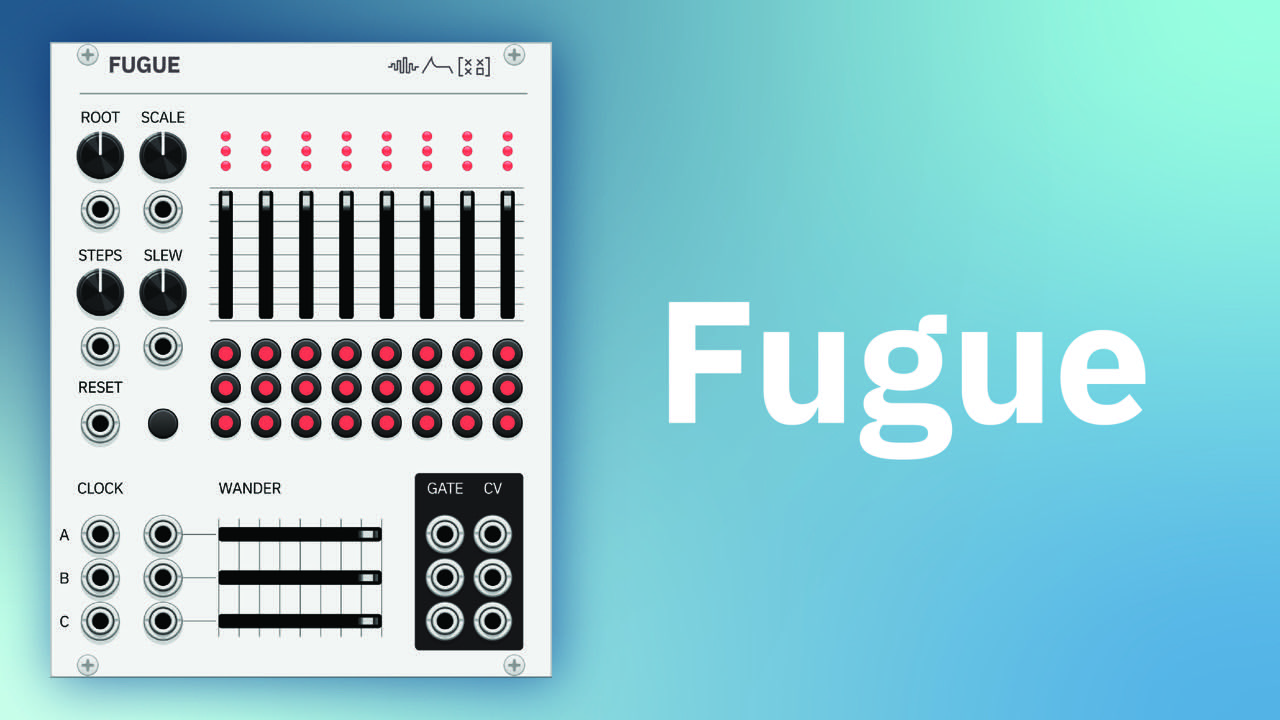
FugueFugue wanders harmonically from a sequence you wrote; Chance writes the sequence for you. Run both from the same clock for counterpoint from two different philosophies.
-
 Muse
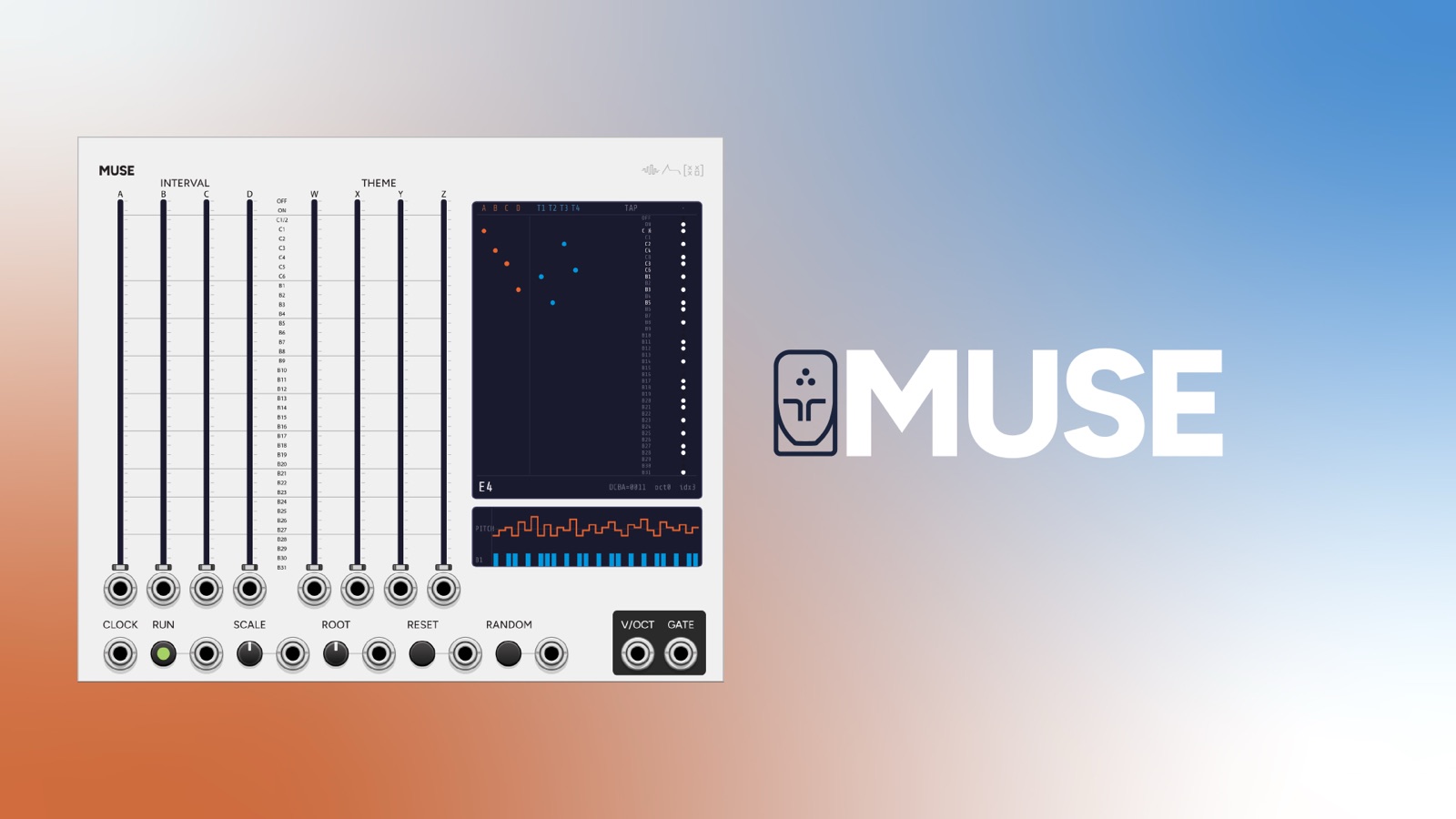
MuseMuse generates long non-repeating melodies from shift-register logic. Chance generates short, repeatable ones from a seeded walk. They layer well as two very different kinds of algorithmic voice.