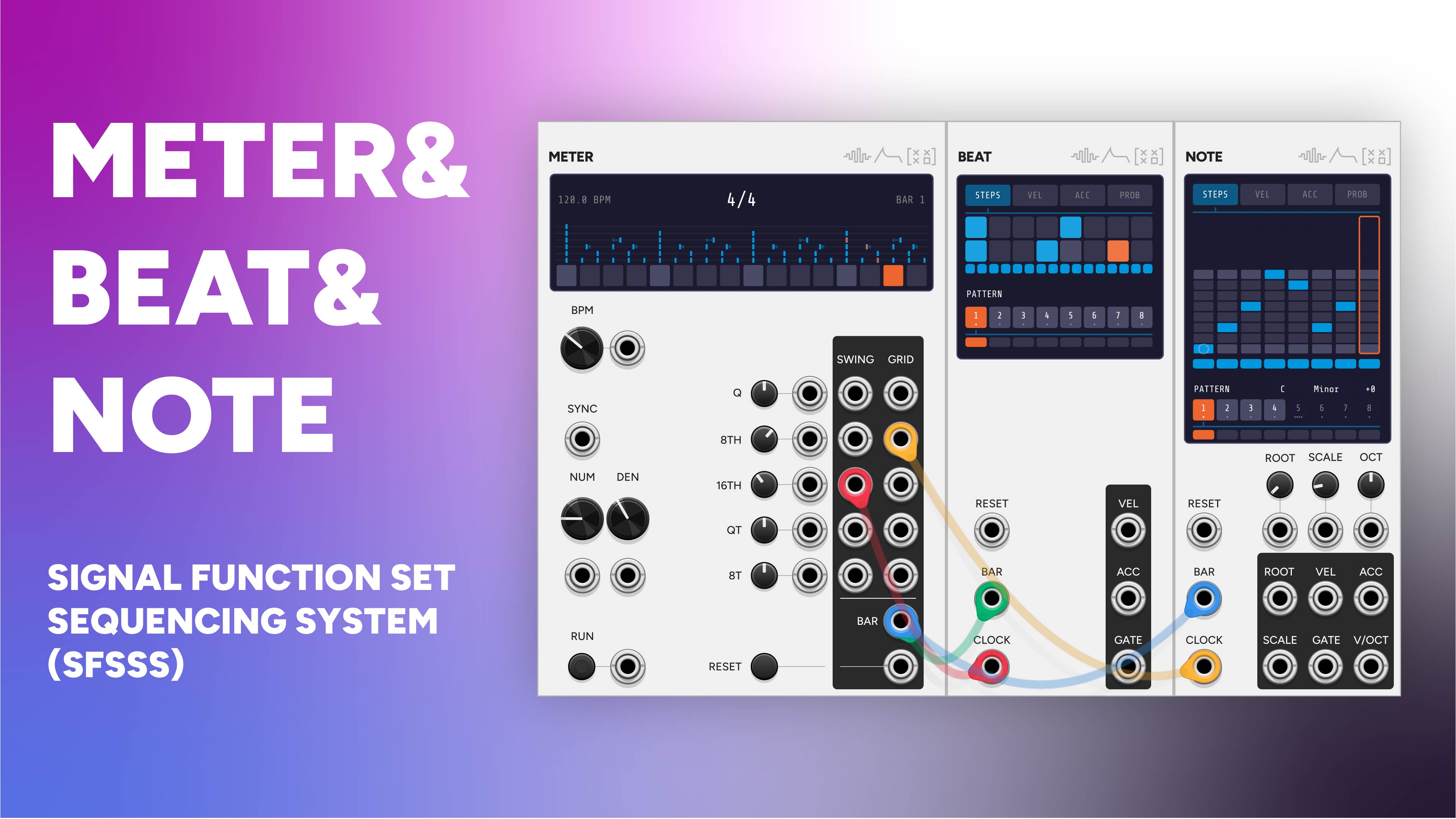
A rhythm and song-form system for VCV Rack. Arrange holds the song’s sections. Meter is a time-signature-aware master clock with per-subdivision swing, and its expander Meter X covers long-form structure. Beat is a single-voice drum sequencer. Note is the pitched cousin of Beat, with 19 scales including just-intonation harmonics and Indonesian Gamelan tunings.
This page is the integrated tour: how the modules fit together. Each one also has its own page with the full detail: Arrange, Meter, Meter X, Beat, Note.
Each module is its own thing, but they’re designed to work together: one Meter drives a rig of Beats and Notes, all sharing bar boundaries, swing, and reset behavior. Each Beat or Note is intentionally a single voice: to build a kit, you instantiate as many as you need, and each holds its own independent pattern bank, length, and feel.
Meter: the master clock
Full detail: the Meter page.
Most VCV clocks are subdivision dividers: they emit evenly-spaced pulses at fixed ratios. Meter understands the musical structure of those pulses: bars, beats, swing, and time signatures with CV control.
18 HP.
Six musical subdivisions
Each output runs at the rate implied by the current time signature:
- BAR: one pulse at the start of every bar
- QUARTER: quarter notes
- EIGHTH: eighth notes
- SIXTEENTH: sixteenth notes
- QUARTER TRIPLET: three pulses per quarter
- EIGHTH TRIPLET: three pulses per eighth
Time signature with CV
Both the numerator (1-16) and denominator (1, 2, 4, 8, 16, 32) are knobs with CV inputs. Time signature changes are queued for the next bar boundary by default, so the current bar plays to completion. A context menu option lets you apply changes immediately if you want unmusical glitching.
Swing per output
Each subdivision (except BAR) has its own swing trimpot (-50% to +50%) and matching CV input. Positive swing delays the off-beats for a shuffle feel; negative swing fires them early for a rushed feel.
For each swingable subdivision, Meter provides two output jacks: SWG (swung) and GRD (grid). You can patch the swung eighth into the hat and the grid eighth into a synth bass, mixing straight and grooved feels from the same Meter.
Swing values are latched per bar to prevent mid-period glitches.
External clock sync
Patch a clock pulse train into EXT CLOCK and Meter measures the inter-pulse interval to derive BPM. PPQN is selectable (1, 2, 4, 8, 12, 16, 24). When external clock is patched, the BPM knob is overridden and a sync indicator flashes on each external pulse.
Display
Top status line shows BPM, time signature (with a 7/8 style pending-change indicator), and a bar counter. Below it, six per-output hit-indicator rows visualize each output’s pulses across the bar: bright tick at each fire position, ghost ticks at the un-swung positions with connector lines to the swung position. The tick that just fired flashes and decays over ~100ms. A position tracker at the bottom shows the current sixteenth-note position in the bar.
Meter X: the long game
Full detail: the Meter X page.
Meter’s own panel covers the musical subdivisions: bar, quarter, eighth, sixteenth, triplets, each with swing. Meter X covers the other half, structure that unfolds over minutes rather than beats.
Place it immediately to the right of Meter. That’s the whole setup: no cables. It reads Meter’s clock over the expander bus.
8 HP.
Outputs
- 24 PPQN: 24 pulses per quarter note, the MIDI-standard clock resolution. Deliberately un-swung, so it stays a true timing reference regardless of Meter’s swing settings, and so anything applying its own shuffle downstream doesn’t swing an already-swung clock.
- RUN: 10V while Meter is running.
- BAR, 2, 4, 8, 16, 32, 64, 128: a trigger every N bars, on the downbeat.
All the bar triggers are aligned to reset: they fire on bars 1, 1+N, 1+2N, and so on. At reset every row fires together, and the whole hierarchy stays locked to the song from that point on.
The pies
Each bar row has a small pie chart that fills clockwise as you advance through that output’s cycle, then resets when it fires. The 4-bar pie fills over four bars; the 128-bar pie creeps around over 128.
This is what makes long-form structure legible. Instead of counting bars in your head, you can see at a glance that you’re three-quarters of the way through a 32-bar section. The pies freeze while Meter is stopped. (The 24 PPQN and RUN rows have no cycle, so they get no pie.)
Why 24 PPQN
It’s the rate to use when you’re driving something that expects a real clock resolution rather than a musical subdivision: modules that derive their own subdivisions internally, anything doing its own swing, MIDI interfaces and clock converters. Note the distinction: Meter’s own PPQN setting is about the clock it receives, and Meter X’s 24 PPQN is a clock it sends.
Beat: drum voice sequencer
Full detail: the Beat page.
Beat is a single-voice pattern sequencer paired with Meter or any source of clock and bar pulses. One Beat instance equals one drum voice. Eight patterns of sixteen steps each, with per-step velocity, accent, and probability.
10 HP.
Patterns and steps
Each Beat instance holds 8 patterns of 16 steps. Each step has four properties: on/off, velocity, accent, and probability. Each pattern has its own length (1-16) and repeat count (1-8 bars). Patterns can be marked active or inactive: inactive patterns are skipped in the rotation, so you can chain a subset without manually editing each one.
When the playhead reaches the last active step, on the next CLOCK pulse it wraps back to step 0: even mid-bar. A 5-step pattern clocked at 16th notes will keep cycling against the underlying meter, producing built-in cross-rhythm.
Display modes
The display is the primary editing surface. Four mode tabs: STEPS, VEL, ACC, PROB.
- STEPS: click cells to toggle on/off, drag to paint
- VEL: click-and-drag vertically to set per-step velocity (0-10V S&H output)
- ACC: click to toggle accent flag (1ms pulse on the ACC output)
- PROB: click-and-drag vertically to set per-step probability (0-100% chance of firing)
Below the grid: length dots, pattern selector with repeat-count indicators, and a repeats bar. Click, drag, scroll-wheel, and double-click all do useful things.
Inputs and outputs
| I/O | Function |
|---|---|
| CLOCK | Advances the step counter |
| BAR | Advances to the next active pattern |
| RESET | Returns to first active pattern, step 0 |
| GATE | 1ms 10V pulse on each fired step |
| VEL | 0-10V sample-and-hold velocity |
| ACC | 1ms 10V pulse on accented hits |
Note: pitched sequencer
Full detail: the Note page.
Note is the pitched (CV/gate) cousin of Beat. Same architecture for clock/bar/repeat behavior (eight patterns, per-step velocity/accent/probability, the four edit modes), but each step also carries a pitch quantized to a selectable scale and root.
10 HP. 8 steps per pattern.
Pitch matrix
The display matrix is 8 columns (steps) by 13 rows (pitches). The bottom row is the scale’s root pitch; rows above are successive scale degrees, with the root plus one octave always shown at the top so the scale octave is visible regardless of scale size. Out-of-scale rows are dim and not clickable.
Click a cell in STEPS mode to set that step’s pitch; click again to clear (rest). Drag-paint paints the same row across columns.
17 scales, including non-12-TET
The standard suspects are all here (Major, Minor, Dorian, Phrygian, Lydian, Mixolydian, Harmonic Minor, the pentatonics, Blues, Whole-tone, Hijaz, Hirajoshi). Note also includes three scales that produce pitches you can’t get from a chromatic quantizer:
- Harmonic: just-intonation harmonics 1 through 12. The V/OCT output gives precise just-intonation ratios.
- Pelog: 7-tone Indonesian Gamelan scale, Surakarta tuning
- Slendro: 5-equal Indonesian Gamelan scale
These three sound noticeably “off-grid” against equal-tempered instruments, by design.
Root, scale, octave: chainable
ROOT, SCALE, and OCT each have a knob, a CV input, and an OUT jack that relays the current value. Patch one Note’s ROOT OUT into another Note’s ROOT CV and changing the bass key transposes the arp automatically. The ROOT and SCALE CVs are also interchangeable with Fugue and Muse, so a single Root/Scale source can govern an entire SFS-based rig.
Inputs and outputs
| I/O | Function |
|---|---|
| CLOCK / BAR / RESET | Same as Beat |
| ROOT / SCALE / OCT CV | 1V/oct semitones, 1V per scale, 1V per octave |
| GATE | 1ms 10V pulse on each fired step |
| V/OCT | 1V/oct pitch (sample-and-hold) |
| VEL / ACC | Velocity CV and accent pulse |
| ROOT / SCALE OUT | Relays current values for chaining |
Arrange: song form
Full detail: the Arrange page.
Meter keeps time and Beat and Note play parts. Arrange is the layer above all of them: it decides what section you’re in, how many bars it lasts, what key and tempo it’s in, and which instruments are playing during it.
It’s a single horizontal chain of 8 phrases. A phrase is a bar-length section: intro, verse, chorus, break. The arrangement walks through the active phrases in order and wraps.
Arrange doesn’t generate a clock. Meter is still the master. Arrange counts Meter’s bars and hands out gated, divided clocks to your instruments.
34 HP.
Wiring it up
Patch Meter’s BAR into Arrange’s BAR input (this is what advances the arrangement) and whichever Meter subdivision you want as the base rate into CLOCK.
Then close the loop the other way: BPM out into Meter’s BPM CV, with Meter’s “BPM CV absolute” context-menu option enabled. That switches Meter’s BPM CV from an offset to an absolute 0.01V/BPM reading, so each phrase’s BPM trimpot sets the actual tempo of the song.
Per phrase
Each column carries a bar length (1-16, set on a 4x4 grid), an enable (double-click; inactive phrases are skipped), its own scale, root, and BPM, four channel enables, and a GATE output that stays high for the whole time that phrase is playing.
Linking key and tempo
Most songs don’t change key every eight bars. Small LED dots between the trimpot columns cascade values down the chain, one dot per row, so scale, root, and BPM link independently. They’re on by default.
A linked phrase inherits its group’s leftmost phrase’s value exactly; its own trimpot is ignored and the value renders dim on screen so followers are obvious. Break a link and that phrase becomes independent, starting a new group that the phrases after it inherit from.
So the common case, one key and tempo for the whole song, is the default, and a key change is one dot away.
The four channels
This is the heart of the module. The four channels are per-instrument clock buses: each one feeds one instrument (a Beat, a Note, a Chance), and each phrase decides which of them are playing.
Per channel there’s a clock division trimpot (1 through 16, bar-aligned) and four outputs: CLOCK (the divided clock), BAR, RESET, and EOC.
The point is that CLOCK and BAR are muted on any phrase where that channel is disabled. Toggle a channel’s coloured bar off for the verse and that instrument simply stops: no muting downstream, no silence tricks. Toggle it back on for the chorus and its RESET fires so the instrument re-enters in sync rather than mid-pattern. Division counters keep running while a channel is off, so a returning instrument stays phase-locked to the master.
Master outputs
BPM (0.01V per BPM, into Meter), ROOT (1V/oct, semitone-quantized), SCALE (1V per scale), and PHRASE (1V per phrase).
ROOT and SCALE use the same convention as Note, Fugue, Muse, and Chance, so one arrangement drives the key of the whole patch. There’s deliberately no master Bar or Clock output: Meter is already the source of both, and instruments should take their channel’s gated, divided versions so they drop in and out with the arrangement.
Patch ideas
A whole song, arranged: Meter BAR into Arrange BAR, Meter SIXTEENTH into Arrange CLOCK, Arrange BPM into Meter BPM CV (with “BPM CV absolute” on). Channel 1 to a Beat (drums), channel 2 to a Note (bass, div 2), channel 3 to a Chance (lead). P1 is a 4-bar intro with only channel 1 on; P2-P3 an 8-bar verse with 1+2; P4 a 16-bar chorus with all three. The band arrives and leaves on its own.
Key change at the bridge: break the root link on P5 and set its ROOT trimpot up a fourth. P5 onward inherits the new key until the next break. Every Note and Chance following Arrange’s ROOT out transposes with it.
Long-form structure: Meter X’s 32-bar output into a sequencer’s reset and its 8-bar output into a pattern advance. The piece reorganises itself on a schedule you can watch approaching on the pies.
3-piece drum kit driven by Meter: Three Beats (kick, snare, hat). Meter QUARTER into kick clock, swung Meter EIGHTH into snare clock, swung Meter SIXTEENTH into hat clock. All three BAR inputs fed from Meter BAR. All three RESET inputs from Meter RESET. Each Beat holds its own pattern bank for its drum, and you can dial swing per voice from the master.
Cross-rhythm playground: Patch Meter QUARTER TRIPLET into one Beat and Meter EIGHTH into another. The triplet fires 3-against-2 against the eighth, producing classic polyrhythms.
Bass and arp from one Meter: Two Notes share one Meter’s clock and bar pulses. Note 1 (bass) on a pentatonic, low octave, 4-step pattern. Note 2 (arp) on the same scale, +1 octave, 8-step pattern with all-on steps. Patch Note 1’s ROOT and SCALE OUT into Note 2’s ROOT and SCALE CV: changing the bass key transposes the arp automatically.
Gamelan ensemble: Four Notes on the Slendro scale, all sharing root via SCALE OUT chaining. Each at a different octave. Different pattern lengths (5, 7, 8, 11) for shifting polyrhythmic feel. Patch each into a Tine for metallic resonator timbre: instant inharmonic gamelan.
Just-intonation drone: Note with scale = Harmonic, single sustained note on row 0 (root), velocity max. The V/OCT output gives precise just-intonation harmonics 1 through 12. Step through them as a sweep through the harmonic series.
Sequenced time signatures: Patch a slow LFO or sequencer into Meter’s NUM CV and DEN CV to morph the time signature mid-piece. Pending changes apply at the next bar boundary by default, keeping the music musical.
External tempo follow: Patch a hardware MIDI clock or a Clk module into Meter’s EXT CLOCK at 24 PPQN. Meter follows the external tempo while still emitting its own subdivisions, swing, and bar boundaries.
Pair with
-
 Chance
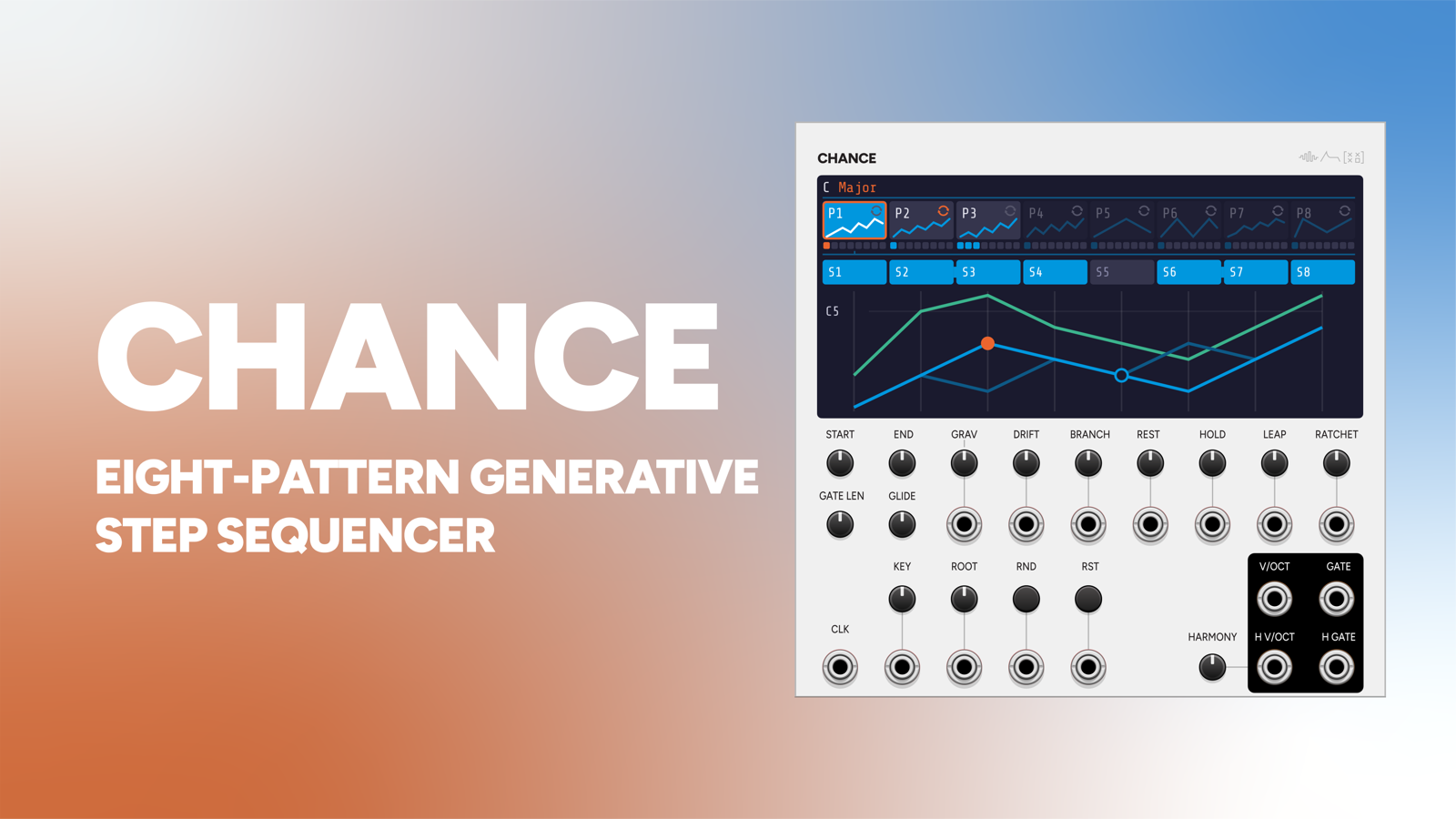
Chance is the generative voice of the system: clock it from Meter and let Arrange drive its ROOT and SCALE so the melody follows the song's key changes.
-
 Fugue
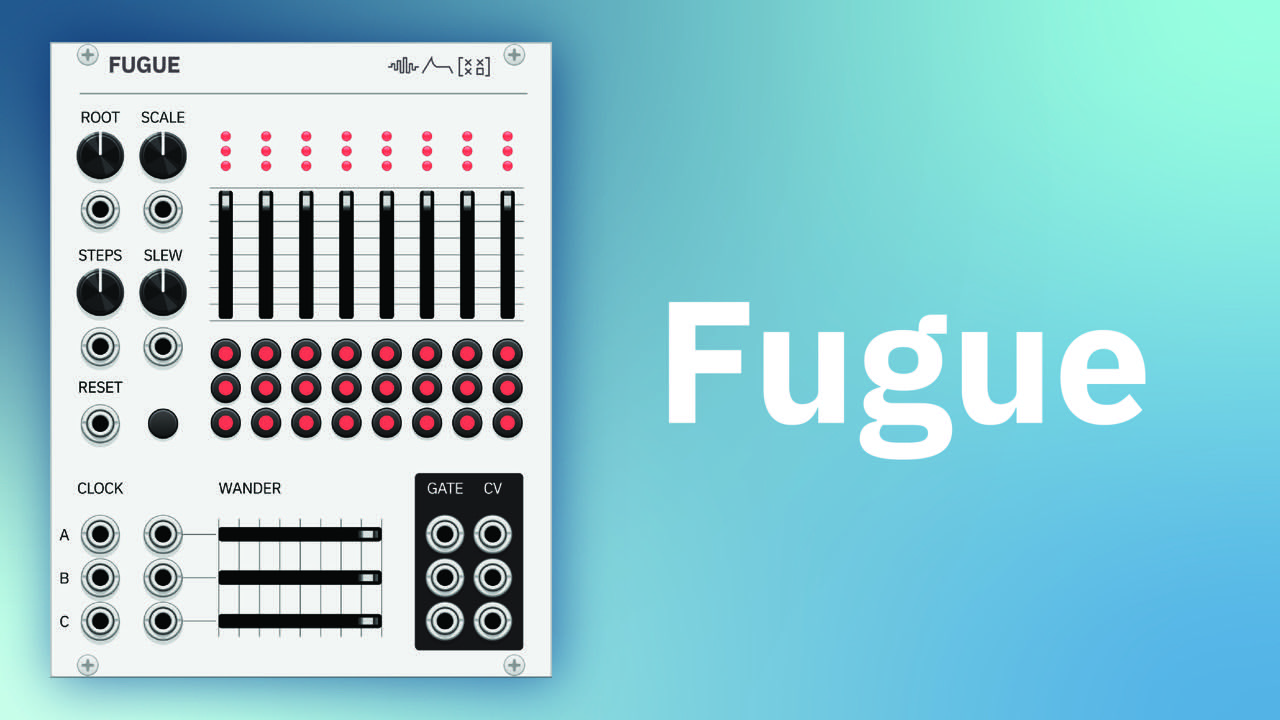
FugueRun Fugue alongside Note as a second pitched voice driven by the same Meter clock and bar pulses.
-
 Muse
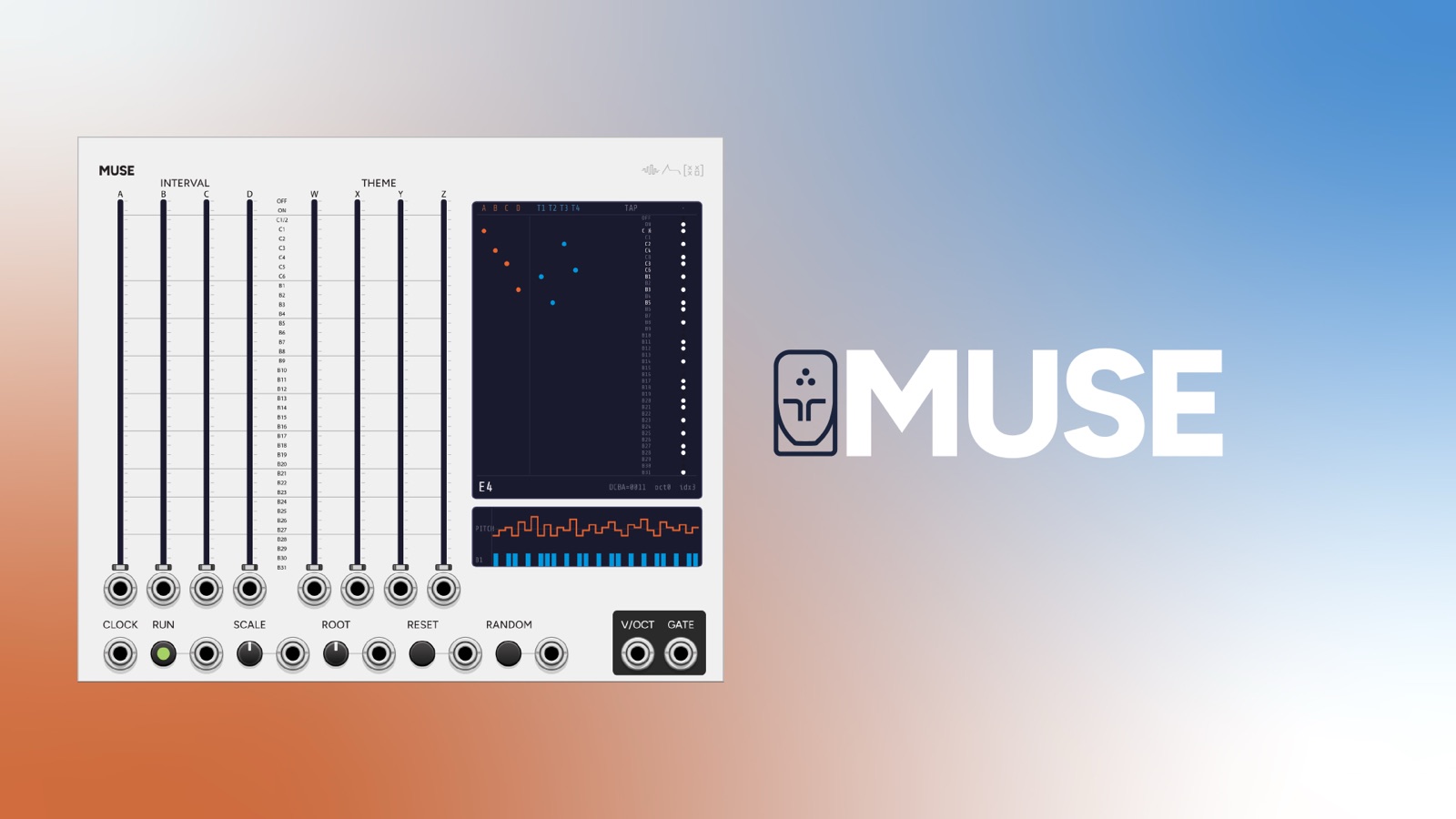
MuseAdd Muse for an algorithmic third voice whose long, non-repeating melodies layer over Note's pattern banks.
-
 Tine
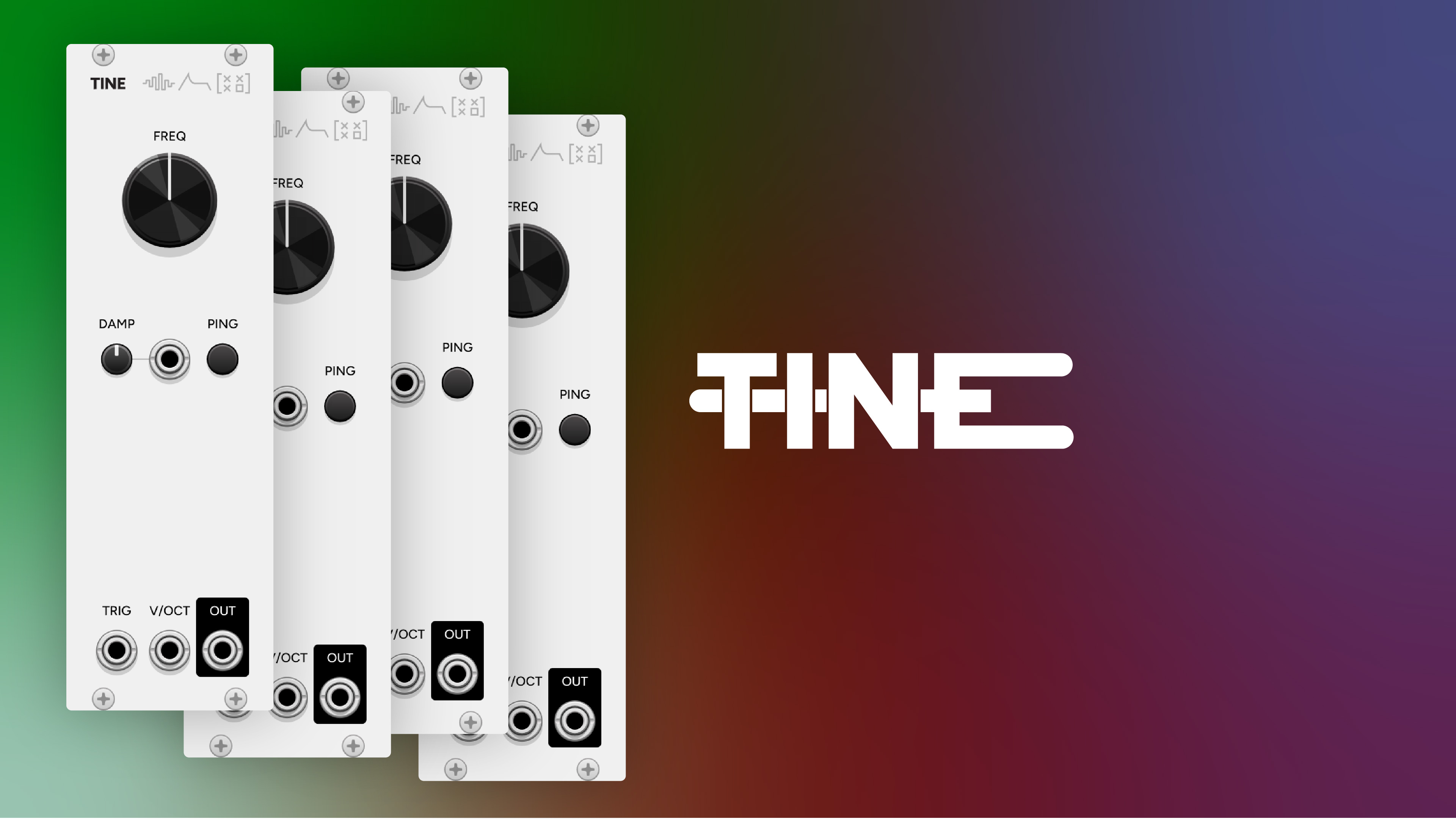
TinePatch Note's CV into Tine for metallic, gamelan-flavored voicing under the rest of the kit.