
Meter’s own panel covers the musical subdivisions: bar, quarter, eighth, sixteenth, triplets, each with swing. Meter X covers the other half, the long game.
It gives you a high-resolution 24 PPQN clock, a run gate, and bar-multiple triggers all the way out to 128 bars, so you can build structure that unfolds over minutes rather than beats.
8 HP.
Connecting it
Place Meter X immediately to the right of Meter. That’s the whole setup: there are no cables to patch. It reads Meter’s clock over the expander bus. If it isn’t directly to Meter’s right, its outputs stay silent.
Outputs
Ten rows, top to bottom:
| Output | What it does |
|---|---|
| 24 PPQN | 24 pulses per quarter note, the MIDI-standard clock resolution. Straight (un-swung). |
| RUN | 10V while Meter is running, 0V when stopped. |
| BAR | One trigger per bar, on the downbeat. |
| 2 / 4 / 8 / 16 / 32 / 64 / 128 | A trigger every N bars, on the downbeat of that bar. |
All the bar triggers are aligned to reset: they fire on bars 1, 1+N, 1+2N, and so on. At reset every row fires together, and the whole hierarchy stays locked to the song from that point on.
Each row has an activity LED: a short flash on each pulse, steady for RUN.
The pies
Each bar row has a small pie chart that fills clockwise as you advance through that output’s cycle, then resets when it fires. The 4-bar pie fills over four bars; the 128-bar pie creeps around over 128.
This is what makes long-form structure legible. Instead of counting bars in your head, you can glance over and see that you’re three-quarters of the way through a 32-bar section, and the change is coming. The pies freeze while Meter is stopped.
The 24 PPQN and RUN rows have no pie: they have no cycle to show.
Why 24 PPQN
24 pulses per quarter note is the MIDI clock standard. It’s the rate to use when you’re driving something that expects a real clock resolution rather than a musical subdivision:
- Modules that derive their own subdivisions internally
- Anything doing its own swing or shuffle: Meter X’s 24 PPQN is deliberately un-swung, so a downstream module’s groove isn’t applied on top of Meter’s
- MIDI interfaces and clock converters
Note the direction: Meter’s own PPQN context-menu setting is about the clock it receives. Meter X’s 24 PPQN is a clock it sends.
Patch ideas
Long-form structure. The 32-bar output into a sequencer’s reset and the 8-bar output into a pattern advance. The piece reorganises itself on a schedule you can watch approaching on the pies.
Section-aware modulation. A 16-bar trigger into a sample & hold fed by noise: a new random voltage every 16 bars for a filter cutoff or a chord inversion that changes once per section.
Run-gated drone. RUN into a VCA or envelope gate so a pad exists only while the clock runs.
Slow evolution. A 64- or 128-bar trigger into an envelope with a very long rise, for changes that take minutes to arrive.
Proper MIDI clock. 24 PPQN into a MIDI interface so external gear follows Meter’s tempo at full resolution.
Pair with
- Meter
Meter X's other half. Place Meter X immediately to the right of Meter (no cables) and it reads Meter's clock over the expander bus.
-
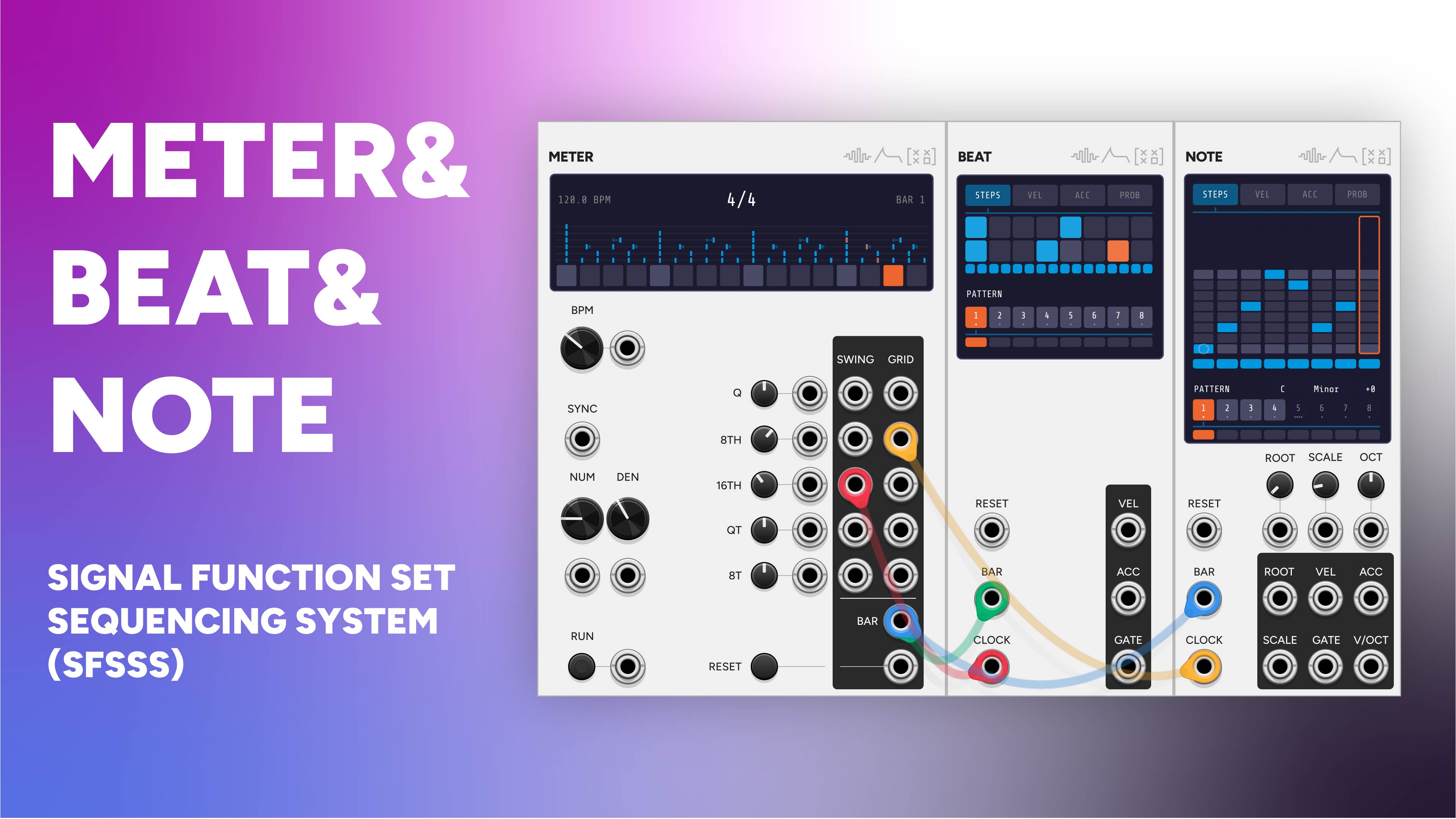 Signal Function Set Sequencer System
Meter X covers the long game for the sequencer system: use its 8- and 32-bar triggers to reorganise a patch of Beats and Notes on a schedule.
-
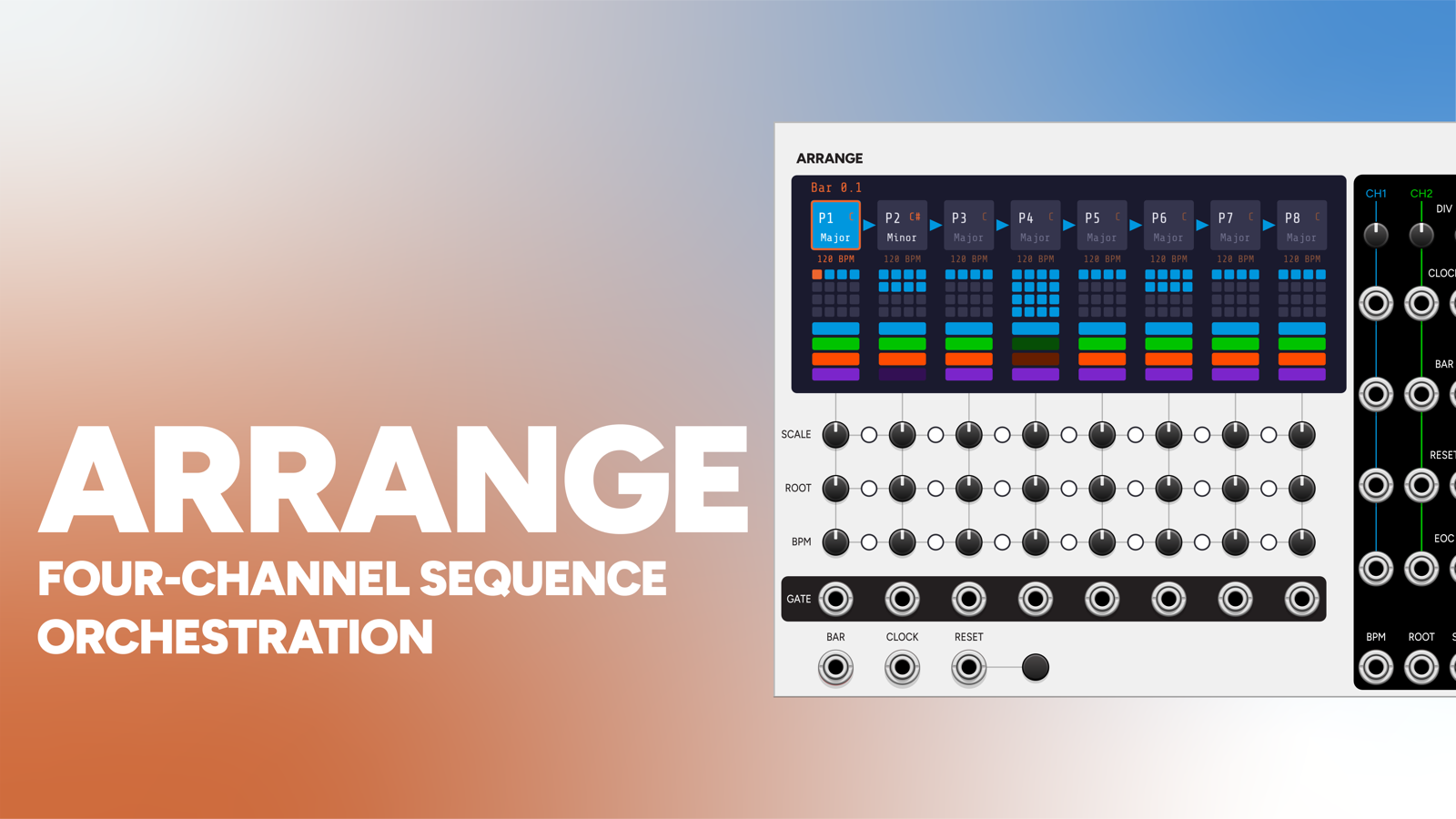 Arrange
Arrange handles the song's sections; Meter X's longer multiples trigger events within a section that the arrangement doesn't know about.