

Version 2.24 is live in the Library. It adds Canopy, a tongue drum played by falling drops, Hocket, which routes one line to eight channels, and Concrète, a clip sampler on a tape loop with a recording expander called Concrète In. ROOT and SCALE cables now work the same way on every module, and a bug that silenced single notes on Loom and Slide is fixed.
Canopy
Canopy is a steel tongue drum played by drops that fall past leaves you place. The drops fall under gravity, bounce off the leaves and sound the drum where they land, and a drop that bounces lands again, so one drop can play several notes. Where a drop lands along a tongue sets which overtones sound, and a landing between tongues gives a muted version of the notes nearby. GATE and V/OCT strike the tongues directly, with or without drops falling.
ROOT and SCALE set the notes and the number of tongues, so a pentatonic scale gives a drum with 10 tongues. Drops can be water, rubber, wood, glass or steel. Leaves come in six forms sized in proportion to the drum, from a 30 cm monstera to a 6 cm ginkgo, and six materials that change how a drop rebounds. A leaf hit makes no sound of its own. It changes where the drop goes next and how fast it is moving, and the sound changes through those two things.
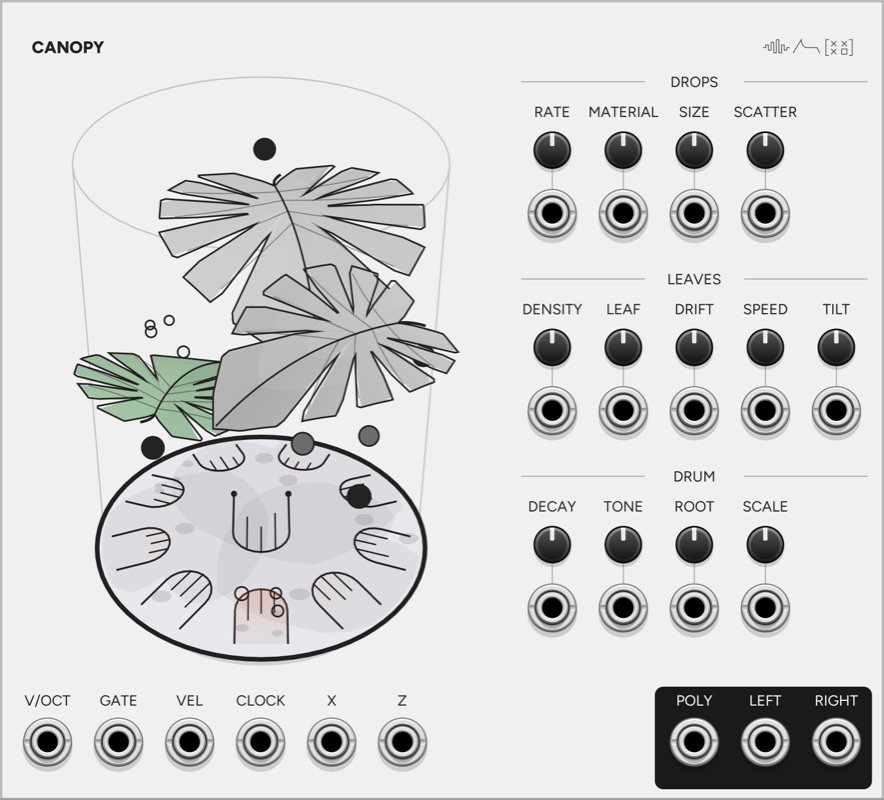
You can download Canopy Meditation, a complete patch that combines Canopy with Hocket, Sigma, Chime, Field and Cistern. It also uses MindMeld MixMaster, the 4ms Dual Looping Delay and VCV Compressor, which comes with VCV Rack 2 Pro. The Canopy page explains how to connect the patch without VCV Compressor, and there is a longer demo of the module on YouTube.
Hocket
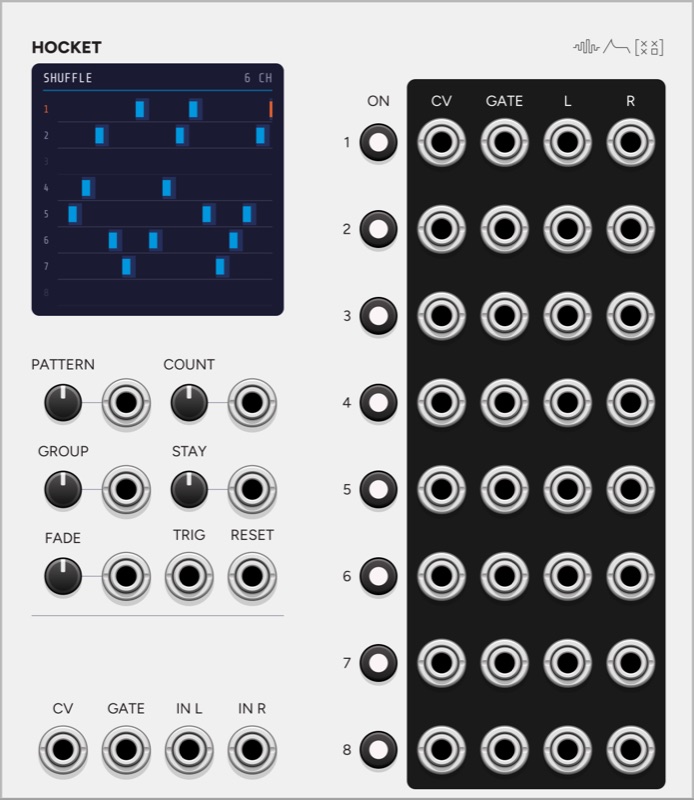
Hocket sends one line of notes or audio to eight channels in turn. Eleven patterns set the order, including Shuffle, Converge, Drunk and Register, which sends low notes to low channels. GROUP sets how many notes a channel plays before the selection moves, and STAY sets the chance that a note stays where it is.
Pitch, gate and stereo audio all follow the same selection. With eight voices on the CV and GATE outputs, a channel holds its pitch after its note ends, so each voice can ring on under the next. With eight effects on the audio outputs, FADE sets the crossfade between them from 0.5 ms to 1 second.
Concrète and Concrète In
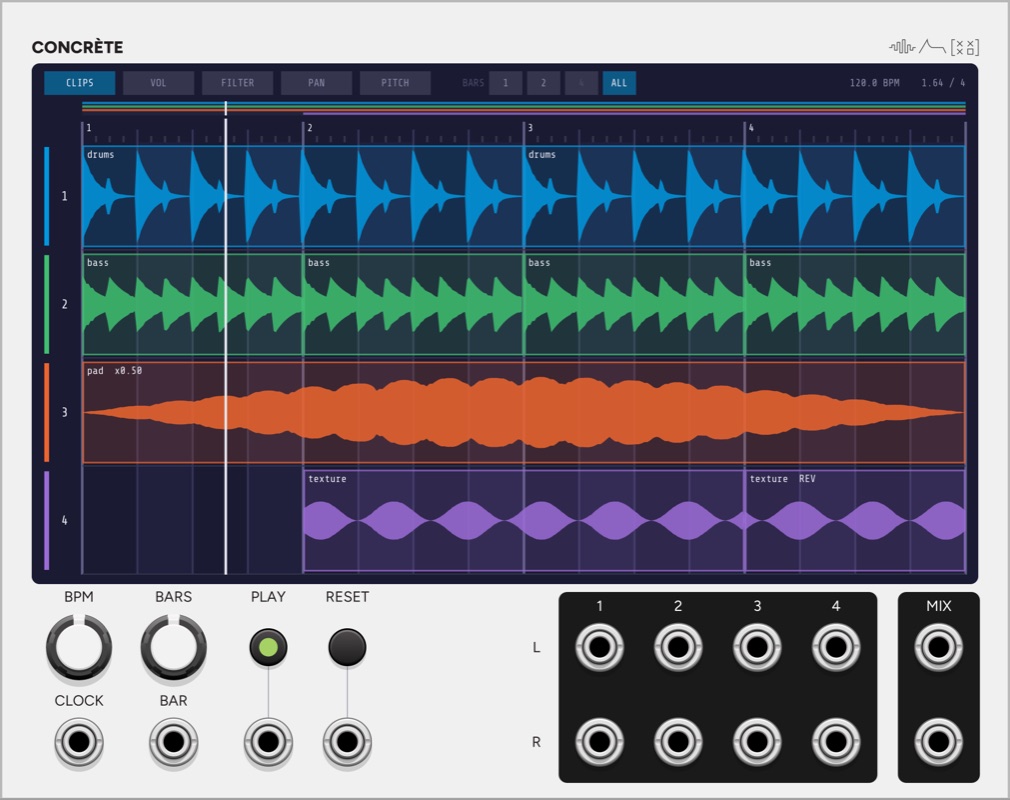
Concrète holds samples in four lanes on one tape loop of 1 to 8 bars. You drop WAV or FLAC files on the lanes, trim and splice them on the screen, and draw volume, filter, pan and pitch curves across the loop. A clip can play at its own speed, with pitch and length changing together as they do on tape, or it can follow the tempo. Each lane has its own stereo outputs alongside the mix.
Concrète In sits to the left of Concrète and gives each lane stereo inputs, a record button and a record gate. A take becomes a clip at the position where it was recorded, and the audio is saved in the patch.
ROOT and SCALE cables
A question on the VCV Rack forum led me to check how every module reads these jacks, and some read the same voltage differently. Fugue and MetaFugue read ROOT at 1 V per semitone, and they now read it at 1V/oct, rounded to the nearest semitone, as the other modules do. On Loom and Slide, 0 V at SCALE meant free tuning, and it now selects Chromatic. Arrange’s SCALE output now sends the full scale bus, so it replaces the knob on the module it drives, as Key’s output does, where it used to add to that knob. Patches that relied on the old readings of those jacks will play different notes.
Every module with a musical ROOT input now has a ROOT CV menu item that reads the jack as 1V/oct (the default), 1 V per semitone, or 0-10 V across the 12 notes. On new copies of Fugue, MetaFugue, Carillon, Key, Wheel and Arrange’s phrases, the SCALE knob starts at Chromatic, the bottom of the list, so a voltage at SCALE is the scale’s own number. Canon stays on Major, because its chords are built from scale degrees and a triad on Chromatic would be C, D and E. Saved patches keep their knob positions. The Root and Scale CV reference lists every voltage and how each module responds.
Fixes and smaller changes
From 2.22.0 through 2.23.1, a single note into a silent Loom or Slide could produce nothing. A string went back to sleep when its pluck burst ended, before the sound had reached the pickup. The problem did not show in a busy patch, because one ringing string kept the others awake through the bridge. A plucked string now stays awake for a full trip round its longest loop. Loom’s Auto mode also changes: with V/OCT unpatched, a mono gate moves the pattern one step instead of strumming all eight strings, and it replaces the internal rate when CLOCK is unpatched.
Sigma no longer recalculates every partial on every sample while a slow envelope is routed in the matrix. A patch with the envelope routed to PAN, a 1.4 second release and 12 voices ringing went from 13% of a core to 2.8%, and every preset renders identically.
Turning FREEZE on or off on Slice used to make a jump in the audio, and resuming left that jump in the buffer for DELAY, SHUFFLE, REVERSE and PITCH to play back. Those changes are now joined over 5 ms, as is a RESET in the middle of a slice. While frozen, straight slices now play the last REACH of audio on a loop. They used to read the oldest end of the buffer, which is silent until a full buffer has been written.
The large knobs across the plugin are now white Rogans, with the same ranges and saved values. I also rewrote about 120 tooltips and menu strings and 35 of the module browser descriptions so that each one says what the control or module does.
The plugin is free in the VCV Rack Library, and you can browse the full set at VCV Rack Modules.