

Version 2.26 is live in the Library with three new modules. Garamut is a physically modelled slit drum. Battery is an eight-lane drum sequencer in which every step has a chance of going to a second channel. Wake is a sequence generator in which up to four cycles drive on a grid, and their turns and crashes become notes and gates.
Garamut
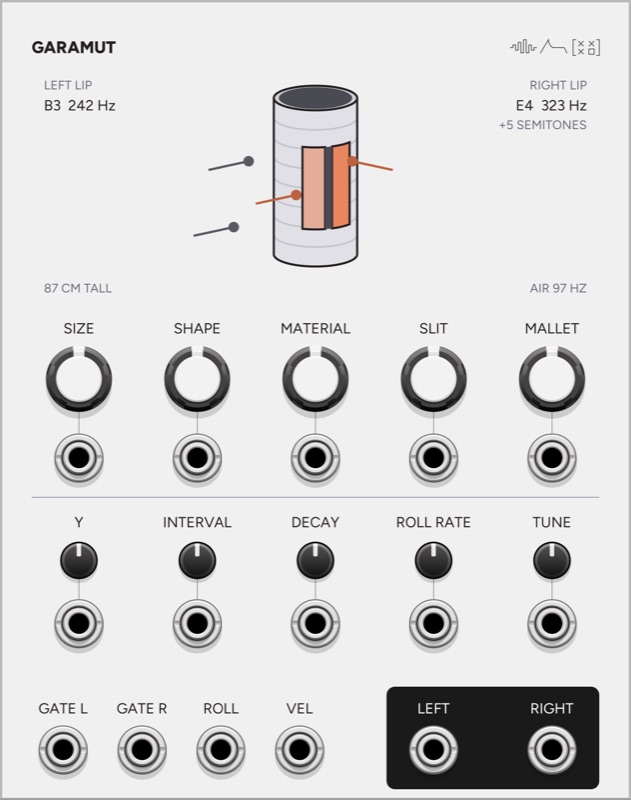
Garamut is a slit drum, a hollow column with a long slit cut into it. The wall on each side of the slit is a lip with its own note, and INTERVAL sets the right lip’s note above the left’s, from unison to an octave. GATE L and GATE R strike the left or the right lip at the height Y sets. Every channel of every gate input plays the same drum, so a strike can land on a lip that is still ringing from the last one.
ROLL strikes for as long as its gate is high, at 4 to 30 strokes a second, with two hands taking turns. The second hand strikes a little more lightly and a little off the first hand’s spot, and every stroke varies slightly in timing and force. SIZE sets the height of the column from 30 cm to 2.5 m, SHAPE runs from a square column to a round one and a pear shape, MATERIAL from cedar to steel, and MALLET from felt to brass. The drum is drawn on the faceplate, each lip fills with orange as it rings, and clicking a lip strikes it.
Battery
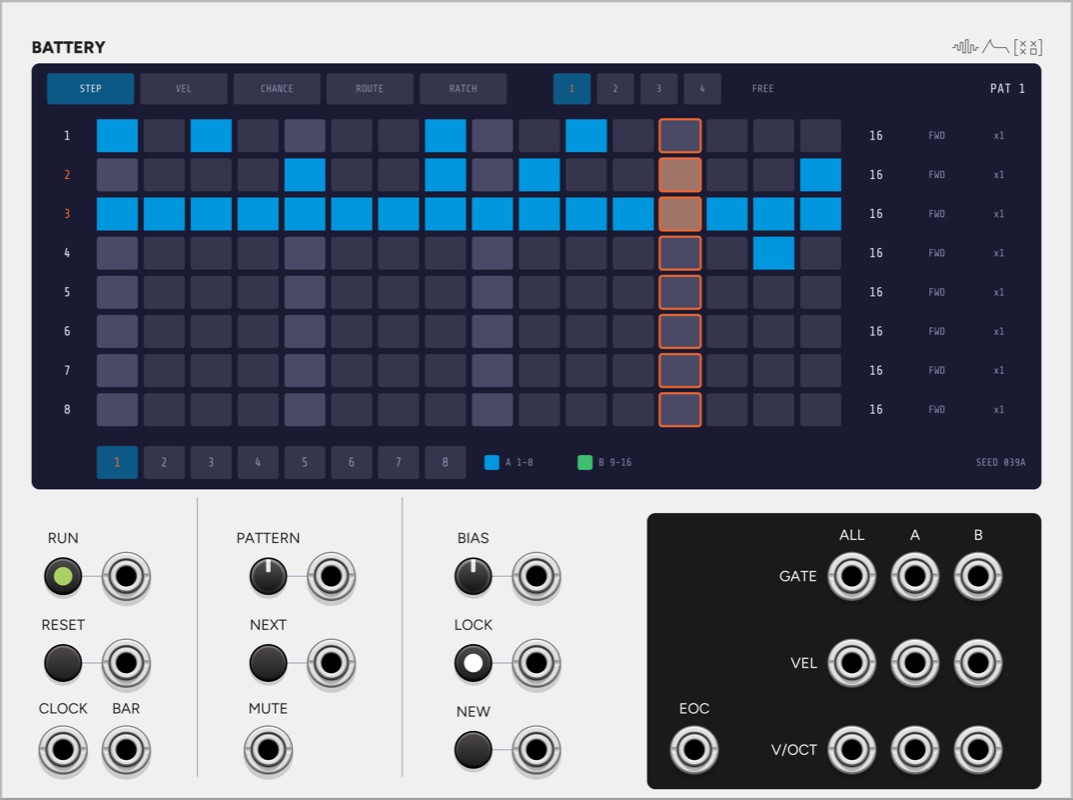
Battery is a drum sequencer with eight lanes of up to 64 steps and eight patterns. Each step has a velocity, a chance of playing, a ratchet of 1 to 4 hits, and a chance of going to the lane’s B channel instead of its A channel. One lane can move between two sounds, such as a closed and an open hi-hat, without a second lane of steps to keep in step with the first. BIAS shifts every step’s chance of going to B, with one CV channel per lane.
Lane N is channel N on the A side and channel N + 8 on the B side of the 16-channel GATE, VEL and V/OCT outputs. The same signals also come out on two 8-channel cables, A and B, so A can drive one Kit and B another. Each lane has its own length, rate and play order, and the serial order plays every step once per pass in a new order each time.
Every random choice Battery makes is computed from a seed, the lane, the pass and the step. LOCK holds each lane on the pass it was playing, so that pass repeats exactly, and NEW draws a new set of choices. A new Battery starts blank, and the Templates menu loads 27 grooves from Fill’s bank.
Wake
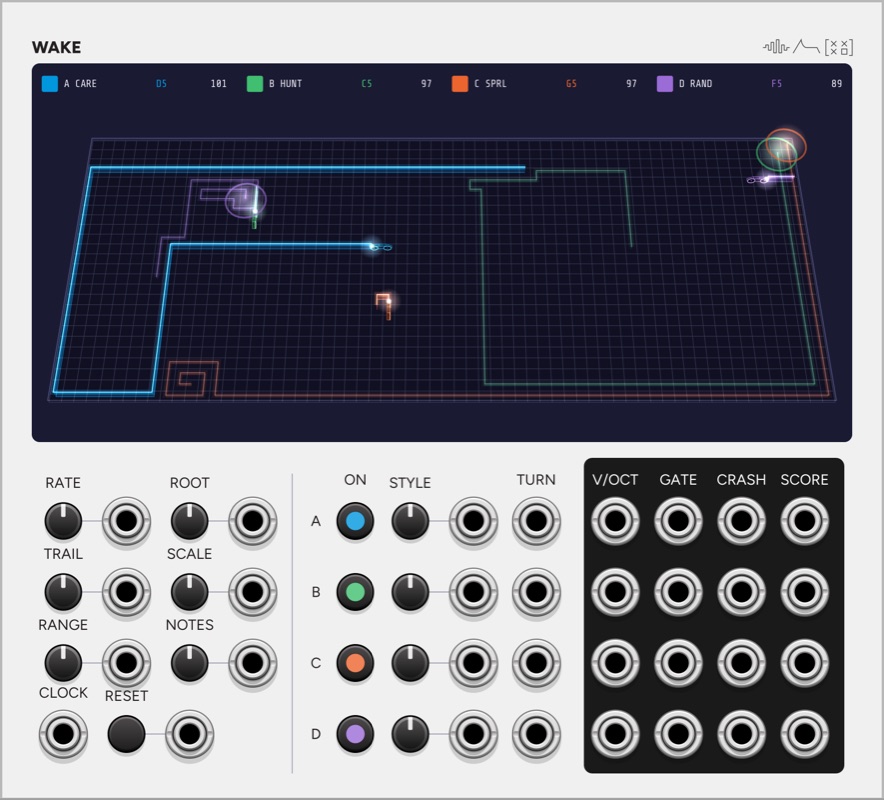
Wake is a four-channel sequence generator based on competing cycle racers. Up to four cycles drive on a grid, one cell per step, and leave trails behind them. A cycle that runs into a trail, the edge of the arena or another cycle crashes and fires its CRASH gate, and it starts again at a free cell.
NOTES sets how each cycle’s moves become a pitch. In the default mode each turn adds the interval for the new heading, an octave up for north and a fifth for east. Other modes move one degree up or down the scale on each turn, or take the pitch from the cycle’s column, row, free room or distance to the nearest cycle. Every pitch is quantized to ROOT and SCALE.
Each cycle has a driving style. Straight, Careful, Hunter, Random, Hugger, Zigzag and Spiral drive themselves, and Keys is steered from the computer keyboard: click the screen, then Z and X turn the first Keys cycle and comma and period turn the second. The grid can have square, hexagonal or triangular cells. On the hexagonal grid with the fifth and major third intervals, the notes lie out as a Tonnetz. The screen shows the arena in 3D with the trails as walls of light, and dragging it turns the view. SCORE counts the cells each cycle drives and the crashes into its trail, at 0.01 V a point.
The plugin is free in the VCV Rack Library, and you can browse the full set at VCV Rack Modules.