
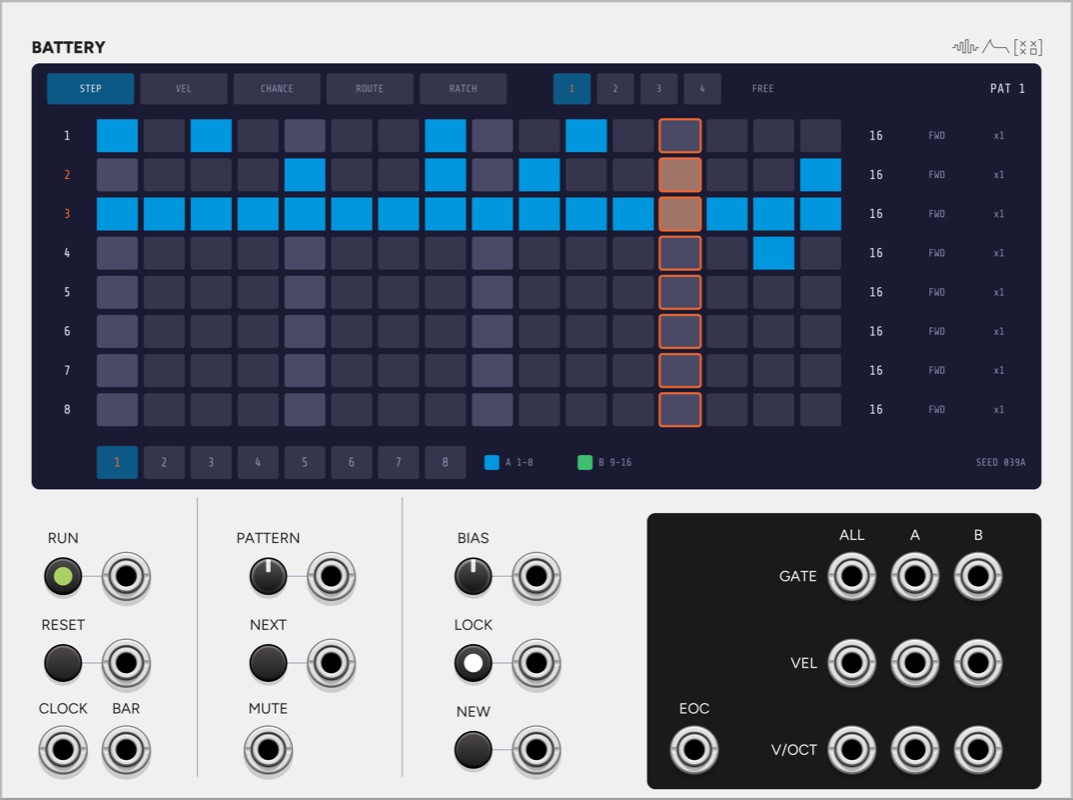
Battery is a drum sequencer with eight lanes of up to 64 steps and eight patterns. A battery is the percussion section of a marching band. All eight lanes are on the screen at once, in four pages of 16 steps, and a lane’s length, play order and rate are set on the screen next to it.
Each lane has two channels, A and B, and every step has a chance of going to B instead of A. I built it so that one lane could move between two sounds, such as a closed and an open hi-hat or a snare and a rim shot, without a second lane of steps that has to be kept in step with the first.
What a step holds
A step is on or off, and it has a velocity, a chance of playing (CHANCE), a chance of going to the B channel (ROUTE), and a ratchet of 1 to 4 hits evenly spaced inside the step. The tabs along the top of the screen choose which of these the grid edits. In the VEL, CHANCE and ROUTE tabs, dragging a step up or down sets its value. CHANCE is drawn first, and if the step plays, ROUTE is drawn once for the whole step, so every hit of a ratchet goes to the same channel.
BIAS adds to every step’s ROUTE chance, from −100% to +100%, and its CV is polyphonic with one channel per lane. With BIAS fully up, every step goes to B.
Channels
Lane N is channel N on the A side and channel N + 8 on the B side, on the 16-channel GATE, VEL and V/OCT outputs. The same signals come out split onto two 8-channel cables, A and B. Kit reads channel N as instrument N and has eight instruments, so a 16-channel cable into one Kit would lose the B side, and the split outputs let A drive one Kit and B another. V/OCT carries a note for each lane and side, set in the lane’s menu, for samplers that choose a sample by pitch. By default the 16 channels are 16 adjacent semitones from C4.
Play orders and rates
Each lane in each pattern has its own length, rate and play order. The rates run from a quarter of the clock to four times it, and a lane faster than the clock spaces its steps from the measured clock period. The play orders are forward, backward, pendulum, ping-pong (which plays the end steps twice), random, a drunk walk, and serial, which plays every step once per pass in a new order each pass and never starts a pass on the step the last one ended on.
LOCK and NEW
Battery has no running random generator. Every random choice it makes (CHANCE, ROUTE, the random and drunk orders, the serial order) is computed from a seed, the lane, the pass and the step. LOCK holds each lane on the pass it was playing when LOCK was pressed, so that pass repeats exactly, with the same steps dropped and the same steps sent to B. NEW changes the seed, which gives a new set of choices. The seed and the locked passes are saved with the patch.
Patterns
The eight patterns are along the foot of the screen. A click opens a pattern for editing and a double-click queues it to play next. NEXT moves to the next pattern that has steps in it, and the PATTERN CV selects one at 1 V per pattern. A change waits for a pulse at BAR when BAR is patched, and otherwise for the end of the longest lane that has steps. The menu can instead start the new pattern on the next step, with every lane keeping its position.
A new Battery starts blank. The Templates menu holds 27 grooves from Fill’s bank, grouped by style. A template loads its main groove into the pattern on screen, or all of its variations into patterns 1 onward. Fill swings some of its grooves and Battery has no swing of its own, so the menu shows each groove’s swing next to its name, and swinging the clock gives the same feel.
Right-clicking a lane gives a Euclidean fill, rotate, randomize, copy, paste and clear, and the lane’s notes. Right-clicking a page tab copies, pastes, clears or duplicates that page across all eight lanes.
Inputs and outputs
Inputs: CLOCK, BAR, RUN, RESET, PATTERN, NEXT, BIAS (polyphonic), LOCK, NEW, and MUTE (polyphonic, one channel per lane).
Outputs: GATE, VEL and V/OCT with 16 channels each, the same split into A and B outputs with 8 channels each, and EOC.
Patch ideas
Two kits from one sequencer. Patch the A outputs into one Kit and the B outputs into another set up with related sounds. Raise ROUTE on a few steps, and turn BIAS slowly to move the whole pattern from the first kit toward the second.
A variation that stays. Set CHANCE below 100% on the hi-hats and let a few passes play. When one sounds right, press LOCK, and that pass repeats until LOCK is released.
Polymetric lanes. Give the kick a 16-step lane, the hats 12 steps at x2, and a percussion lane 7 steps in serial order. EOC fires when the longest lane wraps.
In the synthesis guide
- Step Sequencers: Pitch, Gates, Ratchets, Slides
A step sequencer stores a pitch and a gate for each step and moves to the next step on every clock pulse. Length, gate length, ties, slides and ratchets change how each step plays.
Pair with
-
 Kit
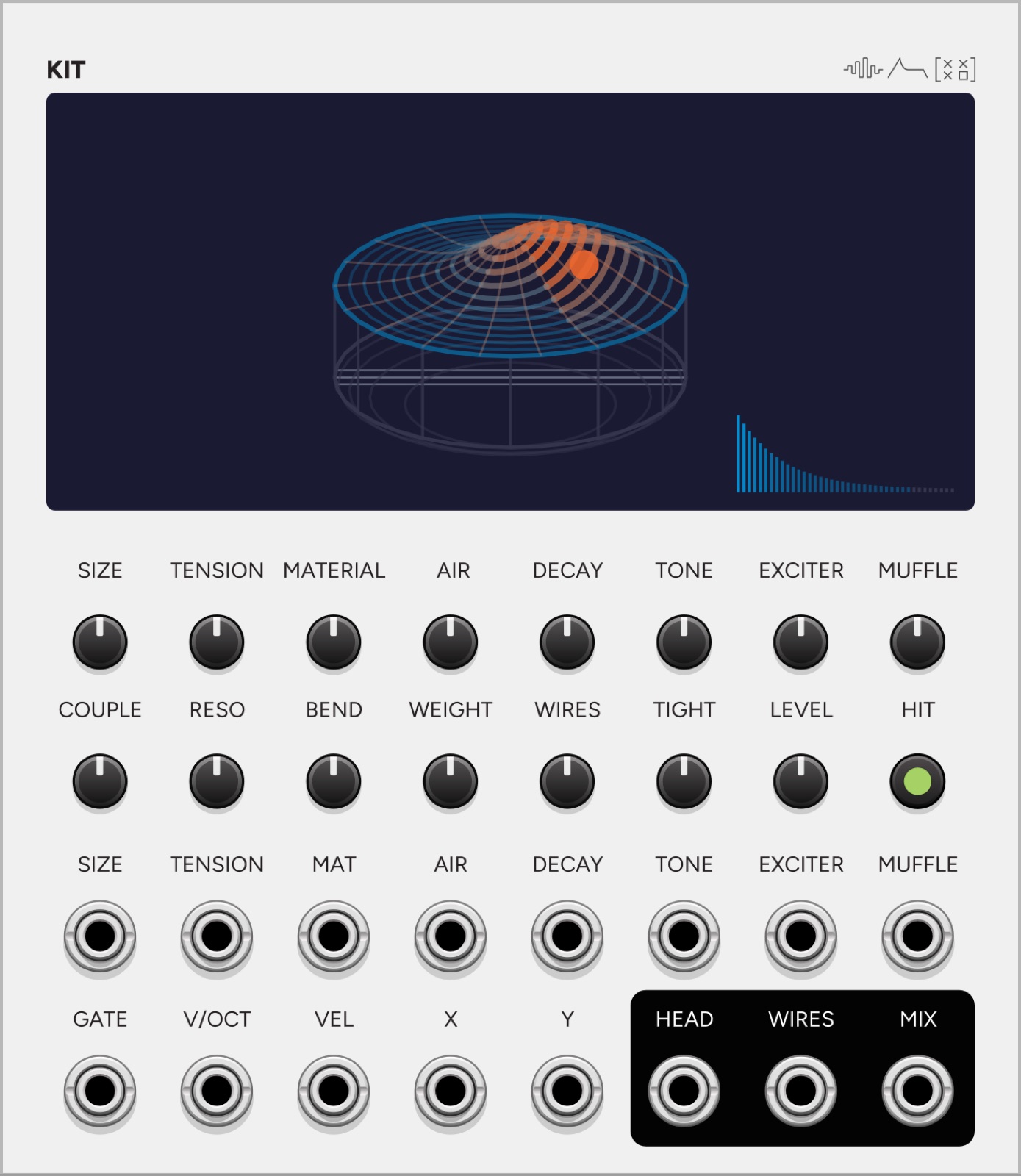
Battery's A outputs into one Kit and its B outputs into another give each lane two instruments, chosen step by step.
-
 Meter
Meter's sixteenth output into CLOCK and its BAR output into BAR keep pattern changes on the bar, and the sixteenth's swing knob swings every lane running at x1.
-
 Fill
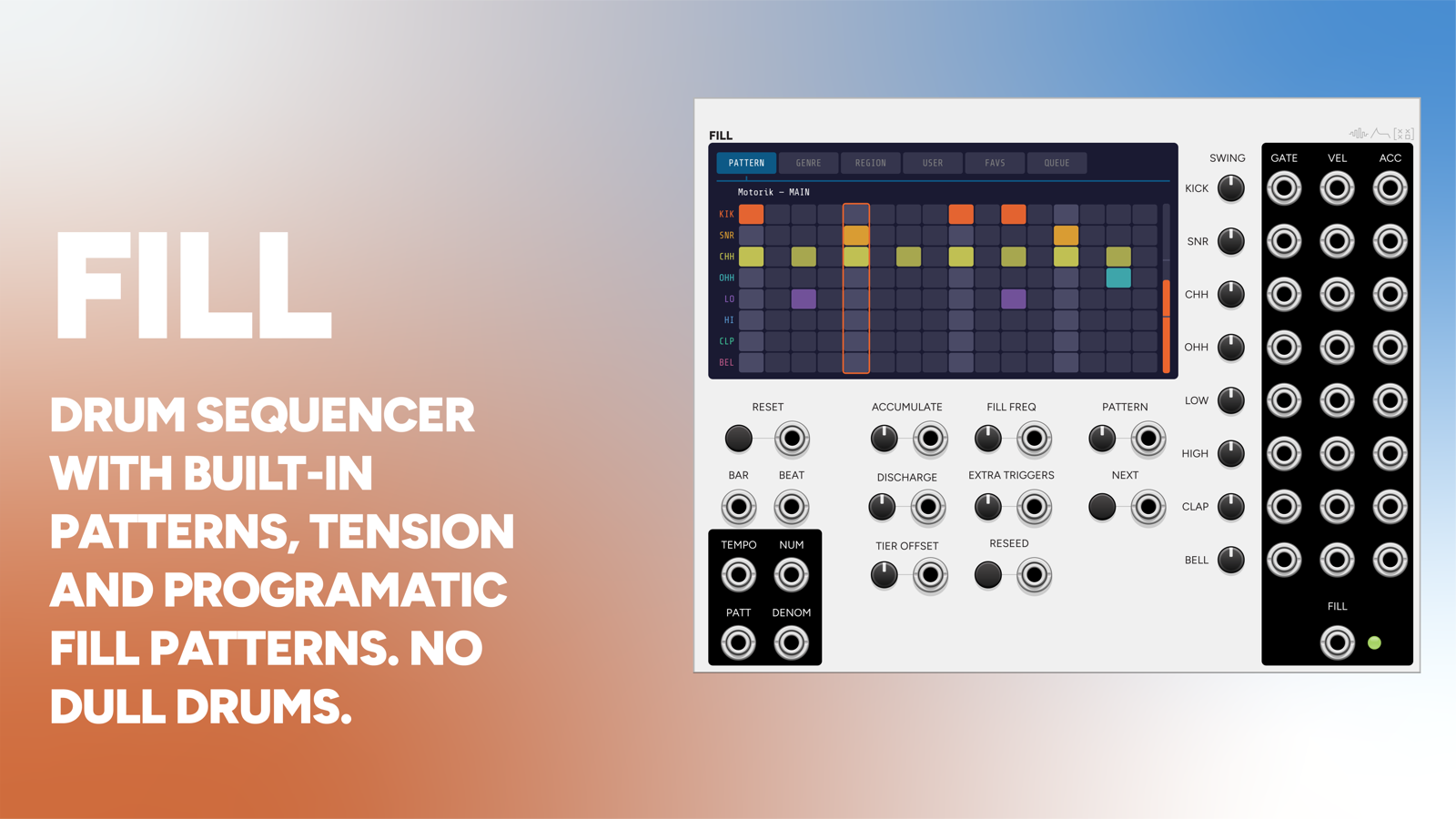
Battery's templates are Fill's grooves, so a pattern can start from one of Fill's sets and be edited step by step.
-
 Play
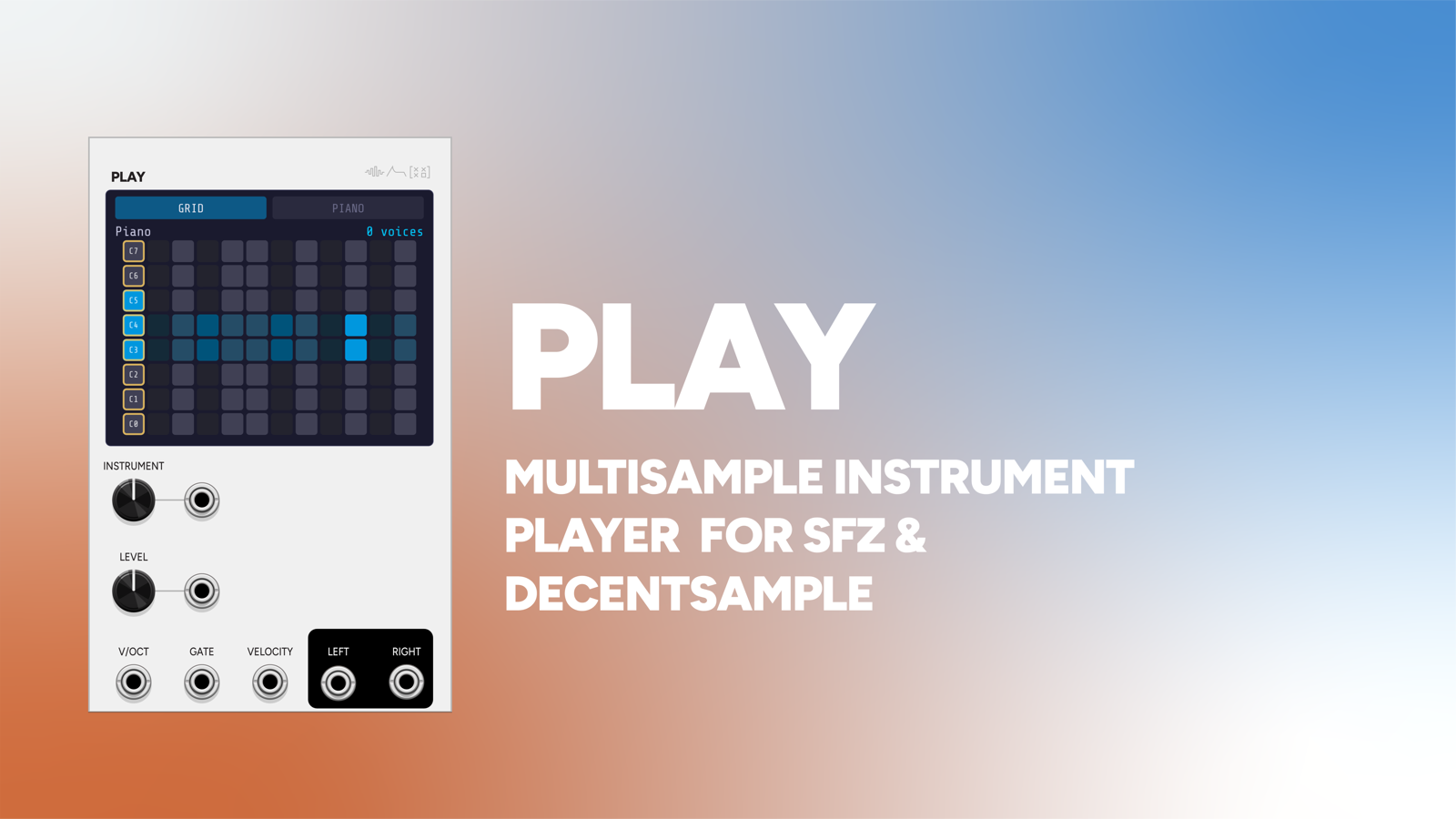
Battery's V/OCT output sends a note per lane and side, so one Play instrument can hold sixteen drum samples.