
Version 2.25 is live in the Library. Every module now has a dark panel. Canopy’s drops can play eight more instruments, from a zither and a steel pan to a balafon, and new CV and TRIG outputs send each note they strike to the rest of a patch. Cistern has two new options that make the positions of the sources easier to hear.
Dark panels
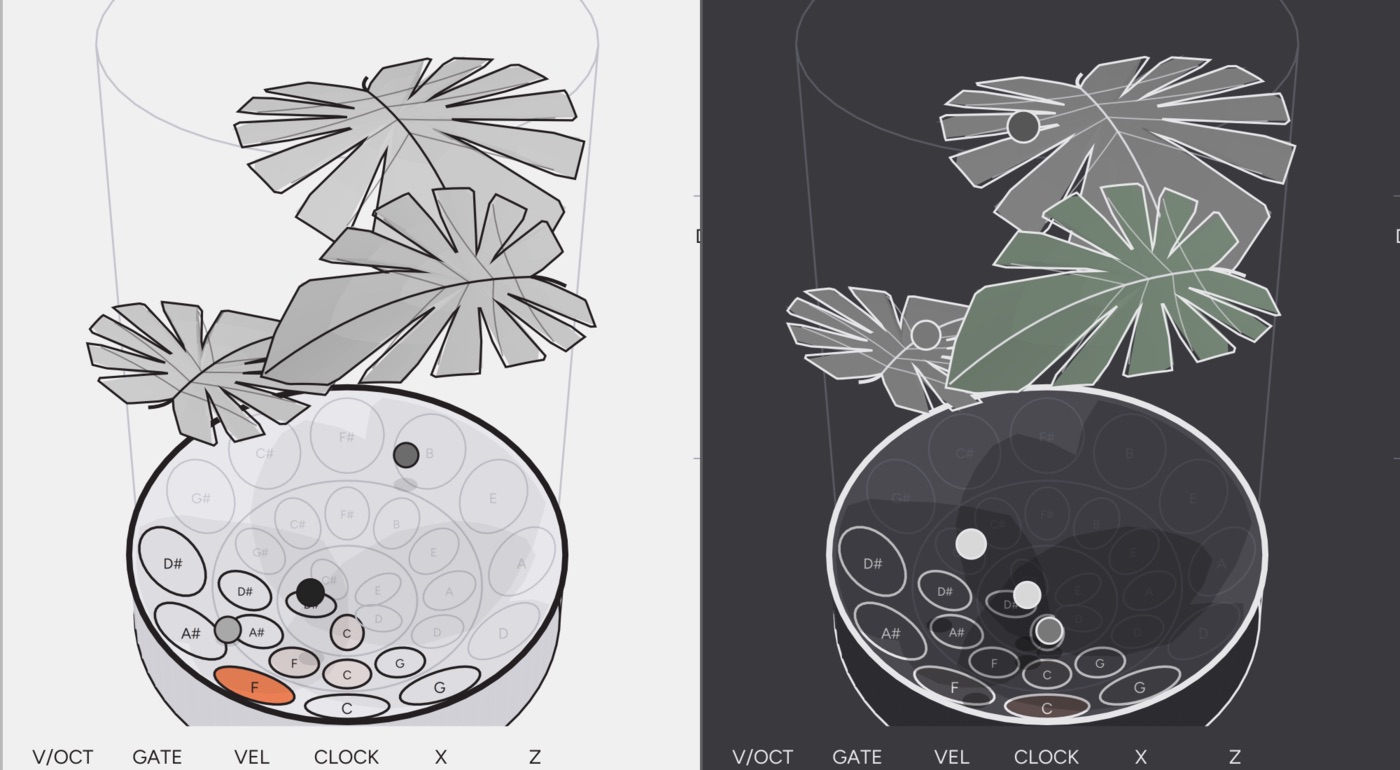
Every panel in the plugin now follows the “Use dark panels if available” setting in Rack’s View menu. The dark artwork is generated from the light artwork by giving each element a colour according to its role, so labels, lines, plates and screens change together and a new panel gets a dark version without being drawn twice. The older panels that were drawn in code have been redrawn so that their jacks, labels and screens change with the setting as well. Screens with drawings on them, such as Canopy’s, use light lines on a dark ground.
Canopy’s instruments
Canopy was a steel tongue drum, and the new TYPE knob chooses the instrument under the leaves. The drops, the leaves and the other controls stay the same when you change it, and the output fades out and back in over 5 ms, so a CV can switch instruments without a click. TYPE reads 1 V per instrument at its CV input.
The tongue drum is the default, and its sound is identical to 2.24. On the zither, where a drop lands along a string sets its tone, and a drop wider than the gap between two strings rests on both and rolls down them, sustaining them quietly as it goes. The steel pan is a low-C tenor pan with 29 pads in a bowl, and a drop rolling down the bowl knocks each pad it crosses. Water that lands in a singing bowl stays there, which lowers the bowl’s note and shortens its ring until it dries over three minutes. The wind chimes swing on their cords after a hit, so a single drop can set off a run of notes.
The handpan has a raised centre note with eight notes round it. The bonang is a set of Javanese kettle gongs in two rows an octave apart, with 10 kettles on a slendro scale and 14 on pelog, and a hit on the flat top round a kettle’s raised centre gives a muted knock. The marimba is chromatic over two octaves and laid out in a circle, with the notes outside the scale damped. The balafon’s gourds buzz when a bar is struck hard. On the bonang, the marimba and the balafon, a drop is drawn toward the nearest kettle or bar as it falls, since most drops would otherwise land in the gaps. The overtone ratios and ring times of every instrument are my estimates rather than measurements.
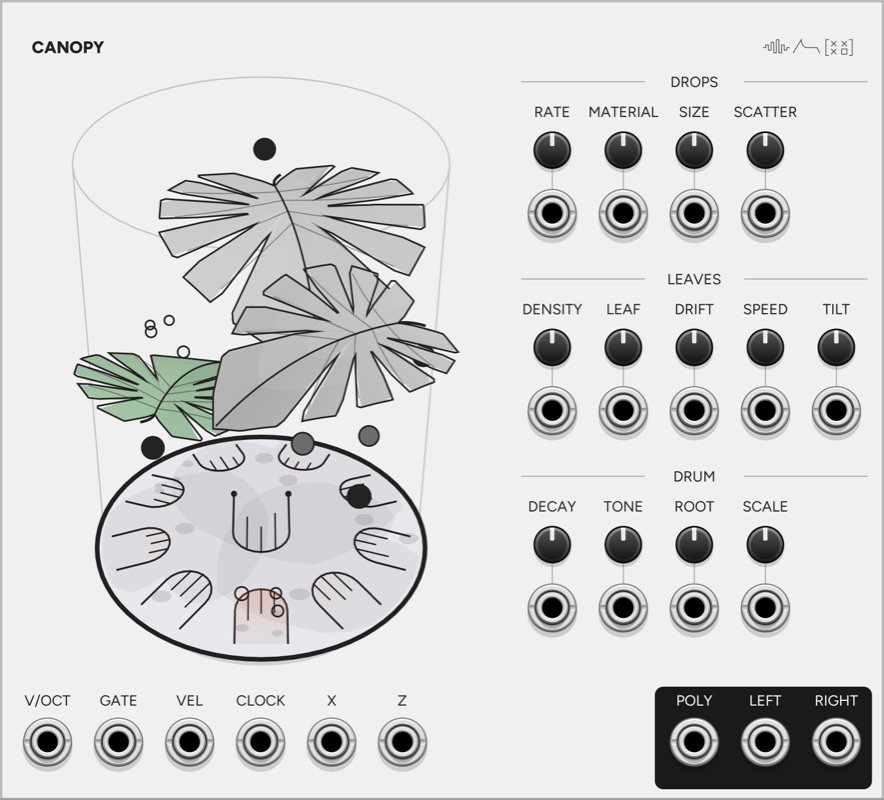
The new CV and TRIG outputs send every note Canopy strikes, by a drop or by GATE, as a 1V/oct pitch and a 1 ms trigger. The pitch is held until that channel’s next note. The menu sets the number of channels, from 1 to 16, and whether each note goes to the next channel in turn or back to the channel that last carried it, so the rain can play a polyphonic voice elsewhere in the patch. The pitch is the note as tuned, so water in a singing bowl does not change it, and a hit between two notes sends nothing.
RATE fully left now releases no drops, so Canopy can be played from GATE and CLOCK alone. Above the bottom 4% of its travel the knob sets the same rates as before, and a positive voltage at RATE’s CV input raises the rate from a knob that is fully left. The Lowest tongue menu item is now called Lowest note, and the steel pan has its own tuning menu: chromatic, tuned to the scale, or chromatic with the notes outside the scale damped, which is the default.
Cistern
Cistern has two new menu options. With Level follows distance on, a source placed closer to the listener is louder by up to 6 dB and one further away is quieter. The second option changes what MIX blends. Cistern used to mix the dry input with the room, and the dry input is the signal with no delay and no placement in the room, so at most settings of MIX it covered most of what moving a source changed. MIX now blends the room’s own direct sound, delayed and placed where the source stands, against the room’s reverberation.
Both options are on for a new Cistern. Patches saved before 2.25 open with them off, so they sound as they did when they were saved.
The plugin is free in the VCV Rack Library, and you can browse the full set at VCV Rack Modules.