
Introduction to Sound Synthesis Beyond subtractive
Additive
Additive synthesis builds a sound from sine waves, setting the frequency and level of each one separately. With an envelope on each sine wave, the balance between them can change over the course of a note, as it does in the sound of acoustic instruments.
Waveforms built a sawtooth by adding harmonics one at a time, and Harmonics and overtones showed that the timbre of a steady sound depends mostly on how strong each of its harmonics is. Additive synthesis makes sound in that way on purpose. Each sine wave in the sum is called a partial, and the synthesiser sets the frequency and level of every partial. A subtractive synthesiser starts from a waveform that already contains many harmonics and lowers some of them with a filter, which can only reduce harmonics that the waveform already has and changes a whole region of the spectrum at once. An additive synthesiser can raise or lower any one partial without changing the ones next to it.
The tool below adds sixteen sine waves. Each bar sets the level of one partial, and the plot above the bars draws the sum of the sine waves. The Stretch control moves the upper partials away from whole-number multiples of the lowest one.
Sixteen partials, each with its own level
Sixteen sine waves play together, and dragging across the bars sets the level of each one. The upper plot draws their sum over two cycles of the lowest partial.
Listen for The Sawtooth preset sums to a sawtooth. Drawing a single tall bar at partial 5 adds a tone two octaves and a major third above the fundamental, which is heard as a whistle inside the sound. Raising Stretch moves the upper partials off the harmonic series, and the tone becomes metallic and its pitch less definite.
Partials
When every partial sits at a whole-number multiple of the lowest one, the partials are harmonics, the waveform repeats at the frequency of the lowest partial, and the sound has a clear pitch. The Sawtooth and Square presets set the levels of the harmonics to the ones those waveforms contain: every harmonic at a level of 1/n for the sawtooth, and only the odd ones for the square. The Organ preset sets partials 1, 2, 3, 4, 6 and 8 to the same level, which on a Hammond organ is the sound of the 8′, 4′, 2⅔′, 2′, 1⅓′ and 1′ drawbars pulled fully out. The footages come from organ pipes: a pipe of 4 feet sounds an octave above one of 8 feet, so each drawbar adds one harmonic of the note.
Stretch raises each partial's frequency above its harmonic, by more for the higher partials. The readout gives the second partial as a multiple of the first. The partials then no longer line up with one another at the end of each cycle, the waveform no longer repeats, and the sound takes on the metallic quality of a struck bar or a bell, whose partials are also not whole-number multiples of the lowest one. A stiff piano string shows a small amount of the same stretching in its upper partials. None of these sounds can be made by filtering a sawtooth, because a sawtooth contains only harmonics.
Additive synthesis was in use long before electronic synthesisers. The inventor Thaddeus Cahill's Telharmonium, which began public service in New York in 1906, generated its tones with rotating electrical alternators and mixed them to build each note. Laurens Hammond's organ of 1935 does the same with small tonewheels, each one producing a nearly sinusoidal tone, and its drawbars set the level of each harmonic in the mix.
Envelopes for each partial
A Hammond organ holds the levels of its partials fixed for as long as a key is held. The partials of acoustic instruments change level at different rates. In the 1960s the composer Jean-Claude Risset and the engineer Max Mathews, working at Bell Telephone Laboratories, analysed recorded trumpet notes and found that the higher harmonics start later in the attack than the lower ones, and Risset used the measurements to synthesise trumpet tones from sine waves. They published the analysis in Physics Today in 1969. In a struck or plucked sound the order is reversed: every partial starts together, and the higher partials die away sooner than the lower ones, so the tone becomes darker as it decays.
The tool below gives each of sixteen partials its own envelope. Onset delays the start of each partial by more the higher it is, so that the top partial starts that many milliseconds after the fundamental. Decay sets how long the fundamental takes to fall by 60 dB, Tilt shortens the decay of the higher partials, and Sustain sets the level that every partial falls towards while the key is held.
Partials with their own envelopes
Each of sixteen harmonic partials has its own envelope. The plot draws each partial's envelope over the first two seconds of a note, with the fundamental at the bottom and each row scaled to its own peak.
Listen for With the Brass preset the upper partials arrive about a tenth of a second after the fundamental, and the note opens out after it starts. With Struck every partial starts together and the upper ones die away first, so the note darkens as it fades. With Steady every partial has the same envelope, and the result is a sawtooth with an envelope on its level.
Because every partial needs its own oscillator and its own envelope, additive synthesis needs far more computation and far more settings than subtractive synthesis. The Bell Labs Digital Synthesizer of 1977, designed by Hal Alles, was a real-time digital additive synthesiser, and the Crumar GDS, based on its design, was programmed from an attached computer with a screen. The Kawai K5000, a keyboard synthesiser of 1996, adds up to 128 sine waves per voice.
Resynthesis
The levels and envelopes of the partials can also be measured from a recording. An analysis divides the recording into short frames, finds the frequency and level of each partial in each frame, and joins the frames into a frequency and a level envelope for every partial. Robert McAulay and Thomas Quatieri published a widely used method in 1986. Playing the measured partials back as sine waves rebuilds the recording, and changing them before playback changes it in ways a filter cannot: stretching every partial's frequency makes a voice metallic, and slowing the envelopes lengthens a note without changing its pitch.
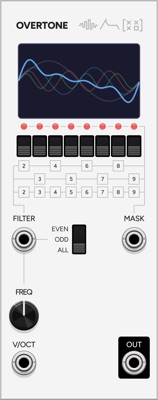
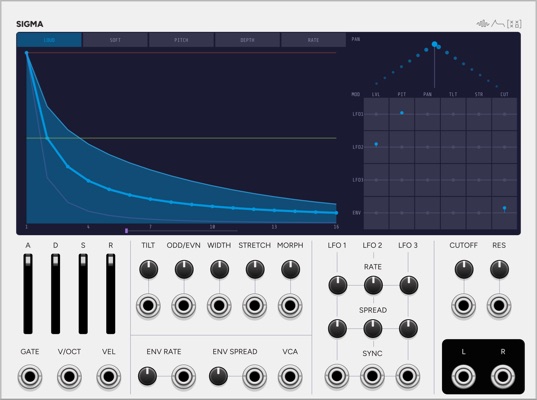
On this site, Overtone is an additive oscillator for VCV Rack that switches individual harmonics on and off, with inputs that put the selection under control. Sigma is an additive voice modelled on the Crumar GDS. It adds up to 64 partials and sets their levels, pitch stretch, pan and envelope rates with curves across the partials, including a control that makes the higher partials decay sooner, as Tilt does in the tool above. The partials in FM synthesis are sidebands whose levels follow the modulation index rather than being set one at a time.
Common questions
What is additive synthesis?
Additive synthesis builds a sound by adding sine waves together, setting the frequency and level of each one separately. Each sine wave is called a partial. When the partials sit at whole-number multiples of the lowest one, the result has a clear pitch, and when they do not, it sounds metallic or bell-like.
What is the difference between additive and subtractive synthesis?
Subtractive synthesis starts from a waveform that already contains many harmonics and lowers some of them with a filter, which moves a whole region of the spectrum at once. Additive synthesis sets the level of each partial directly, so one partial can be changed without changing its neighbours, and partials that the starting waveform did not contain can be added.
Is a Hammond organ an additive synthesiser?
Yes. Each drawbar on a Hammond organ sets the level of one nearly sinusoidal tone from a tonewheel, at a fixed multiple of the note's frequency, and the organ adds them together. The difference from later additive synthesisers is that the levels stay fixed through each note.
Why do additive synthesisers need so many controls?
Each partial has its own frequency, level and envelope, so a sound made of 64 partials has 64 envelopes per voice. Most additive instruments group the partials under a few controls, such as one that sets how quickly the level falls from the lowest partial to the highest.
Related modules
Published Glossary