
Introduction to Sound Synthesis Beyond subtractive
Vector
Vector synthesis mixes four sound sources with a single two-dimensional control. Each source sits at one end of two crossed axes, and the position of a joystick, or of a point moved by an envelope, sets how much of each source is heard.
The Wavetables chapter moved through a row of waveforms with one position control. Vector synthesis uses two dimensions. Four sources, labelled A, B, C and D, sit at the left, top, right and bottom of a diamond, and one point inside the diamond sets the mix. At a corner only that source is heard. Between two corners the two sources are mixed, and at the centre all four are mixed at equal levels. A joystick moves the point in both dimensions at once, with one hand.
Sequential Circuits introduced vector synthesis in the Prophet VS in 1986. Each voice has four digital oscillators, each playing a single-cycle waveform chosen from 96 presets or 32 of the player's own, and the joystick mixes them before an analogue lowpass filter. The tool below works the same way, with four single-cycle waveforms at the same pitch.
Four waveforms mixed by one position
Four single-cycle waveforms play at the same pitch, one at each corner of the diamond, and the position of the point sets the mix. A second plot draws one cycle of the mixed waveform and the level of each source.
Listen for Drag from A to C and the sawtooth gives way to the Formant wave, which has two strong groups of harmonics and little else. Towards D the sound becomes a plain sine, and towards B it becomes the hollow tone of a square wave. With Detune raised, B and D drift against A and C, and positions between corners beat and shimmer while positions at a corner stay steady. With Motion set to Circle the point travels round the diamond by itself.
Mix envelopes
A joystick needs a hand, so vector synthesisers also store a path for the point to follow over each note. On the Korg Wavestation this is called the mix envelope, and moving the joystick while playing overrides it. A mix envelope that moves from a bright source to a dark one does the work of a filter envelope, and one that loops round the diamond keeps a held note changing for as long as it lasts, as the Circle setting above does. An LFO can move the point in the same way.
Each source is a separate oscillator, so the sources can differ in more than waveform. Detuning two of them against the others makes the mix beat, as two detuned oscillators on any synthesiser do, and a source can be pitched an octave or a fifth away from the others. On later instruments the sources are often samples rather than single cycles: Yamaha's SY22 of 1990 puts an FM voice and a sampled sound on each axis, and the Wavestation's sources are recorded waveforms.
The Prophet VS and the Wavestation
Yamaha bought Sequential Circuits in the late 1980s and closed it. In 1989 Dave Smith, the founder of Sequential and designer of the Prophet-5, and several of its engineers joined Korg, where they designed the Wavestation, released in 1990. Korg called its version advanced vector synthesis. Each of its four sources can play a wave sequence, which steps through a list of recorded waveforms, each with its own duration, pitch and level, and crossfades from one to the next. A wave sequence changes the sound in time while the vector mix changes it across the four sources, and the two together give sounds that keep changing over long held notes.
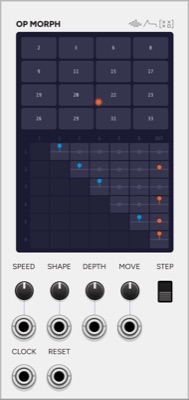
On this site, OP MORPH applies the same two-dimensional idea to FM. It moves through a 4 by 4 field of sixteen stored FM routings for the Operator module and blends between neighbouring ones, rather than mixing four sound sources.
Common questions
What is vector synthesis?
Vector synthesis mixes four sound sources with a single two-dimensional control, usually a joystick. The sources sit at the four ends of two crossed axes, and the position of the joystick sets how much of each is heard. An envelope or an LFO can move the position over each note.
Which synthesisers use vector synthesis?
Sequential Circuits introduced it in the Prophet VS in 1986, with four digital oscillators mixed by a joystick and then passed through analogue filters. Korg's Wavestation of 1990 and Yamaha's SY22 of the same year also use it, and later Korg instruments such as the OASYS and Kronos include it.
How is vector synthesis different from wavetable synthesis?
A wavetable position moves through a row of waveforms in one dimension, and the waveforms are frames of one oscillator. Vector synthesis mixes four separate sources across two dimensions, and each source is its own oscillator or sample with its own pitch and tuning, so two sources can be detuned against each other or play different kinds of sound.
Related modules
Published Glossary