
Introduction to Sound Synthesis Beyond subtractive
Sampling
A sampler plays a recording back as an instrument. It changes the recording's pitch by changing its playback speed, can loop part of it to sustain a note, and can play it backwards.
The oscillators in the earlier chapters generate their waveforms, by calculation in software or with a circuit in hardware. A sampler plays back a recording instead, such as a recording of an instrument, a voice, a drum or a room. Its controls set where playback starts and stops, how fast it plays, whether it loops, and in which direction it plays. The Fairlight CMI, built by Peter Vogel and Kim Ryrie in Sydney and released in 1979, was the first widely used digital sampler, and the E-mu Emulator followed in 1981. SampleStack has a longer history of sampling, from tape and musique concrète to Eurorack.
The tool below plays two short recordings: a melodic phrase that ends in a held chord, and one bar of a drum pattern. It draws the waveform of the chosen recording, with the part being played shaded and the playhead marked on it.
A sampler
A recording plays between adjustable start and end points at any speed from a quarter to double, forwards or backwards, once or looped.
Listen for Doubling the speed raises the pitch by an octave and halves the length. Halving it lowers the pitch by an octave and doubles the length, and the drums become slow and low. Reversed, each note swells and stops abruptly instead of starting abruptly and fading. A short loop near the end of the phrase holds the chord for as long as it plays.
Speed and pitch
A classic sampler changes pitch by changing playback speed. Played twice as fast, every cycle of every waveform in the recording passes in half the time, so every frequency doubles and the pitch rises an octave. The recording also lasts half as long. Each semitone is a speed change of the twelfth root of two, about 6%. The speed change also moves the resonances of the original instrument or voice, called formants, and changes the timing of every event in the recording, so a sample played far from its original pitch sounds like a different source: a voice pitched up an octave speeds up and sounds like a smaller person, and drums pitched down slow down and sound like larger drums. Multisampling, recording an instrument at several pitches and using the nearest one for each key, keeps that change small. SampleStack's interactive guide to pitch shifting shows how a recording changes as it is moved further from its original pitch, and how many pitches to record.
Loops and direction
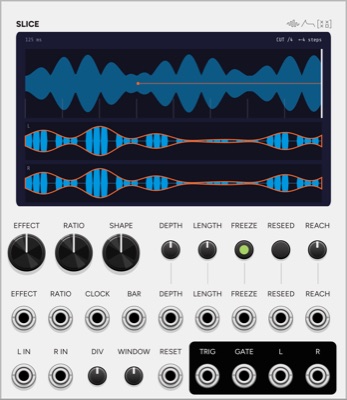
Looping a section of a recording lets a short sample sustain for as long as a key is held. The loop points have to be chosen so that the end joins the start smoothly, or the join is heard as a click or a bump on every repeat. Placing the loop points at zero crossings and crossfading across the join are the usual fixes, and SampleStack's guide to why a loop clicks has controls for both. Reversing a recording turns each sound's shape around in time, so a sound that started sharply and decayed now swells and stops abruptly. The Slice module on this site cuts a live signal into slices and reverses, repeats and reorders them in the same way.
Sample libraries
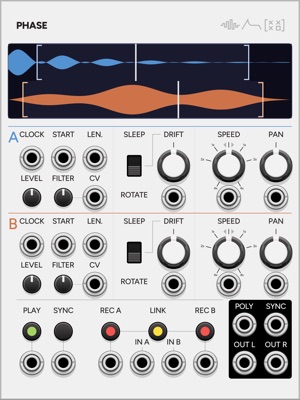
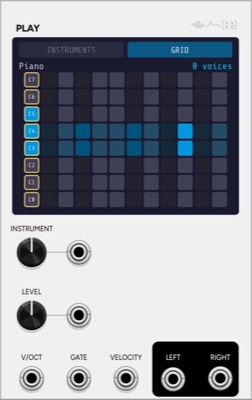
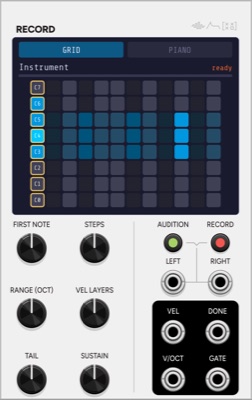
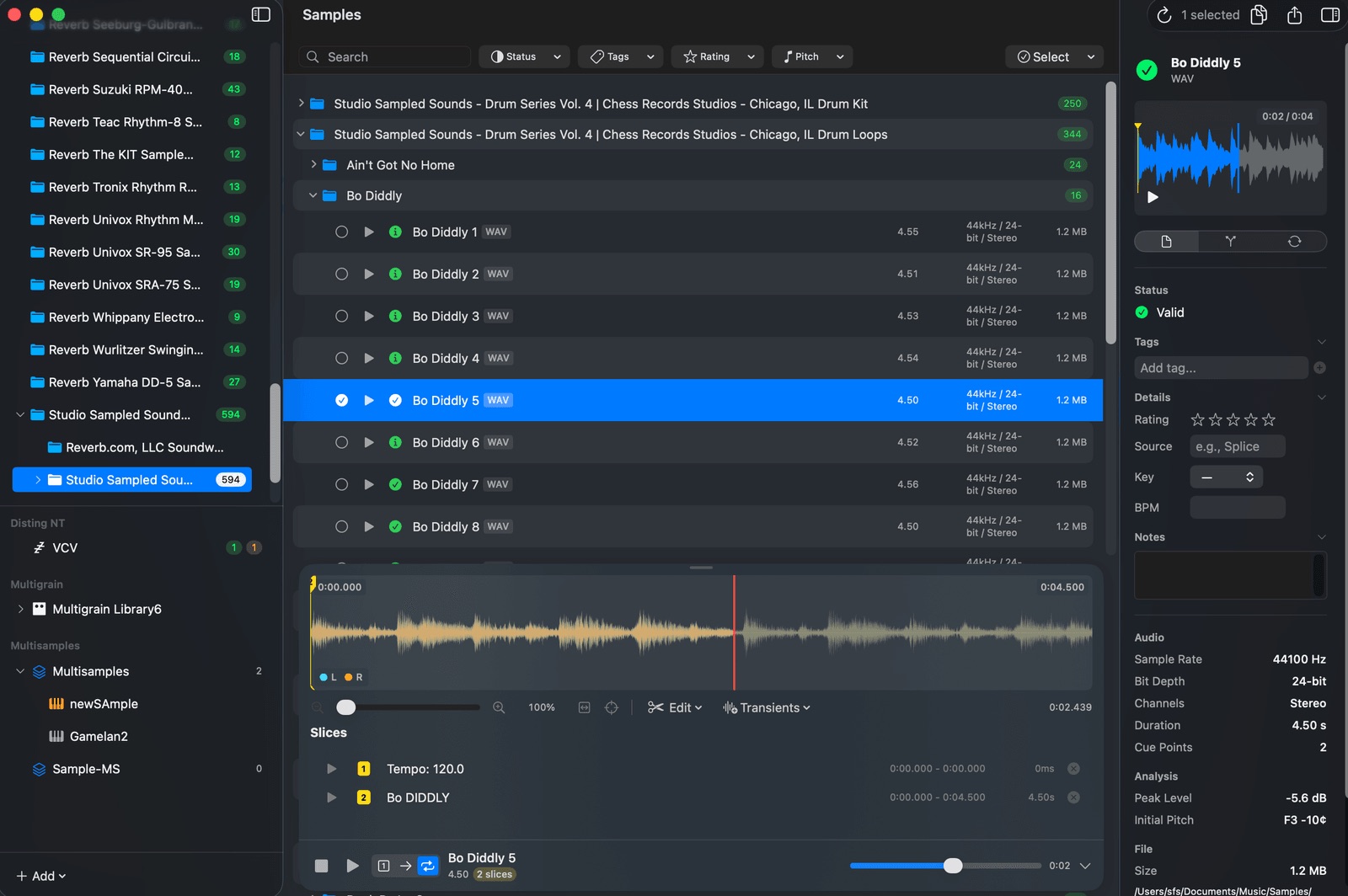
Hardware samplers and the modules that play samples on a modular synthesiser each expect their own folder layouts and file formats. SampleStack, a Mac application from Signal Function Set, organises sample libraries and converts and transfers them for those instruments. Its guides to sample rates and to WAV, AIFF and FLAC cover which files different samplers load. On this site, Play is a VCV Rack module that plays multisampled instruments, and Record records any voice in a rack across a range of notes and velocities to make one. The granular chapter takes the same two recordings apart into short grains.
Common questions
What is a sampler?
A sampler is an instrument that plays recordings back. It can change a recording's playback speed to play it at different pitches, loop part of it so a note can be held, play it backwards, and shape it with filters and envelopes as a synthesiser does.
Why does a sample get shorter when it is pitched up?
On a classic sampler, pitch is changed by changing playback speed. Playing a recording twice as fast raises its pitch by an octave and halves its length, because every cycle of the waveform passes in half the time. Changing pitch without changing length needs time-stretching, which granular instruments can do.
What is multisampling?
Multisampling is recording an instrument at several pitches, and often at several loudnesses, and playing each key from the nearest recording. Each recording is then pitched only a little way from where it was made, so the instrument keeps the character of its source across the keyboard.
What was the first sampler?
The Fairlight CMI, built in Sydney by Peter Vogel and Kim Ryrie, the founders of Fairlight, and released in 1979, was the first widely used digital sampler. Earlier instruments such as the Mellotron played tape recordings, one tape per key.
Related modules and software

Published Updated Glossary