
Introduction to Sound Synthesis Beyond subtractive
Wavetables
A wavetable is a set of single-cycle waveforms stored in order. A wavetable oscillator plays one of them at a time, and moving its position control through the set changes the timbre at the oscillator, without a filter.
A standard oscillator has a few waveforms and switches between them. A wavetable oscillator holds a longer list of waveforms, called frames, arranged so that neighbouring frames are similar, and its position control moves through the list. Sweeping the position with an LFO or an envelope changes the timbre continuously, in ways a filter cannot, because a frame can contain any set of harmonics at any levels.
Wolfgang Palm developed the technique in Germany in the late 1970s, and his company PPG released the PPG Wave in 1981. Waldorf, a German company founded after PPG closed, continued it with the Microwave in 1989, and software synthesisers such as Xfer Records' Serum and the open-source Surge XT made it common. The tool below has three small tables of six frames each. The frames are drawn one behind the other, with the waveform being played drawn in front.
A wavetable oscillator
A 110 Hz tone plays from one of three six-frame wavetables. Position chooses the frame, Blend or Step chooses whether the oscillator crossfades between neighbouring frames or jumps, and Movement sweeps the position automatically.
Listen for Drag the position slowly. In Blend mode the timbre changes smoothly, and in Step mode it changes in jumps at each frame. With Movement set to LFO, the formant table sweeps a peak up and down the spectrum like a slow wah, and the harmonics table sounds like a filter opening and closing, although no filter is involved.
Frames and position
Each frame is one cycle of a waveform, so it has the harmonics of that shape, and the order of the frames sets what happens as the position moves. In the shapes table the frames are a sine, a triangle, a sawtooth, a square and two narrower pulses, so moving the position through it steps through the standard waveforms and then makes the pulse narrower. The harmonics table is a sawtooth built from 1, 2, 4, 8, 16 and then 32 harmonics, so moving through it adds harmonics in the way a lowpass filter opening lets them through. In the formant table every frame has a peak of energy around a different harmonic, and moving the peak gives the sweep a vocal quality, because vowels are distinguished by where the peaks in their spectra, called formants, fall.
Blending and stepping
Between two frames an oscillator can blend, mixing the neighbouring frames in proportion to how close the position is to each, or step, jumping from one to the next. Blending gives a smooth sweep. Stepping gives a sweep in audible stages, as on some early digital instruments, and some current wavetable oscillators still offer it as a mode. In a table with many closely spaced frames, each step is a small change, so stepping sounds nearly as smooth as blending, and wavetables commonly have 64 or 256 frames. WaveStack's interactive guide to how wavetables work goes further into frame size, two-dimensional tables and aliasing.
Making wavetables
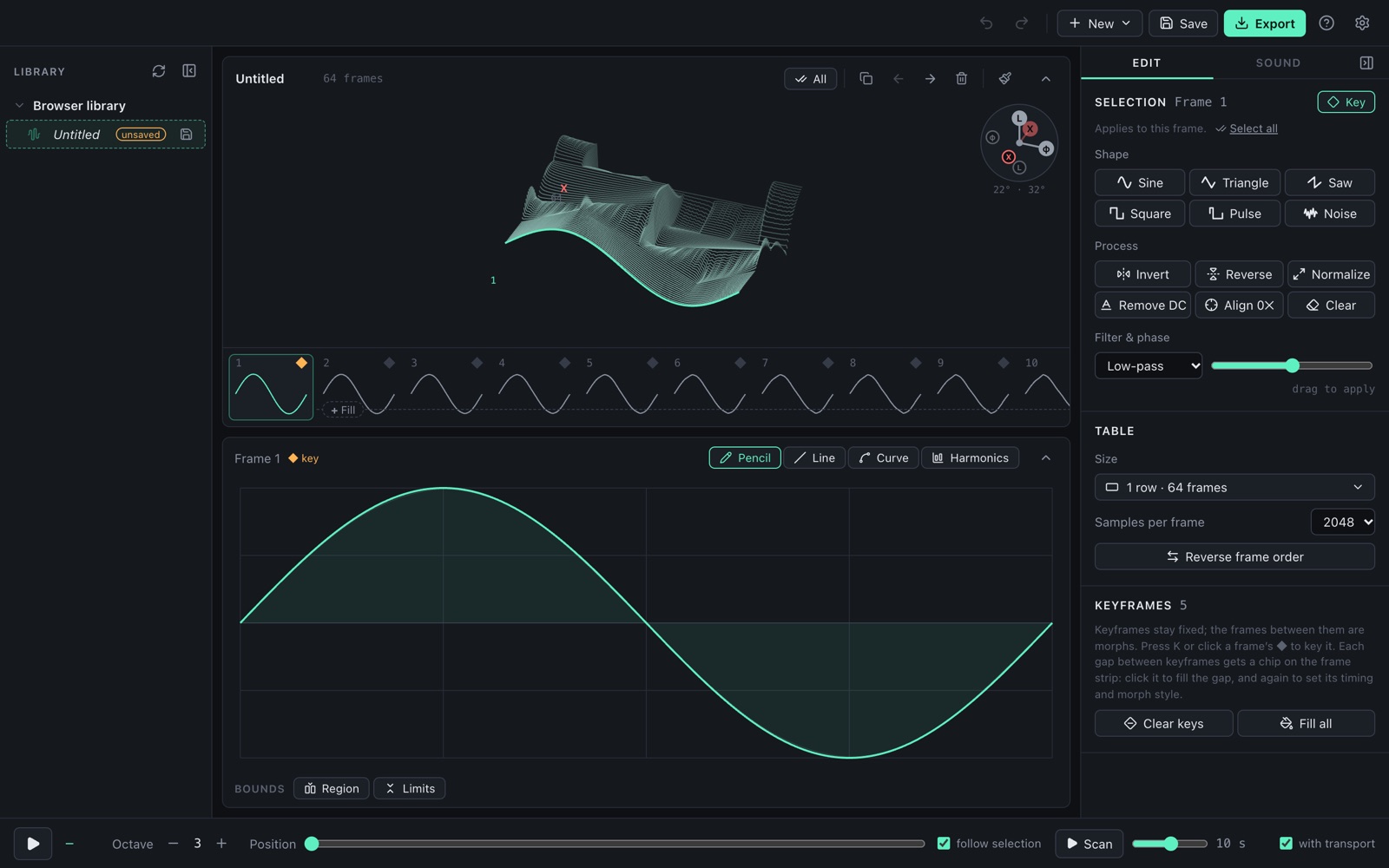
Frames can be drawn by hand, calculated from harmonic levels, cut from a recording one cycle at a time, or generated by sweeping a parameter of another synthesis method and capturing a cycle at each step. WaveStack, a wavetable instrument from Signal Function Set, does all of these and exports tables in the formats that hardware and software wavetable oscillators read. Its guides cover making a wavetable from a recording and the frame size each synthesiser expects.
Common questions
What is a wavetable?
A wavetable is a set of single-cycle waveforms, called frames, stored in order. A wavetable oscillator plays one frame at a time as a repeating waveform, and a position control chooses which frame, or blends two neighbouring ones.
What is the difference between wavetable and subtractive synthesis?
Subtractive synthesis changes a sound's timbre with a filter after the oscillator. Wavetable synthesis changes it at the oscillator, by moving to a different stored waveform. The two are often combined: most wavetable synthesisers also have filters.
Who invented wavetable synthesis?
Wolfgang Palm developed it in Germany in the late 1970s, and his company PPG released the PPG Wave in 1981. Later instruments, including Waldorf's Microwave and software such as Xfer Records' Serum and the open-source Surge XT, use the same idea.
What is a single-cycle waveform?
A single-cycle waveform is a recording or drawing of exactly one cycle of a wave. Played repeatedly at a given rate, it produces a steady tone whose pitch is set by the rate and whose timbre is set by the shape of the cycle.
Related modules and software
Published Updated Glossary