
Introduction to Sound Synthesis Beyond subtractive
Physical modelling
Physical modelling recreates the sound of a string, a tube or a drum head by calculating how the object vibrates. Its controls are the object's physical properties and the way it is played. Making a modelled string stiffer, for example, raises its upper harmonics slightly above whole-number multiples of the lowest, as stiffness does on a real string.
Subtractive, FM and wavetable synthesis specify a sound by its waveform or its spectrum, and a sampler starts from a recording. Physical modelling specifies the object that makes the sound. A model of a string has a length, a stiffness and an amount of damping, and it is plucked at a point along its length. The waveform and the spectrum come out of the calculation, and they change over the life of a note in the way the real object's would, because the calculation follows the same physical rules in simplified form. The tools below use two common approaches: a delay-line model of a plucked string, known as the Karplus-Strong algorithm, and a modal model of a drum head, built from the frequencies at which a circular membrane vibrates.
A plucked string
Each key plucks a string modelled by the Karplus-Strong algorithm, calculated when the key is pressed. The plot shows what is in the string's delay line at three moments after the pluck.
Listen for Each note starts with a bright noisy attack that turns into a clear pitch within a few milliseconds and darkens as it rings. Lower Brightness and the pluck sounds softer, as if plucked with a finger rather than a pick. Move the pluck point towards the end and the tone becomes thinner and more nasal, as it does on a guitar played near the bridge.
A string as a delay line
The computer scientists Kevin Karplus and Alex Strong published their plucked-string algorithm in 1983. A wave travelling along a string reaches the end, reflects and comes back, and the time it takes to make the round trip is one period of the note. The algorithm models that round trip as a delay line one period long. A pluck fills the delay line with a burst of noise, and every sample that comes out of the end is averaged with its neighbour and fed back in. The repetition gives the note its pitch, and the averaging is a gentle lowpass filter applied once per trip, so the high harmonics fade faster than the low ones, as they do on a real string.
Each control corresponds to a physical property of the string or the pluck. Brightness filters the noise burst before it goes into the delay line, which imitates the difference between a pick, which excites more high harmonics, and a fingertip. Damping makes the averaging stronger, so the string loses its high harmonics sooner, as a string muted by the palm does. Sustain sets how much of the signal's level is kept on each trip round the loop. Pluck point removes the harmonics that have a node at that point, as a real pluck does: a string plucked at a quarter of its length has no fourth, eighth or twelfth harmonic. The plot shows the contents of the delay line, which in this model represent the wave travelling along the string, changing from noise into a smooth repeating shape as the note rings.
The engineer Julius O. Smith at Stanford University generalised the idea in the late 1980s as digital waveguide synthesis, with delay lines for each direction of travel and filters for the body and the ends, and set out the method in his 1992 paper on physical modelling with digital waveguides. His online book Physical Audio Signal Processing, published by Stanford's Center for Computer Research in Music and Acoustics, covers the method in detail. Yamaha's VL1 of 1994 used waveguide models of wind and string instruments.
A struck drum head
A circular drum head is modelled as nine modes. Each mode is a decaying sine wave at one of the frequencies a real membrane vibrates at, and the strike point sets how strongly each one starts.
Listen for Struck at the centre the drum sounds round and hollow, because only three of the nine modes are excited. Move the strike point outwards and more modes join in, and the sound becomes brighter, with more inharmonic partials. Raising the damping shortens every mode and shortens the higher ones most.
Modes
A drum head, a bell or a metal bar vibrates in a set of patterns called modes, each at its own frequency, and any strike sets several of them moving at once. For an ideal circular membrane those frequencies follow from the zeros of Bessel functions, and relative to the lowest mode they are 1, 1.59, 2.14, 2.30, 2.65, 2.92 and upwards. None of these is a whole-number multiple of the lowest, which is why a drum has a less definite pitch than a string. Modal synthesis plays one decaying sine wave for each mode, and the model sets how strongly each one starts and how quickly it decays.
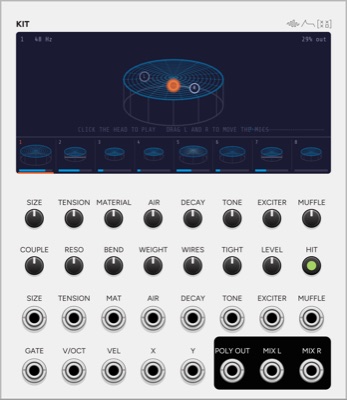
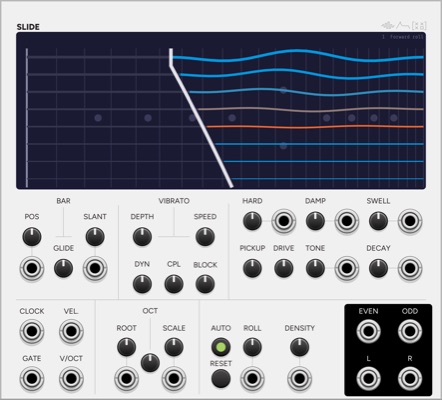
Where the head is struck sets the starting levels. Every mode except the lowest has nodal lines inside the edge, circles or diameters that do not move, and a strike on a node cannot excite that mode. The centre of the head lies on a diameter of every mode that has one, so a centre strike excites only the modes that rise and fall in rings, which in this model are three of the nine. Striking off centre brings in the others. The Kit module on this site models eight instruments mode by mode in the same way, from tom and timpani to gong and tabla.
Common questions
What is physical modelling synthesis?
Physical modelling synthesis is a method that recreates the sound of a physical object, such as a string, a tube or a drum head, by calculating how it vibrates. Its controls are physical properties, such as how hard and where the object is struck, how stiff or damped it is, and how large it is.
How does the Karplus-Strong algorithm work?
A short burst of noise is written into a delay line exactly one period long, and the delay line's output is fed back into its input through a filter that averages neighbouring samples. Each trip round the loop repeats the waveform, which gives a pitch, and smooths it a little, so the high harmonics die away first, as they do on a plucked string.
What is modal synthesis?
Modal synthesis models a vibrating object as a set of modes. Each mode is a sine wave at a fixed frequency that decays at its own rate. Where the object is struck sets how strongly each mode starts. It suits bars, bells, plates and drum heads, whose modes are known or can be measured.
Why does a drum sound different when struck in the centre?
A circular drum head vibrates in many modes, and some of them have a node, a line that does not move, through the centre. A strike at the centre cannot set those modes moving, so it excites fewer modes and sounds rounder and more hollow. A strike nearer the edge excites more of them and sounds brighter.
Related modules
Published Updated Glossary