
Introduction to Sound Synthesis Beyond subtractive
FM
FM synthesis makes sound by changing one oscillator's frequency with another at audio rate. The ratio between the two frequencies sets where the new frequencies fall, and the depth of the modulation, called the index, sets how many of them are strong.
Modulation at audio rate showed that moving a carrier's pitch at audio rate adds sidebands either side of it, spaced by the modulator's frequency. FM synthesis builds an instrument on that effect. It starts with two sine waves and creates new frequencies by modulating one with the other, and it changes the timbre over each note by changing the index with an envelope. Subtractive synthesis instead starts with many harmonics and removes some with a filter.
The first tool below plots the two sine waves in three lanes over the same few milliseconds. The top lane is the modulator. The middle lane is the carrier's frequency, which rises while the modulator is above zero and falls while it is below it, by an amount set by the index. The bottom lane is the carrier's waveform drawn over a plain sine at the carrier's own frequency: its cycles bunch together where the frequency is high and spread apart where it is low. With a ratio of a few hundredths the modulator runs at a few hertz and the movement is heard as vibrato. As the ratio is raised towards 1, the same movement repeats too fast to follow as a change in pitch, and it is heard first as roughness and then as a change in timbre.
One sine wave modulating the frequency of another
A modulator sine wave moves the frequency of a 220 Hz carrier sine wave. The plot draws the modulator, the carrier's frequency over time, and the carrier's waveform against an unmodulated sine, over the same few milliseconds.
Listen for At a ratio of 0.03 the modulator runs at about 7 Hz and the pitch wavers up and down, as vibrato. Past a ratio of about 0.1 the wavering repeats too fast to follow and becomes a roughness in the tone, and from about 0.5 upwards the result is a steady tone whose timbre changes with the index. At index 0 the carrier is a plain sine and its waveform lies on top of the reference.
The composer and researcher John Chowning found the technique at Stanford University in 1967 and published it in 1973 as "The Synthesis of Complex Audio Spectra by Means of Frequency Modulation", in the Journal of the Audio Engineering Society. Stanford licensed it to Yamaha, and the Yamaha DX7, released in 1983, made FM one of the most widely heard kinds of synthesis of that decade. The next tool is the simplest FM voice: a modulator and a carrier, both of which are sine waves, with an envelope on the index and another on the level.
Two-operator FM
A modulator sine wave changes the frequency of a carrier sine wave. The ratio sets the modulator's frequency relative to the carrier, and an envelope moves the index over each note. The spectrum is calculated from the current index and ratio.
Listen for With a ratio of 1 and a decaying index, each note starts bright and becomes rounder, close to an electric piano. A ratio of 1.41 gives a bell. With the Brass preset the index stays high while the key is held, so the tone stays bright for the whole note. At index 0 the result is a plain sine, whatever the ratio.
Ratio
The modulator's frequency is set as a ratio of the carrier's, so the relationship holds across the keyboard. The sidebands fall at the carrier's frequency plus and minus whole multiples of the modulator's. When the ratio is a whole number, every sideband lands on a harmonic of the carrier, and the result has a clear pitch. A ratio of 1 gives every harmonic, as in a sawtooth, and a ratio of 2 gives only the odd harmonics, as in a square wave, although the levels of the harmonics differ from those waveforms and change with the index. When the ratio is not a simple fraction, such as 1.41 or 3.14, the sidebands fall between the harmonics, and the result is inharmonic and bell-like.
Index
The index is the frequency deviation, which is how far the carrier's frequency moves either side of its centre, divided by the modulator's frequency. At index 0 there is no modulation and the carrier is a plain sine. As the index rises, energy moves from the carrier into the sidebands, and further sidebands appear. The amount in each one follows a set of curves called Bessel functions, which is why the spectrum does not simply grow brighter: some sidebands rise, fall back and rise again as the index increases, and the carrier itself drops to silence near an index of 2.4. The spectrum in the tool above is calculated from those functions for the index the envelope has reached.
An envelope on the index changes the brightness over each note, as a filter envelope does in a subtractive voice, but without a filter. A fast decay from a high index gives a bright attack that settles, which suits electric pianos and bells. A slow rise gives a swell into brightness, which suits brass.
Operators and algorithms
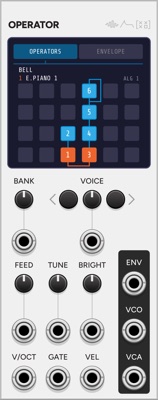
In an FM synthesiser each sine oscillator, with its own envelope, is called an operator. The DX7 has six operators per voice and 32 algorithms, which are fixed arrangements of which operators modulate which and which are heard. A modulator can itself be modulated, several modulators can feed one carrier, and one operator can modulate itself through feedback. Many synthesisers since have used the same technique, sometimes under the name phase modulation, which moves the oscillator's phase instead of its frequency and gives the same spectrum for a steady index. The DX7 itself works by phase modulation.
Common questions
What is FM synthesis?
FM synthesis is a method of making sound in which one oscillator, the modulator, changes the frequency of another, the carrier, at audio rate. The modulation adds sidebands to the carrier's spectrum. The ratio between the two frequencies sets where the sidebands fall, and the depth of the modulation, called the index, sets how strong they are.
Who invented FM synthesis?
The composer and researcher John Chowning, at Stanford University, found in 1967 that frequency modulation at audio rates could produce a wide range of timbres with very little computation. He published the technique in 1973, Stanford licensed it to Yamaha, and Yamaha's DX7 of 1983 made it widely used.
What is an operator in FM synthesis?
An operator is an oscillator with its own envelope, which can act as a carrier, heard at the output, or as a modulator of another operator. The Yamaha DX7 has six operators per voice, and an algorithm sets which ones modulate which.
Why do FM synthesisers sound bell-like?
When the ratio between the modulator and carrier frequencies is not a whole number or a simple fraction, the sidebands do not fall on a harmonic series, and the result has the inharmonic spectrum of a bell or a metal bar. With an index that decays over the note, the sound starts bright and settles, as a struck bell does.
Related modules
Published Updated Glossary