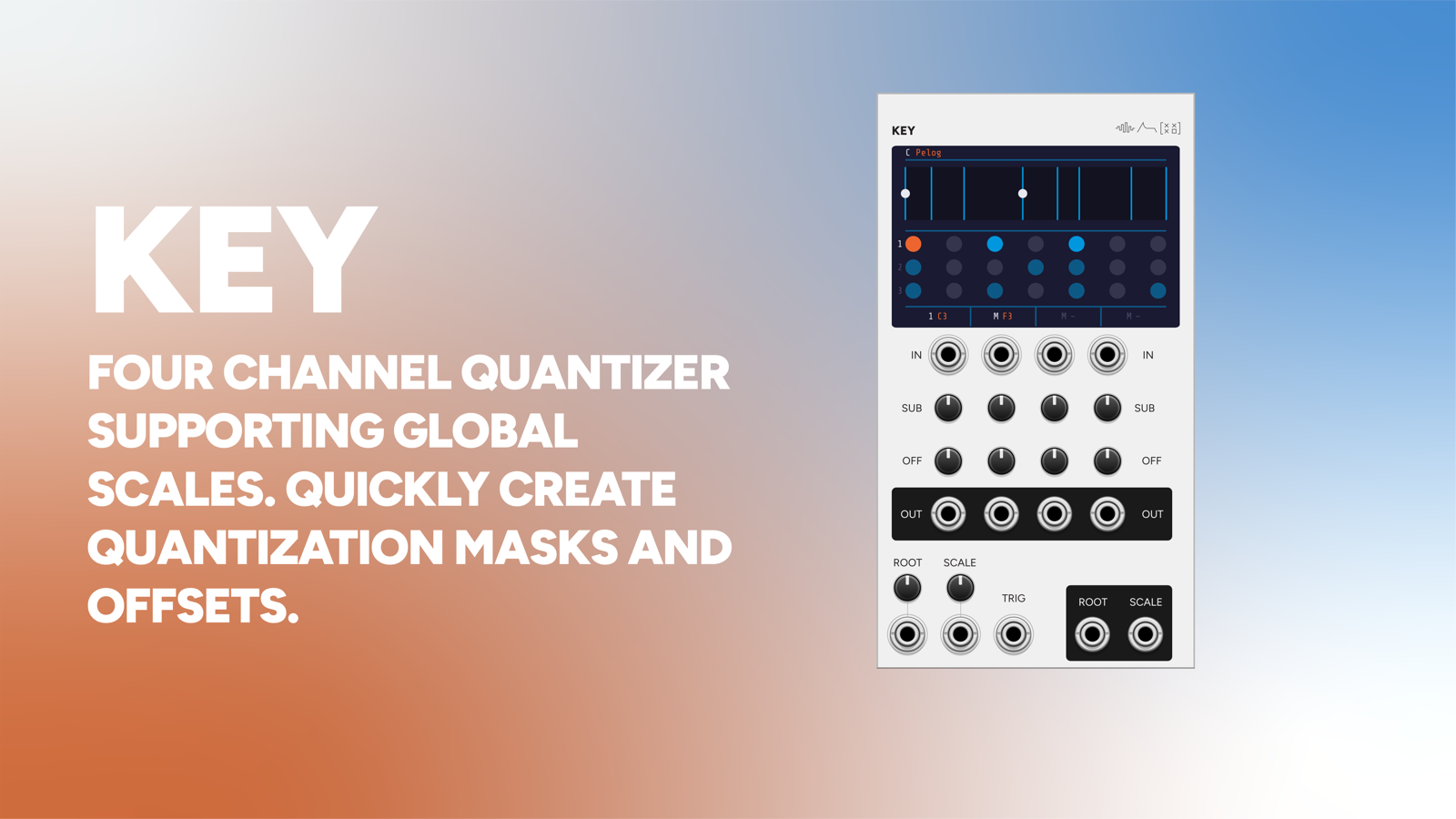
Most quantizers make you set a scale by hand and then keep it in step with everything else yourself. Key instead reads ROOT (1V/oct, semitone-quantized) and SCALE (1V per scale) in the plugin’s own convention, so Arrange, Note, Chance, Muse, Fugue, Chime, Loom and Slide all follow one key change, and Key hands the same key back out of its own ROOT and SCALE outputs. Four channels, each polyphonic to 16 voices. 14 HP.
Rebuilt in 2.20. Each channel is now a scale in its own right, every channel has its own polyphonic TRIG, the inputs normal left to right, and Scala scales run to 256 degrees. The panel is new. See what’s new in 2.20.
Each channel is a scale
Four channels side by side. MAIN quantizes to the full scale, SUB 1, SUB 2 and SUB 3 to the three sub-scales. There is nothing to select: the column you patch into is the scale you get.
A sub-scale is a mask over the parent scale’s degree indices, not over absolute pitches, so {1st, 3rd, 5th} is a triad in any key: C E G in Major, C D♯ G in Minor. The selection survives a change of scale and a change of root, because what you picked was a role in the key. An empty sub-scale falls back to the parent rather than going silent.
A menu option lets a sub-scale leave the key, so it can carry an accidental that transposes with ROOT and stays put when SCALE changes.
The inputs normal left to right
One cable in IN 1 feeds all four channels, and a new cable anywhere breaks the chain from that point. A cable in IN 3 gives channels 3 and 4 the new source while 1 and 2 keep the first.
TRIG works the same way. One pitch and one clock into channel 1 gives four channels sampling the same line at the same moment, with four sub-scales and four offsets between them.
A trigger per channel
Each channel has its own TRIG, and it is polyphonic. Trigger channel N resamples voice N of that channel, so a poly CV and a poly trigger give every voice its own timing. A mono trigger resamples every voice. A trigger cable with fewer channels than the CV repeats its last channel rather than leaving the extra voices frozen.
Microtonal and Scala
Key works in real pitch, not a 12-bit mask, so Harmonic series, Pelog and Slendro keep their fractional intervals. Scala (.scl) files load from the menu at SCALE index 19, leaving 0 to 18 as the canonical list so cross-module SCALE CV is unaffected. The period need not be an octave, so Bohlen-Pierce and other non-octave scales work, and the parsed scale saves into the patch.
A sub-scale mask covers up to 256 degrees, which is enough for a 53-note Fokker block or a 79-note MOS of 159-tET. The cap was 24, then 64, and each time a real file hit it the top of the octave fell out of every sub-scale without saying so.
The keyboard shows when the scale lands on twelve semitones. Otherwise Key draws a region strip that is linear in pitch, so the gaps between the degree lines are the snap regions. On the strip, the sub-scale cells sit at the same pitch-linear position as the degree lines above them, and the footer names a note by its degree and repeat, written 31 (5), rather than by the nearest 12-tone name.
The scale bus
SCALE OUT is polyphonic: the index on channel 0, the period on channel 1, the degrees behind them. A consumer that reads only channel 0 sees the plain 1V-per-scale index and costs nothing.
Fourteen degrees is the maximum that travels, being sixteen channels less the index and the period. A larger Scala scale still quantizes in full on Key’s own outputs, and the context menu says how many degrees will not travel.
Inputs and outputs
- Controls: Root, Scale, and per channel Offset.
- Inputs: Root, Scale, and per channel In and Trig, both polyphonic.
- Outputs: per channel Out (poly), plus Root and Scale.
OFFSET moves in scale degrees by default, so +2 goes two steps up the scale and stays in key, with semitones as a menu option.
Pair with
-
 Arrange
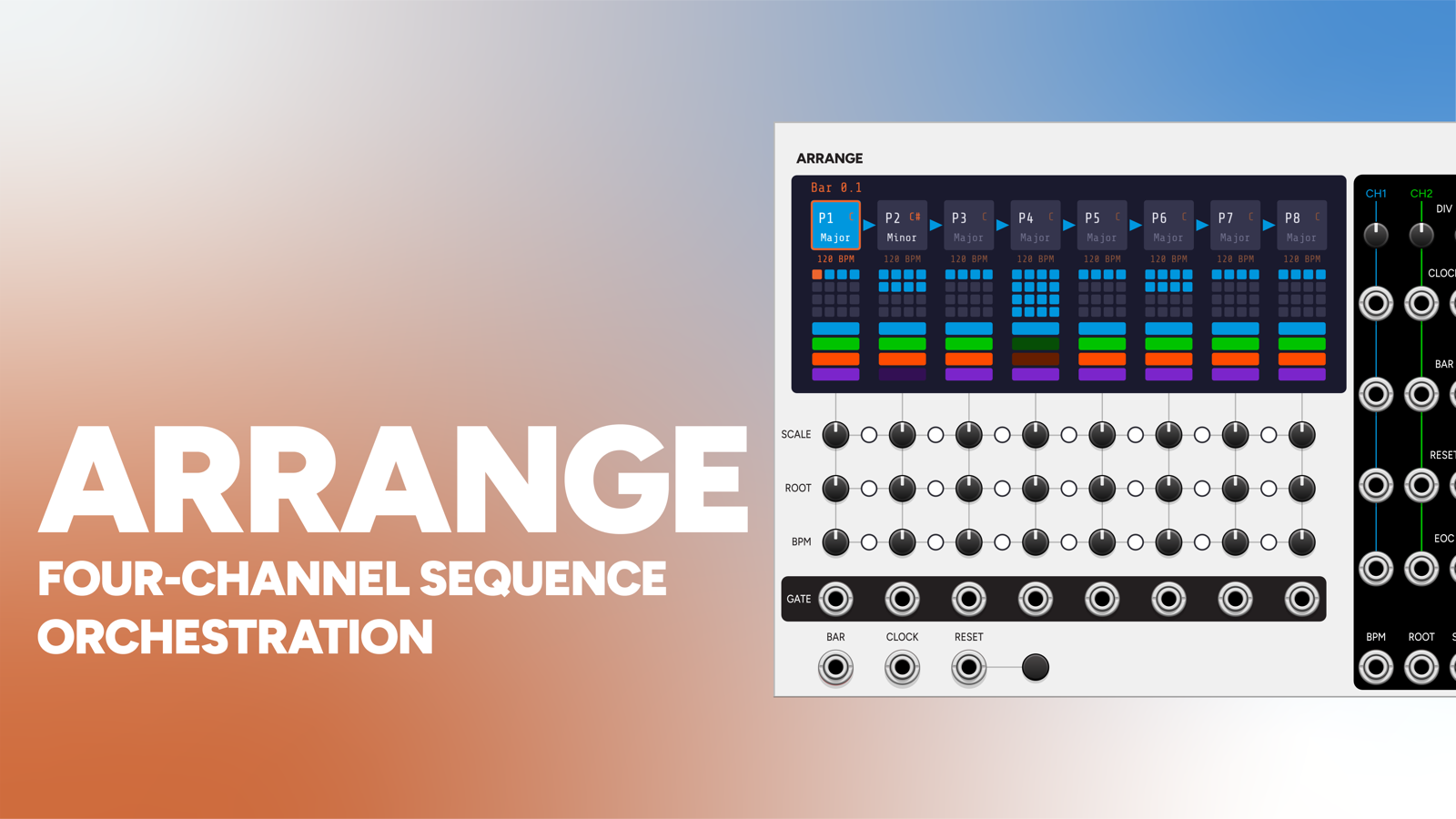
Arrange sets the song's key per phrase. Patch its ROOT and SCALE into Key and every quantized voice in the patch changes key with the arrangement.
-
 Note
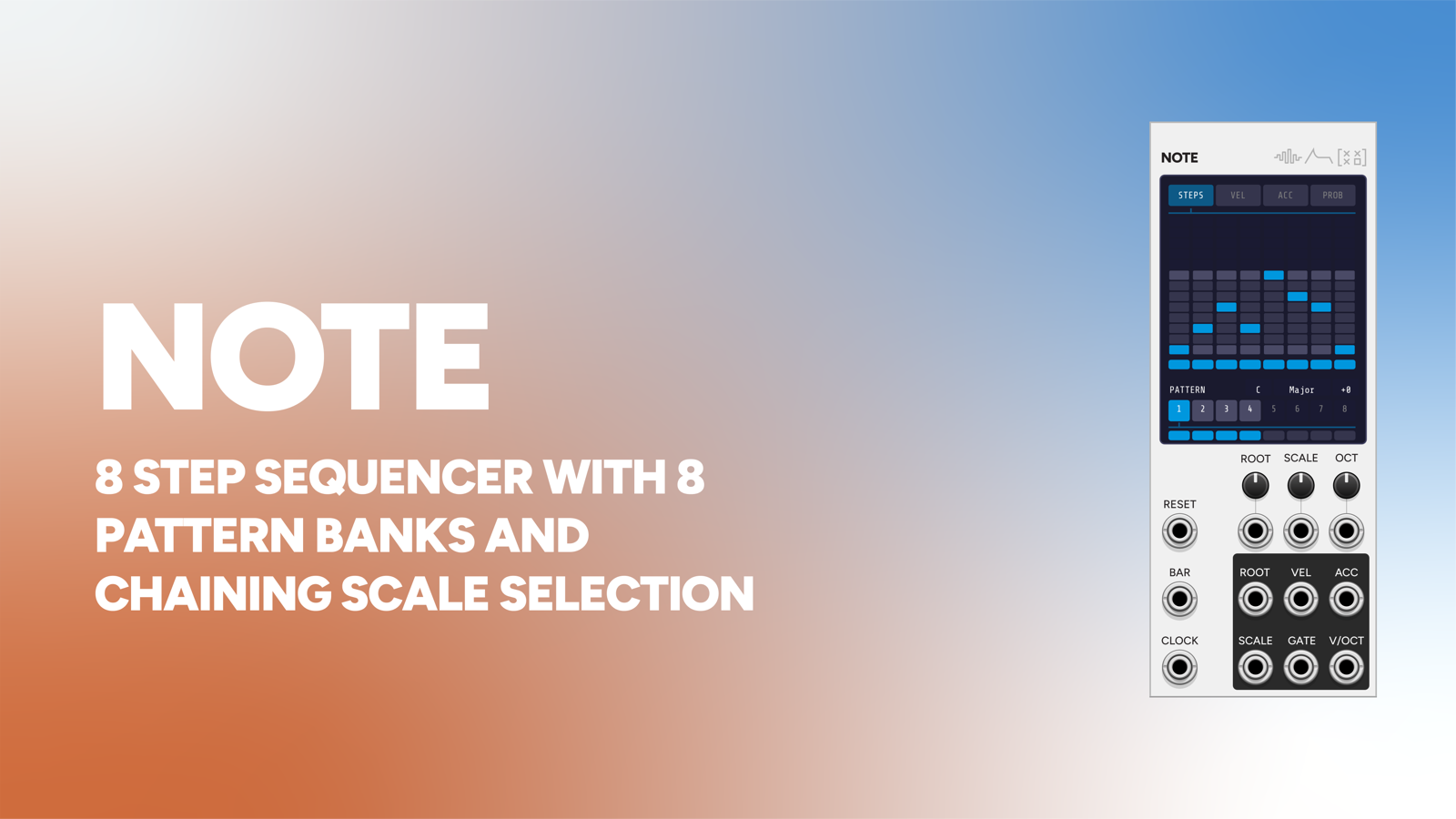
NoteNote, Chance, Fugue, Muse, Chime, Loom, and Slide all read the same Root and Scale convention Key speaks, so one source of key drives the whole rig.
-
 Chance
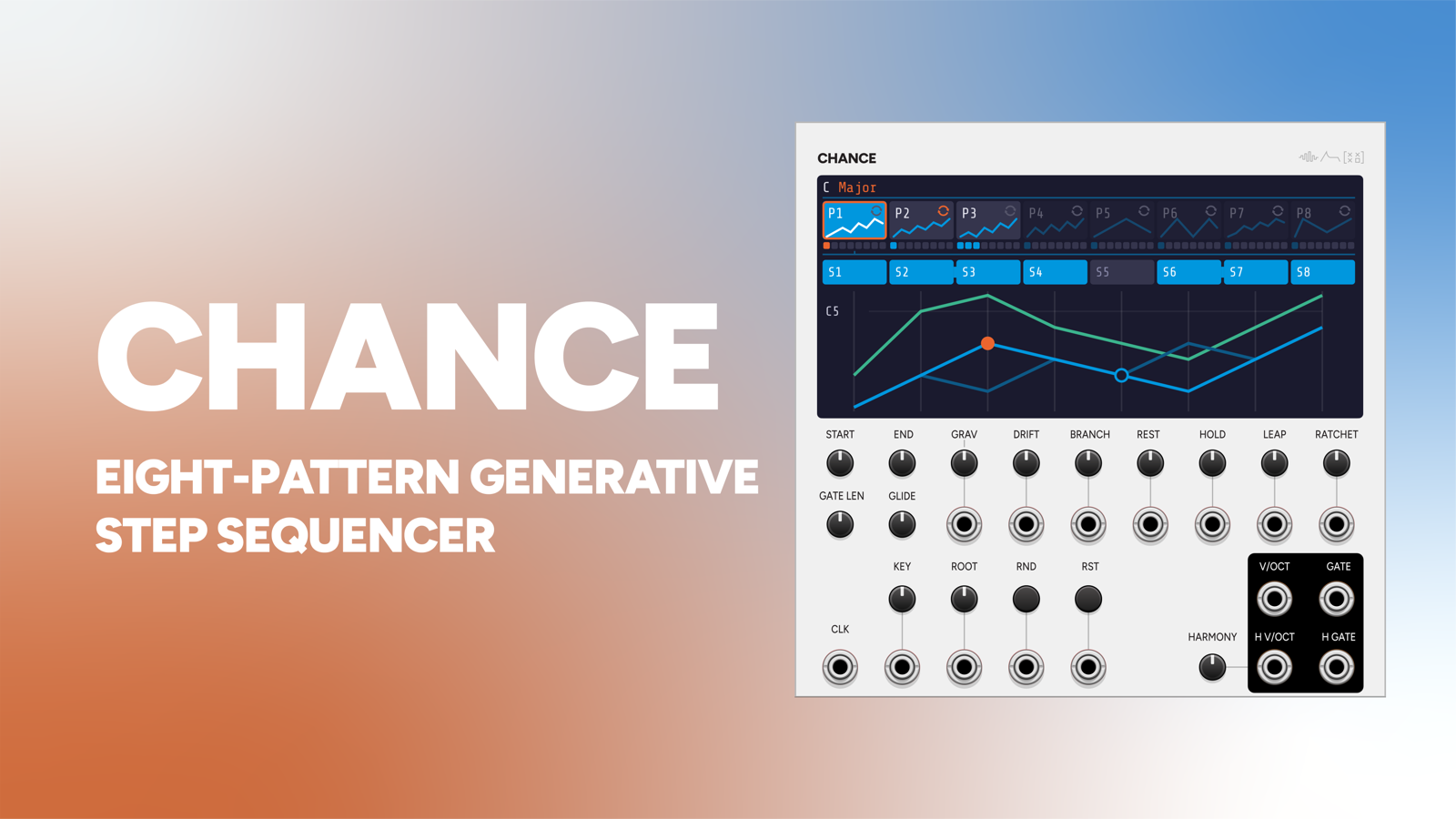
Quantize Chance's generative line through Key so its melody and the rest of the patch always share a key.