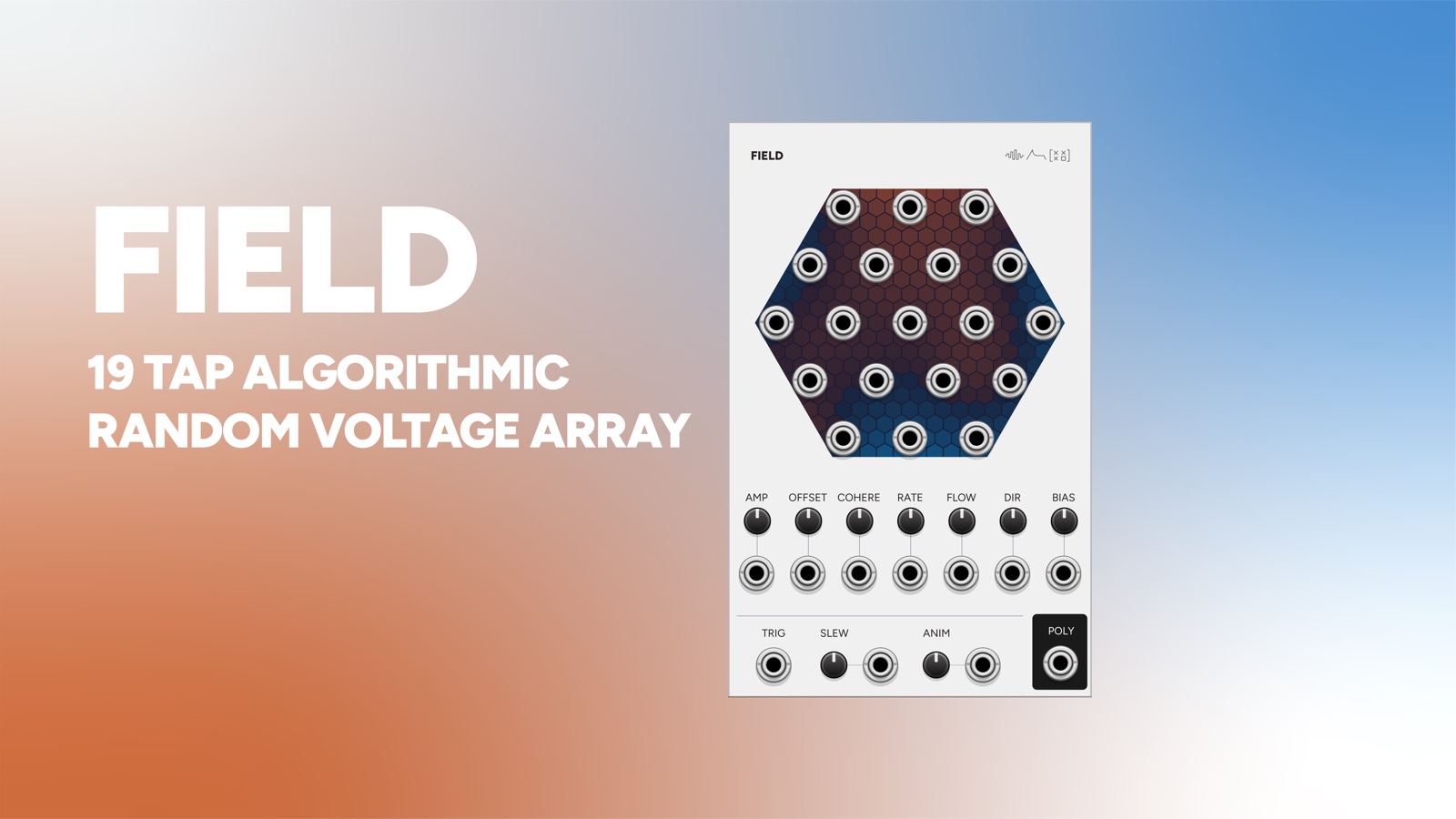
Field is nineteen random voltages that are one thing.
The jacks sit on a hexagonal grid, one at the centre, a ring of six and a ring of twelve. Under the grid is one smooth random field, a surface in x, y and time, and each jack reads that surface at its own position. Neighbours agree because they sample nearby points of the same surface, and how nearby is what COHERENCE means.
16 HP.
The jacks are the display
There is no screen. The plate behind the jacks is tiled with hexagonal cells, coloured by the field from the same functions the outputs read. What you see under a jack is what comes out of it.
Controls
Each has a trimpot and a CV input beneath it, where plus or minus 5V covers the whole knob.
| Control | What it does |
|---|---|
| AMP | Output range, 0 to 10V peak. The field is bipolar, so 5V swings between -5V and +5V. |
| OFFSET | Shifts every output, -5V to +5V. |
| COHER | How far across the grid the field agrees with itself. |
| RATE | How fast the field changes, 0.002 Hz to 20 Hz. |
| FLOW | Moves the field across the grid, 0 to 4 jacks per second. |
| DIR | Which way, 0 to 360 degrees. |
| BIAS | Tilts amplitude by radius. Centre hot and rim quiet, or the reverse. |
| SLEW | Slews every output, 0 to 2 s. |
| ANIM | Picks the animation. The CV adds one mode per volt. |
COHERENCE is the control to understand. At zero, neighbouring jacks are unrelated and Field is nineteen sample-and-holds. Turn it up and the grid becomes weather: a pattern spans several jacks and, with FLOW and DIR, travels across the plate, so the jacks fire in a spatial order.
Eleven animations
FLOW is always the speed and DIR always the direction. What they move depends on the animation.
Flow slides the window across the field. Zoom scales it, radiating outward at DIR 0 and inward at 180. Spin rotates it. Random gives each jack its own window, so they drift independently.
The rest are systems running on the tiling itself:
- Life, a cellular automaton on the hexagonal grid, stepping on RATE, with a trickle of random births so it never freezes.
- Rain and Wave, one damped wave equation driven two ways: drops that dent the surface and ring outward, or crests launched from the edge facing DIR.
- React, Gray-Scott reaction-diffusion. COHERENCE walks from spots to stripes to worms.
- Cyclic, the rock-paper-scissors automaton, which winds itself into spirals.
- Sand, the Bak-Tang-Wiesenfeld sandpile, with avalanches of every size.
- Worley, drifting seed points read as distance to the nearest, so the plate is a moving mosaic.
Inputs and outputs
Inputs: CV for every control, and TRIG.
Outputs: nineteen jacks, plus POLY carrying jacks 1 to 16 on one cable, numbered from the centre outward.
With nothing in TRIG the outputs follow the field continuously. Patch a trigger and every jack holds until the next one. A polyphonic TRIG holds jack N from channel N, so each output can be clocked on its own.
Context menu
Colour, the palette the plate is drawn in. Seven two-colour pairs and Rainbow. It changes nothing about the outputs.
Patch ideas
A kit that breathes. Nineteen slow modulations into a drum kit’s per-instrument CVs, COHER high and FLOW low, so the whole kit leans one way and then the other.
Spatial sequencing. FLOW up, DIR set, TRIG from a clock. The held values sweep across the grid in order, so jacks patched to a row of voices fire as a wave.
Weather on one voice. Rain into cutoff, resonance and level from three neighbouring jacks. Each drop hits all three, a little apart in time.
Pair with
-
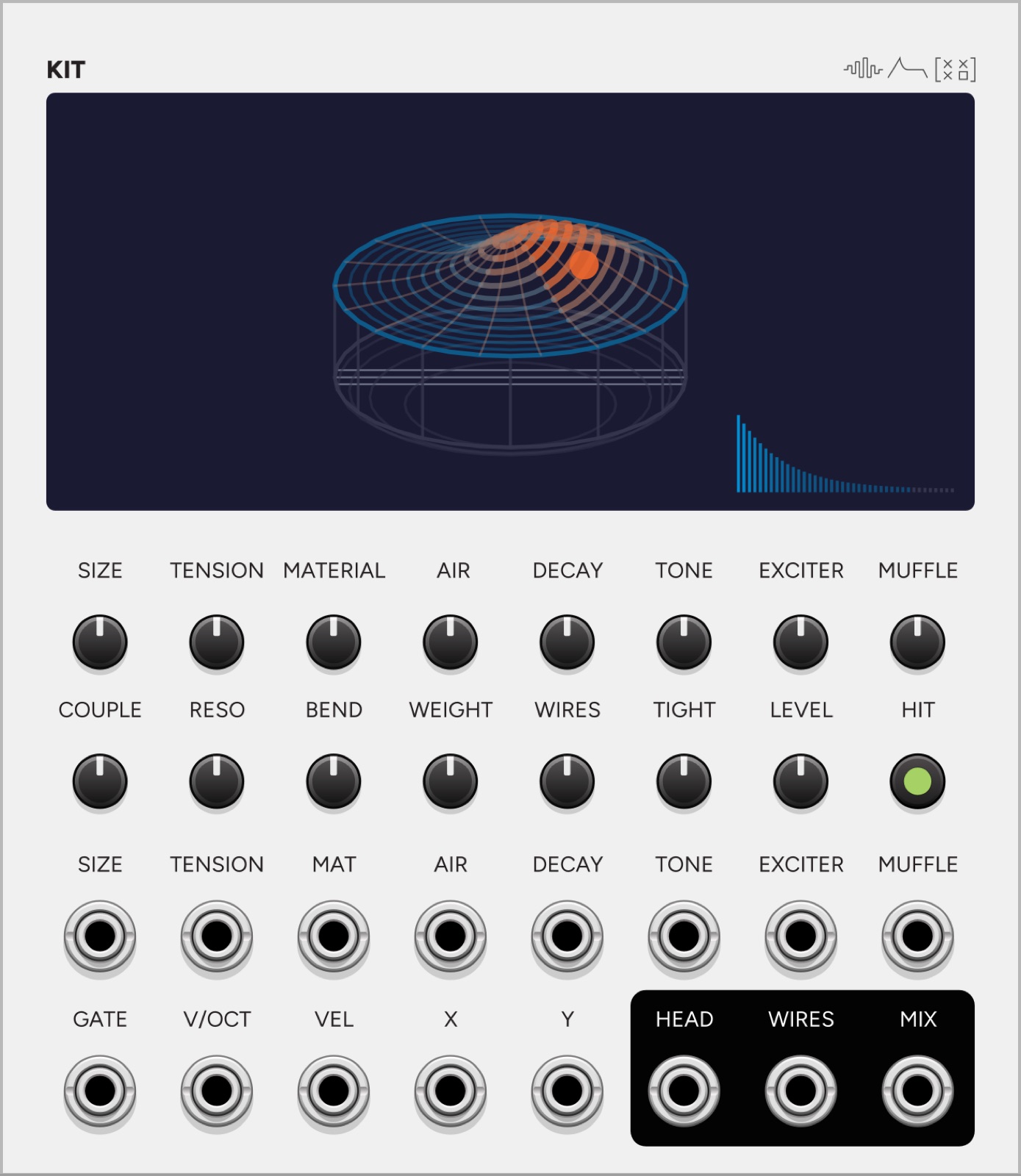 Kit
KitNineteen slow related modulations into Kit's per-instrument CVs, so the whole kit leans one way and then the other.
-
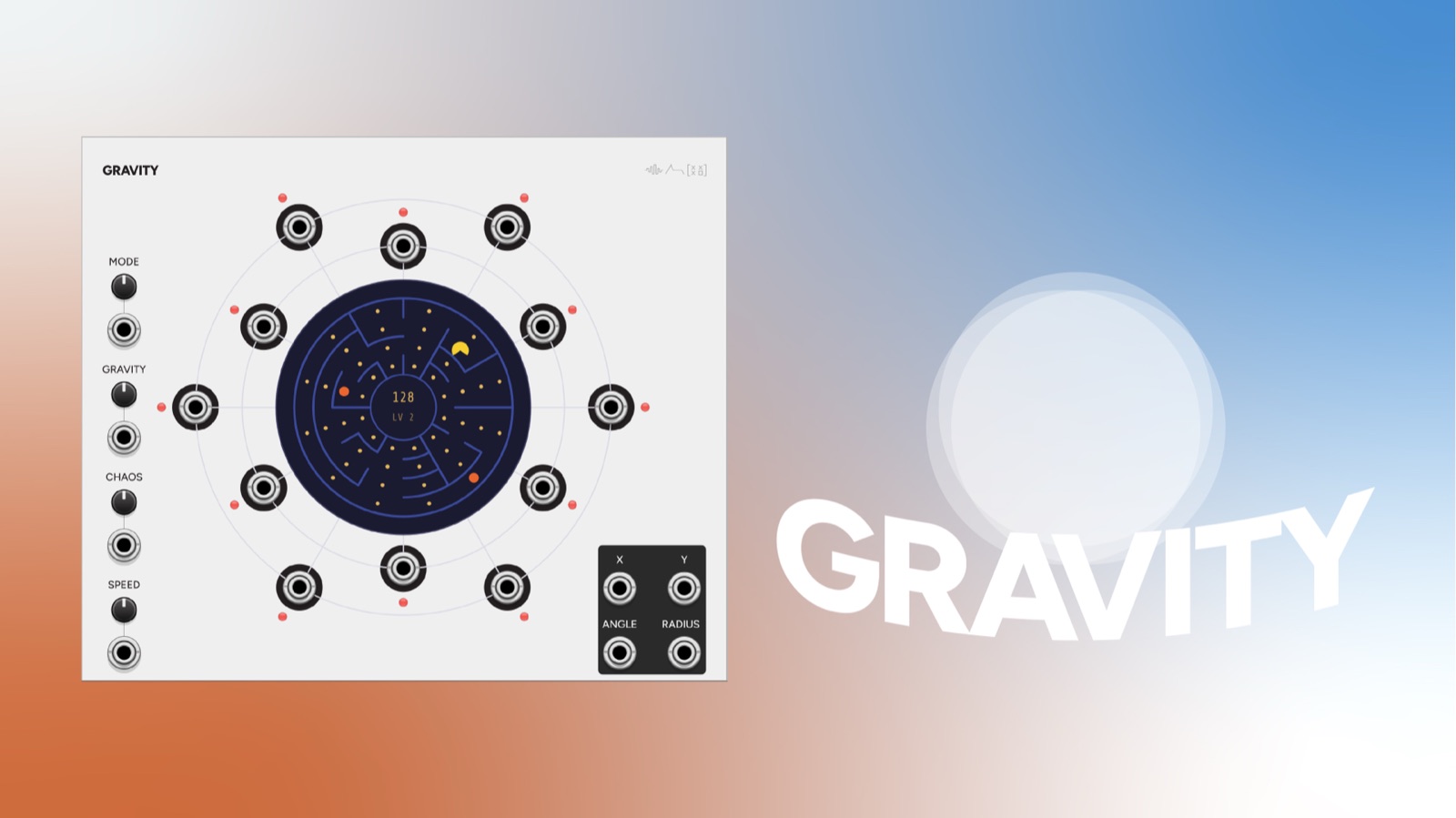 Gravity
Two takes on structured randomness. Gravity has bodies with momentum, Field has a surface sampled in nineteen places.
-
 Meter
MeterMeter's subdivisions into TRIG turn Field into a bank of sample-and-holds on the patch's grid.