
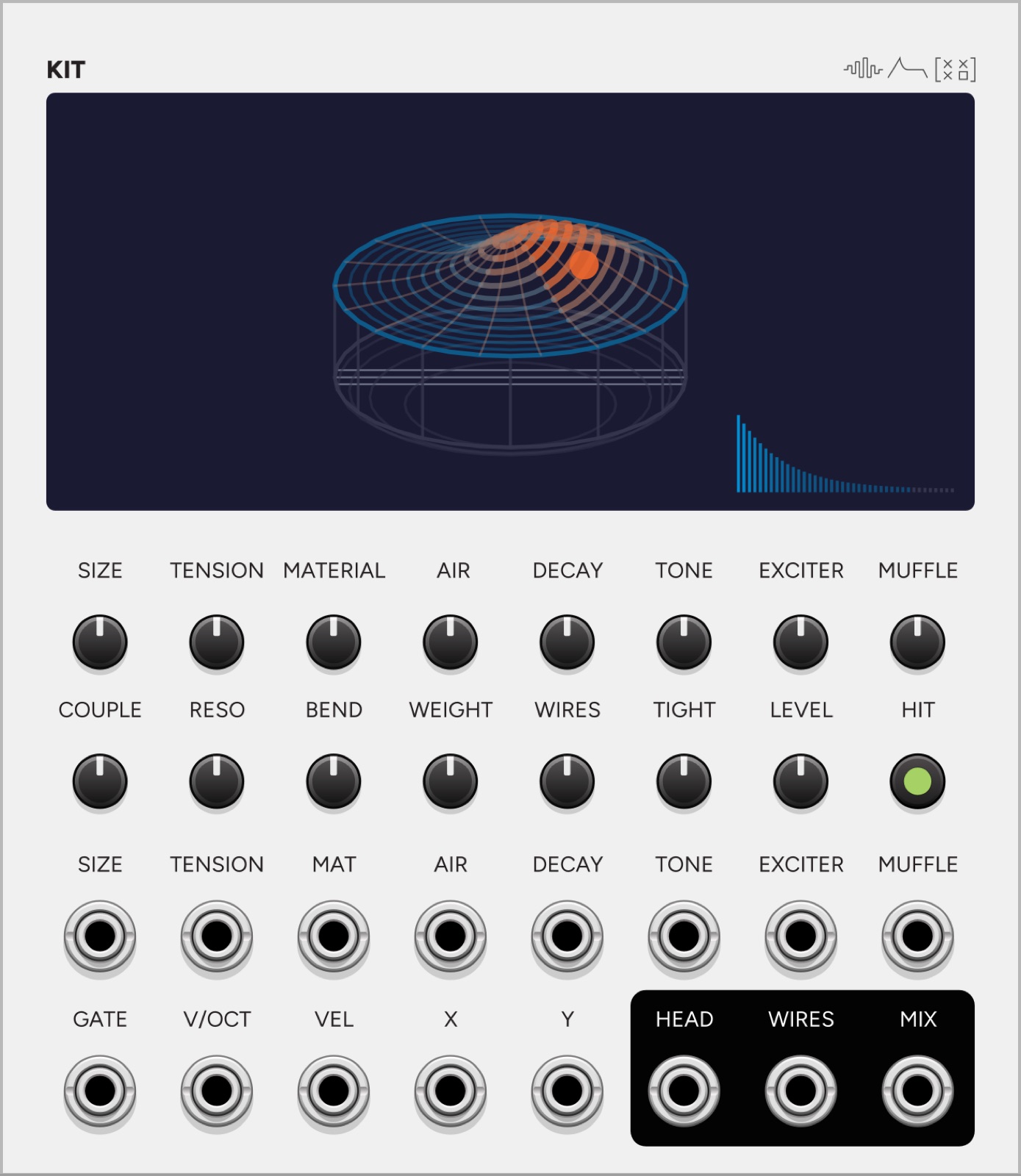
Kit is a struck membrane, modelled mode by mode.
A drum head is a 2D wave equation on a disc, and its solutions are the Bessel modes. Rather than run a mesh over the disc, Kit runs one resonator per mode. That is cheaper, and it puts every parameter you would want to play in plain sight: strike position becomes a per-mode gain you can evaluate in closed form, and muffling becomes the same evaluation used subtractively.
22 HP.
Rebuilt in 2.20. Kit now holds eight instruments on one panel instead of one, with a poly out, a new default kit and the PolyKit In expander. Patches saved before this load as instrument 1 and sound as they did. See what’s new in 2.20.
Eight instruments, one panel
The screen has a row of eight tabs along its foot, one per instrument, each a small drawing of that drum which moves when it is struck. Click a tab and the panel’s knobs show that instrument. Turn a knob and only that instrument changes. A level bar under each tab shows what each drum just did, on one baseline, so the balance of the kit is visible at a glance.
Channel N is instrument N. A polyphonic GATE fires instrument N from channel N, and a mono gate fires instrument 1 only. VEL, V/OCT, X, Y and the eight CV inputs read channel N for instrument N, so a mono cable modulates all eight.
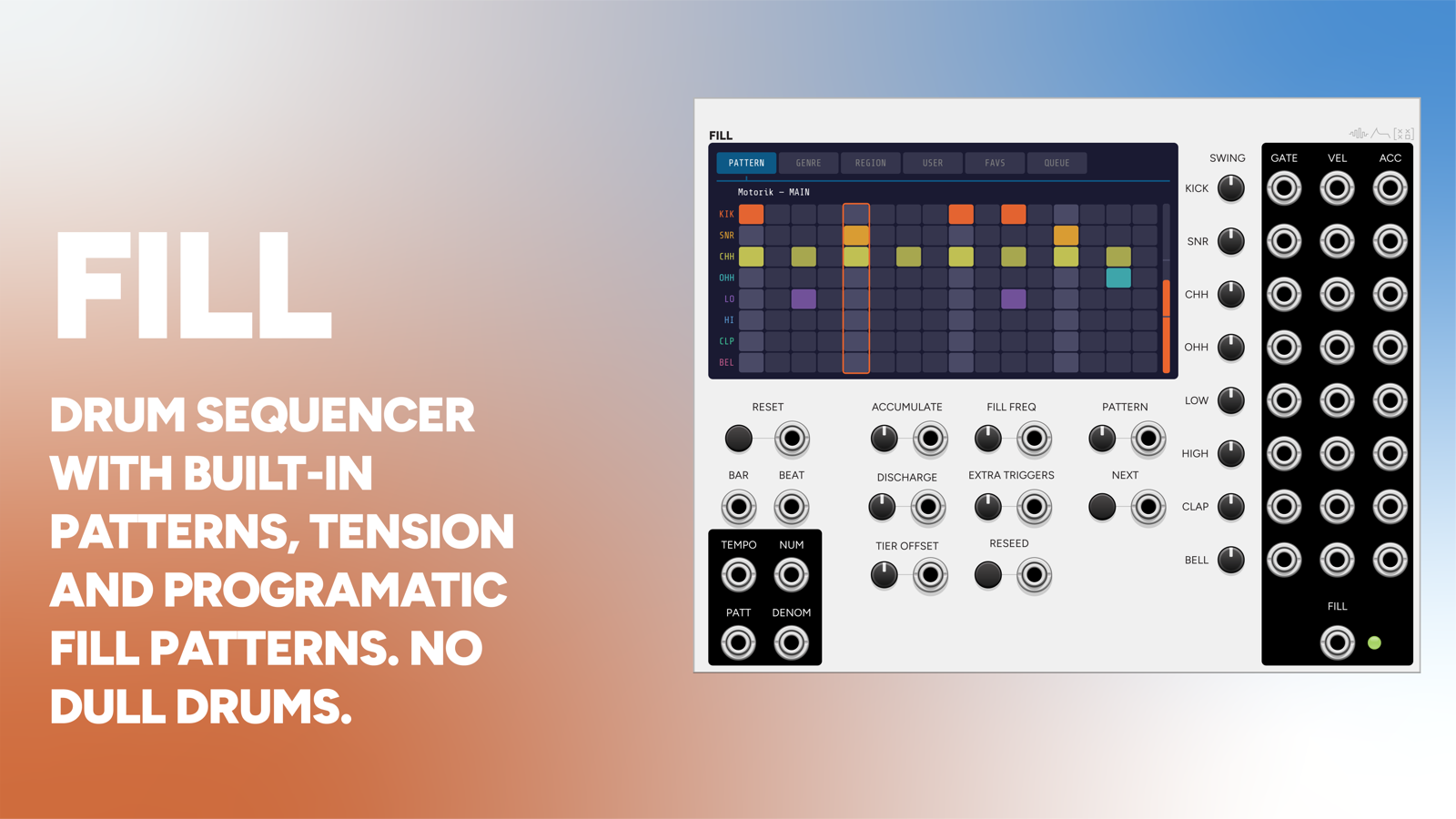
A new Kit comes loaded with Fill’s eight channels in Fill’s order: Kick, Snare, Closed hat, Open hat, Low tom, High tom, Clap, Bell. A poly cable from Fill plays the right drum on every channel with nothing to map.
A drum that is not ringing costs nothing, so the cost of the module follows how many drums are sounding rather than how many are loaded.
Striking a drum that is still ringing
A new trigger neither stops the old hit nor starts a second voice. It is one drum, and the mallet lands on a head that is still moving. The strike re-arms the mallet and re-latches the mic delays, and never clears the mode bank, so the new hit’s energy adds to whatever is still ringing. A fast roll on a ringing tom sounds different from the first hit, and two hits close together can sum louder than one.
That is per instrument. Hitting instrument 3 does nothing to instrument 2’s ring. There are no choke groups yet.
The one thing to know about the controls
For an ideal membrane, radius and tension scale every mode by the same factor and leave the ratios untouched. Acoustically, SIZE and TENSION are therefore the same control, and shipping both as separate knobs would be shipping a duplicate.
What breaks that scale invariance is bending stiffness, the air cavity, and damping that depends on size. That is why MATERIAL and AIR exist, and it is why SIZE is allowed to sit alongside TENSION. A small tight drum and a large slack one at the same pitch are different instruments, and those three controls are where the difference lives.
AIR closes the bottom of the shell. At zero it is an open shell with a resonant head across it, which is a tom or a kick. Wound up it bellies into a sealed bowl, which is a kettledrum.
Controls
The panel is eight columns by four rows. Every control is a trimpot, on one pitch. Tooltips report quantities, not percentages: a drum has a diameter, a beater has a weight and a contact time.
What the drum is
| Control | Range | What it does |
|---|---|---|
| SIZE | 6 to 22 inches | Reads inches and centimetres. |
| TENSION | ±8.4 semitones | Head tension, read as a pitch offset. |
| MATERIAL | drum head to gong | Bending stiffness. Pushes the modes from a membrane’s inharmonic ratios toward a plate’s. |
| AIR | open shell to sealed kettle | Closes the bottom of the shell. |
| DECAY | 80 ms to 7 s | Scaled by SIZE as well, and the tooltip says so. |
| TONE | How much faster the high modes die than the low ones. | |
| EXCITER | soft felt to hard stick | Reads as a beater name and a contact time. |
| MUFFLE | 0 to 100% | A hand on the head. Subtracts the modes that are live at that spot. |
How it is played and dressed
COUPLE (batter head into resonant head), RESO (resonant head tuning), BEND (pitch drop after the hit), WEIGHT (beater mass, 10 to 70 g), WIRES, TIGHT (wire tightness), LEVEL, and HIT, a momentary strike.
The third row is CV: one jack per control in the row above, directly underneath.
Inputs
All polyphonic, channel N for instrument N.
GATE strikes on a rising edge. V/OCT is 1V per octave. VEL is 0 to 10V. X and Y are strike position, ±5V, summed with the panel’s strike position.
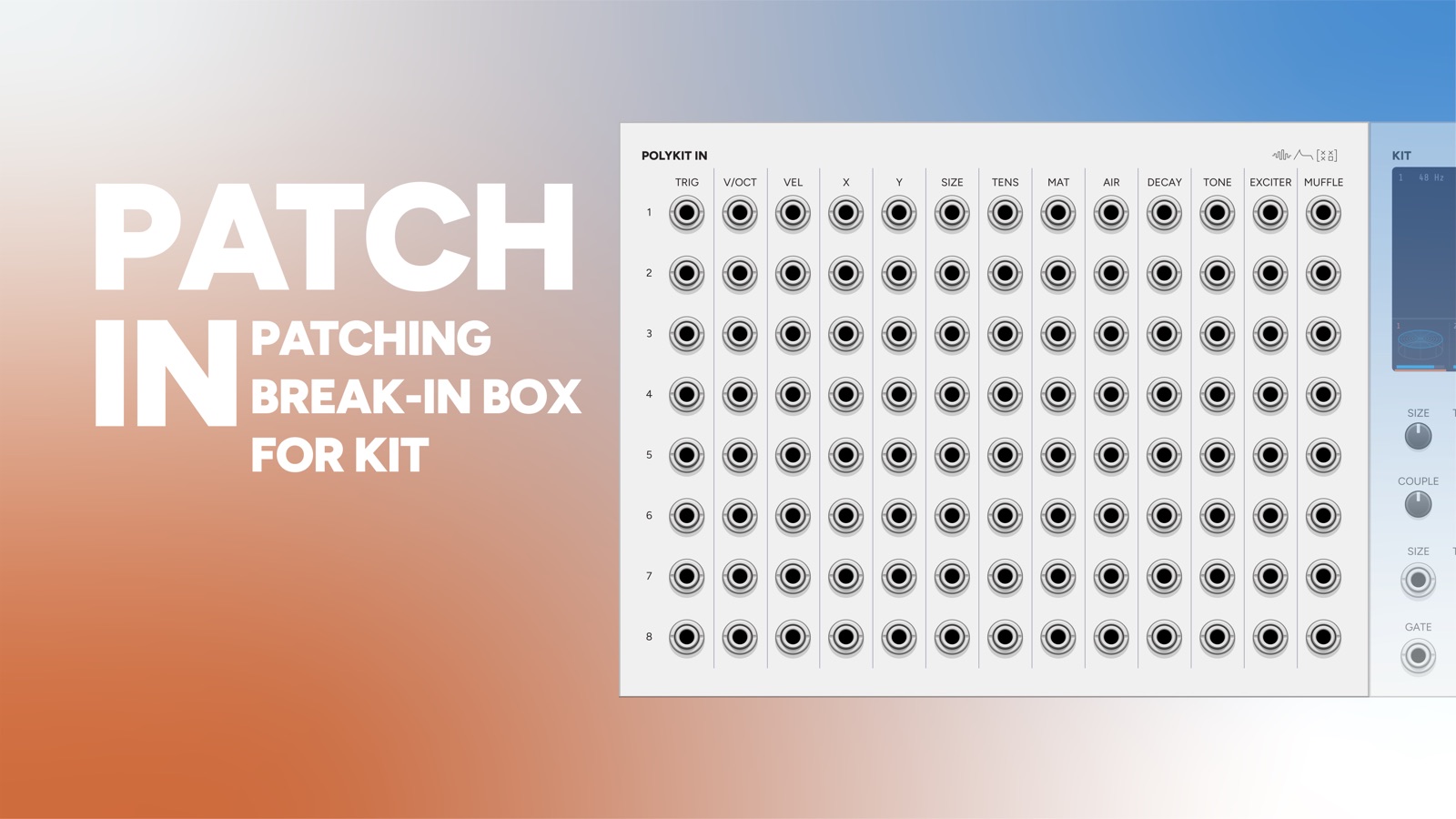
If your sources are eight modules rather than one poly cable, PolyKit In goes immediately to Kit’s left and gives every input of every instrument its own jack.
Outputs
| Output | What it does |
|---|---|
| POLY | Sixteen channels: instrument N on channels 2N-1 (left) and 2N (right). |
| MIX L, MIX R | All eight summed, in stereo. |
Head and wires are summed per instrument. Eight instruments in stereo is exactly sixteen channels, which is all a cable holds, so the wires no longer have a jack of their own. A snare that wants its own compressor takes its own pair off the poly out.
The display
The head is drawn as it moves. Rings and spokes trace the modal displacement, excited areas warm toward orange, and the strike mark sits where X and Y put it. Click or drag on the head to strike it, and the position you click becomes the strike position.
Two details are load-bearing rather than decorative. The grid redistributes with TENSION, so a taut head pulls its rings out toward the rim and a slack one lets them gather in the middle. AIR closes the bottom, and you watch the open shell belly into a sealed bowl.
A small spectrum in the corner answers the one question the head cannot: which modes are actually sounding.
Context menu
Head view (flat or 3D), Stereo pairs (two mics in the air over each head, on by default), Reset mic positions, Load into instrument N, and Load the default kit into all eight. Right-clicking a tab gives the same menu for that tab’s instrument.
Fourteen presets: Tom, Floor tom, Timpani, Kick, Snare, Brush snare, Gong, Steel pan, Frame drum, Tabla, Closed hat, Open hat, Clap, Bell.
The last four are provisional. They exist so the default kit lines up with Fill’s eight channels, and they do not sound right yet. Everything they need lives below 2 kHz, where the mallet’s contact time and the pickup tilt work against them, and the fix is engine work rather than preset values.
Patch ideas
A kit from one module. A poly gate from Fill or Beat into GATE, MIX L and MIX R to the mixer. Eight drums, one cable.
Per drum processing. Take the poly out and split it. Instrument 2 is channels 3 and 4, so the snare gets its own compressor while the rest stay dry.
Timpani that follow a line. Load Timpani, patch V/OCT from Note, and put a slow LFO on TENSION CV. The pedal glide comes from tension rather than from pitch.
Playing the head. An LFO into X and another, slower, into Y. The strike position walks around the head and the timbre moves with it, because position is a per-mode gain rather than a filter.
Pair with
-
 PolyKit In
The expander to Kit's left. Every input of every instrument as its own jack, for racks patched from eight sources rather than one poly cable.
-
 Fill
FillFill decides when to break, and Kit's default kit is Fill's eight channels in Fill's order, so a poly cable plays the right drum on every channel.
-
 Beat
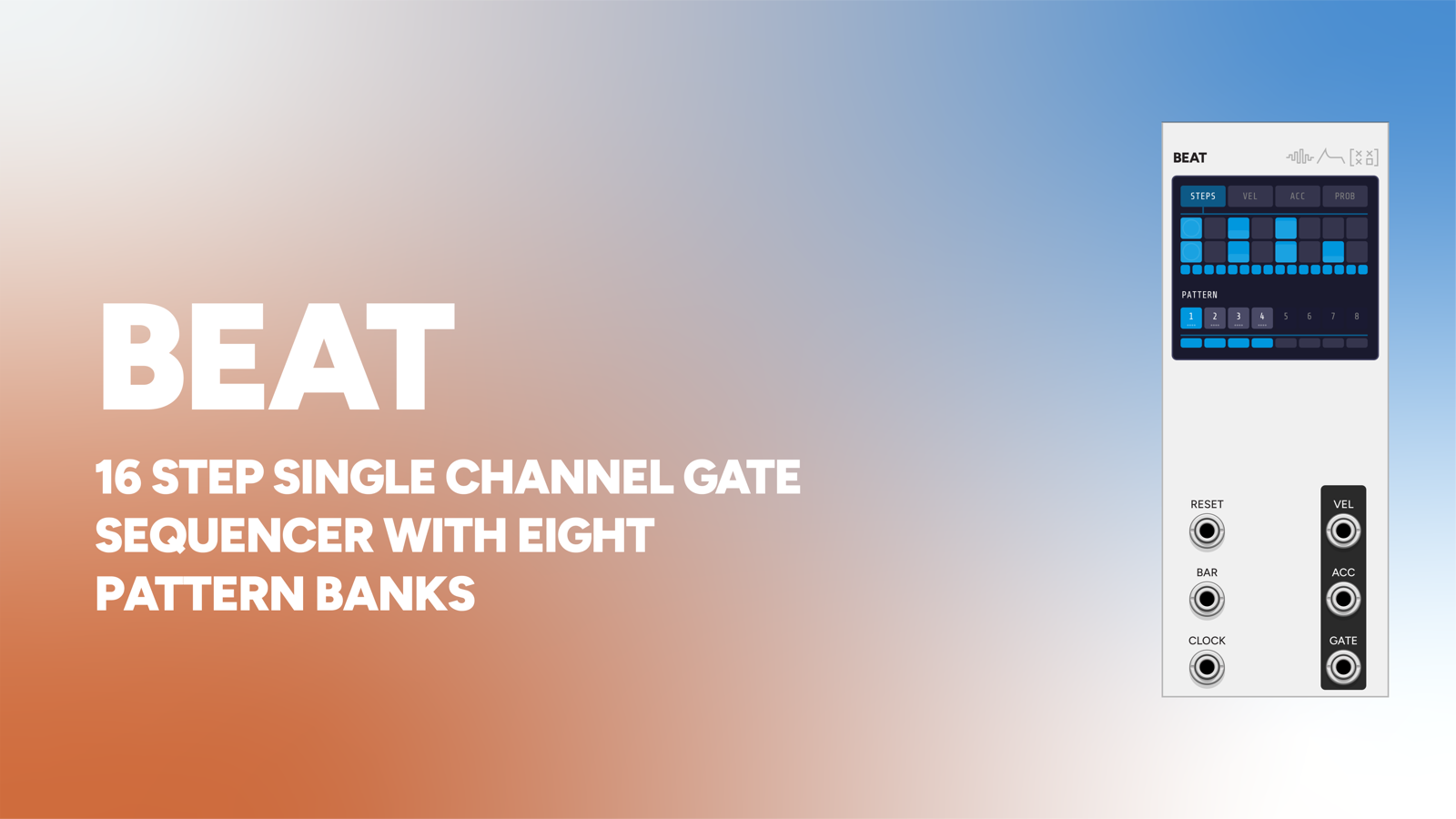
BeatBeat programs the pattern. A poly gate from Beat fires instrument N from channel N.
-
 Slice
SliceKit into Slice puts the grid over a drum that was never a loop, so the glitches cut a live performance.