2.21 is live in the Library. Two new modules, both about one idea, and a mode Spool has been asked for since it shipped.
Flock
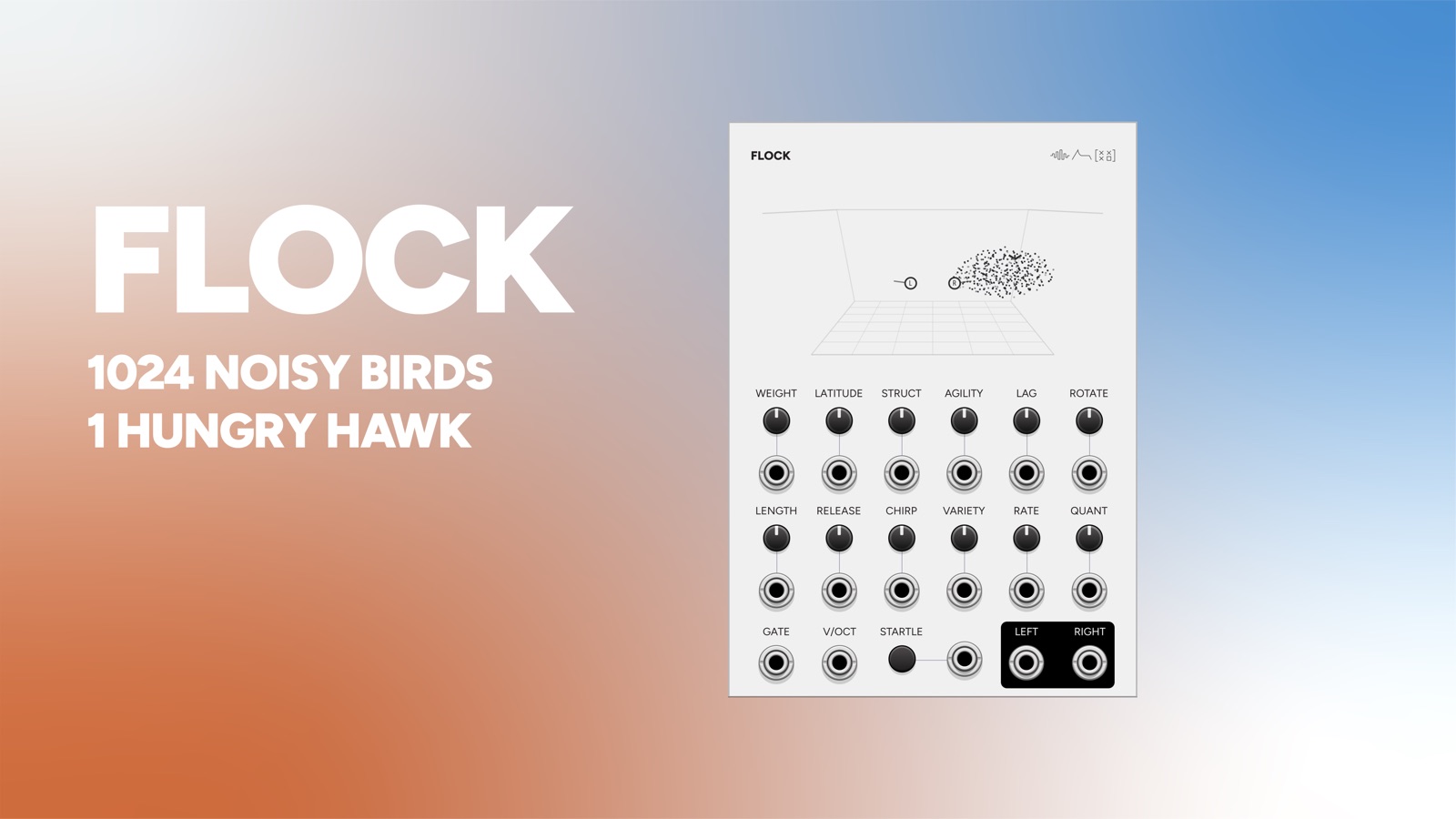
Flock is a murmuration as a voice.
Up to a thousand birds fly as a real flock, each steering by its seven nearest neighbours, and every call a bird makes is a grain. Height in the flock is pitch. V/OCT is the roost the flock leans toward, LATITUDE is how many semitones the flock’s shape is worth, and LAG makes a new note travel through the flock bird to bird rather than arriving all at once. STRUCT gathers the birds at just intervals, QUANT snaps calls toward a grid, and STARTLE sends a hawk through so the flock scatters past the listeners and settles.
Two choices carry it. Each bird steers by its seven nearest birds whatever the distance, rather than by everything inside a radius, which is what the Rome starling studies found real flocks do (Ballerini and others, 2008). A radius model fragments when the flock is sparse and gridlocks when it is dense. The other is that the display is the listener’s view, drawn in perspective on the faceplate with the two listeners standing at the flock’s edge, and you can drag the camera round the room.
Three faults turned up on the first build, all found by ear and then confirmed by measurement. The textbook Boids steer asks for full speed toward a target at any distance, so the flock crossed its roost and oscillated about it, three semitones of overshoot, until the pulls were given an arrive rule. The listeners stood inside the flock, which is why the stereo image was narrow: a point inside a cloud hears birds from every side and the sum is a diffuse centre. And a thousand birds cost the same as one, because the cost is the sixty-four voices rather than the birds.
Flock In
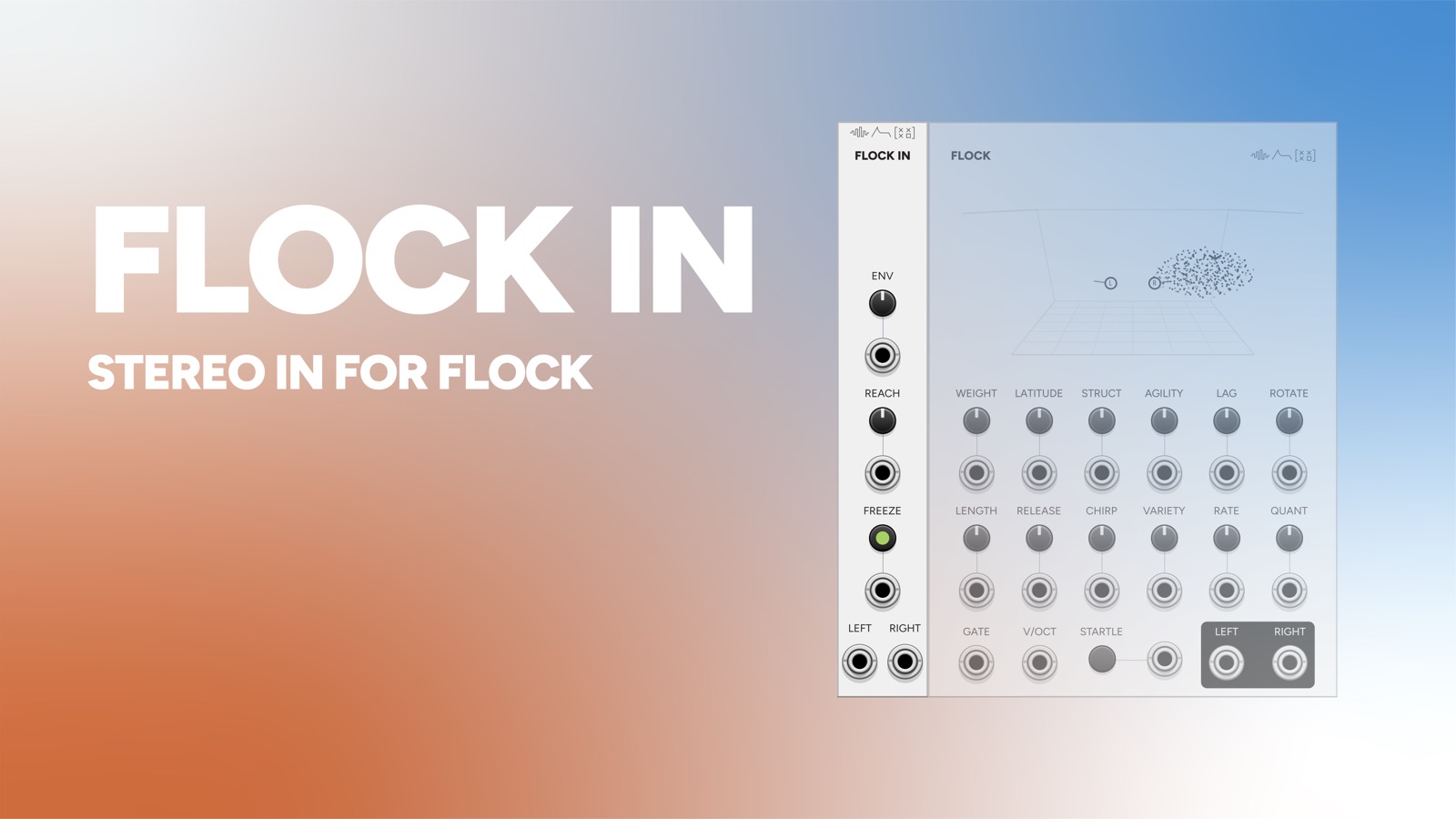
Flock In is the 4 HP expander to Flock’s left. Patch audio in and the birds sing grains of it instead of sines. ENV is where each grain peaks, from a struck grain to a reversed swell. REACH is how far back into the last ten seconds the birds may read, and birds deep in the flock read further back than the ones at the front, so the flock is spread through time as well as space. FREEZE holds the buffer.
Spool time-stretches
Spool was varispeed only, on purpose, because a Mellotron is. It still is by default. A context menu mode, Pitch only, keeps the loop’s length and moves only the pitch, two octaves either way.
An earlier attempt at this was not good enough to ship, and the reason is worth a paragraph. Every time-domain pitch shifter is two read heads sweeping the tape at the shifted rate and crossfading as each runs out of window. The crossfade is the artefact: the heads carry the same waveform at different phases, so at every handover they partly cancel, and that periodic cancellation is the warble. Spool already measures each tape’s pitch for its absolute mode, so in this mode the heads are held a whole number of the tape’s own periods apart. The handover then blends two copies of one waveform at one phase. Measured on a tape with vibrato, the level ripple is the same as plain varispeed, where a fixed window ran three to five times that. Tapes with no pitch get a window that changes length at every handover, so the two heads do not make a comb.
2.20.1
Between 2.20 and this, a point release fixed Band’s POLY and MIX outputs, whose jacks were swapped against their labels. A user spotted it.
Smaller things
Field gained its POLY label; the jack was always there.
Five modules are in the nightly and not in this release: Wave, Ratio, Touch, Helix and Brigade. The nightly un-hides whatever is in progress, which is where to try them before they ship.
Everything is free on the VCV Rack Library. Browse the full set at VCV Rack Modules.