

Cistern is a reverb modelled on the shapes of real places. You choose a space, place two sources and a listener in it on the screen, and Cistern works out how sound would reflect around that shape, at that size, from where everything stands. It is a model rather than a recording of the room: the geometry is simplified, the surface materials are estimates, and only the first part of the reverb is traced. What you get is a room of the right size and shape with a plausible character, not a reproduction of what it would sound like to stand there.
It is named for the Dan Harpole Cistern at Fort Worden in Port Townsend, Washington: an empty concrete water tank 57 metres across and just over 4 metres high, its roof held up on a grid of columns. In 1988 the composer and accordionist Pauline Oliveros, the trombonist Stuart Dempster and the composer Panaiotis recorded the album Deep Listening inside it, and its reverb is quoted at around 45 seconds.
Twelve rooms
Three of the spaces are built from published dimensions. The Dan Harpole Cistern is a cylinder on a grid of square columns with flared tops under a grid of beams. The Buffalo Bayou Cistern in Houston is a former reservoir of 221 concrete columns standing over water, and the Basilica Cistern in Istanbul is 336 columns under brick vaults, also over water. Where a detail such as the column spacing could not be found, it is an estimate.
The other nine are photogrammetry scans of real interiors: the Pantheon in Rome, Hintze Hall at the Natural History Museum in London, the Leake Street tunnel under Waterloo station, an old church, the undercroft of Lincoln’s Inn Chapel, St Bartholomew-the-Less, St Peter’s church at Stourton, a mosque in Jordan, and the lower room of the Salt Tower at the Tower of London. Each scan is reduced to the air inside it, with real openings such as the Pantheon’s oculus or the ends of the tunnel kept open so sound can leave through them. The decay times the model gives run from about a second in the mosque to around twenty in the cisterns.
Placing the sound
The screen draws the room at its true proportions, the cisterns as their structure and the scans as architectural sections cut through the building. The two orange dots marked L and R are the sources: the L input is played from one and the R input from the other, with R normalled to L for a mono signal. The white dot is the listener, a pair of microphones angled toward the sources, and the L and R outputs are what those two microphones pick up. Drag any of the three around the floor, and shift-drag to lift them. Moving a source moves it in the stereo image, and positions are kept for every space separately and saved with the patch.
Distance is musical by default. Past 25 metres, extra distance counts for less, so a source at the far end of the 300 metre tunnel arrives late enough to sound far away without arriving too late to play with: 150 metres is heard as about 65. The menu switches to true distance, with the delay and level as the model calculates them.
How it works
On a background thread, rays leave each source, reflect off the room’s surfaces, lose energy at each surface and in the air, and are caught at the listener. What arrives in the first part of the reverb becomes the early reflections. The rest of the reverb comes from a feedback delay network, a standard reverb design, with its decay at each octave set to what the room’s volume, surfaces and air predict, and it starts where the traced reflections end at a level matched to them. Tracing a room takes from a fraction of a second to about a second, and the screen says TRACING while it runs.
A lot is left out. The scans are smoothed and reduced to a few thousand surfaces, so carvings, furniture and people are gone, and the materials are assigned by the kind of surface and building rather than measured. Sound bending around columns and edges is not modelled, and the tail follows the predicted decay rather than the room’s actual echo pattern. The decay times are calculated, not measured in the real buildings, so treat the rooms as starting points that sound like large spaces of the right shape and size.
Changing space starts a new reverb and leaves the old room ringing out in its own acoustic, so whatever was already sounding dies away naturally under the new room instead of changing pitch. Moving a source or the listener retraces the same room and crossfades the early reflections without cutting the tail.
Controls
| Control | What it does |
|---|---|
| SPACE | Chooses the room. |
| SIZE | Scales the room from a quarter to twice its real size. The tooltip reads the result in metres. |
| DECAY | Sets the decay from a tenth to four times the decay the model calculates for the room, read in seconds. |
| SCATTER | How much of each reflection goes diffuse. Low, the round cistern’s wall focuses sound back toward the middle; high, every room is smooth. |
| HUMID | The humidity of the air. Drier air absorbs more high frequencies, which is most of what darkens a long tail. |
| MOVE | Slow movement in the tail, so a long tail does not settle into fixed resonances. |
| MIX | Dry to wet. |
| FREEZE | Holds the tail and shuts the input out of it, with a gate input. |
Every control has a CV. The bottom of the screen shows the decay at each octave from 125 Hz to 4 kHz.
Scan credits
The scanned rooms are licensed under Creative Commons Attribution 4.0 and were converted to room geometry for Cistern. The CREDITS button on the module’s screen lists them too.
- The Pantheon Interior by artfletch
- Hintze Hall by artfletch
- Leake Street Graffiti Tunnel by artfletch
- Old church modeling - Interior Scene by Aurélien Martel
- Lincoln’s Inn Chapel Undercroft by artfletch
- St Bartholomew-the-Less Interior by artfletch
- Church Of St Peter Stourton by artfletch
- Mosque of Tree of Al Buqayawiyya, Jordan by SJoudeh
- Salt Tower Lower Room by artfletch
Patch ideas
Deep Listening. The Dan Harpole Cistern, fully wet, with a long sustained tone into L. Walk the listener toward the wall and back; with SCATTER low the curved wall focuses the sound at certain spots.
Two players in one hall. Two voices into L and R, with the sources at opposite ends of Hintze Hall. Each keeps its place in the stereo image and the room joins them.
Down the tunnel. Leake Street, the source at one end and the listener at the other, then switch to true distance to hear a source 300 metres away with the delay and level the model gives it.
Freeze and play. Play a chord, press FREEZE, and play over the held room.
Pair with
-
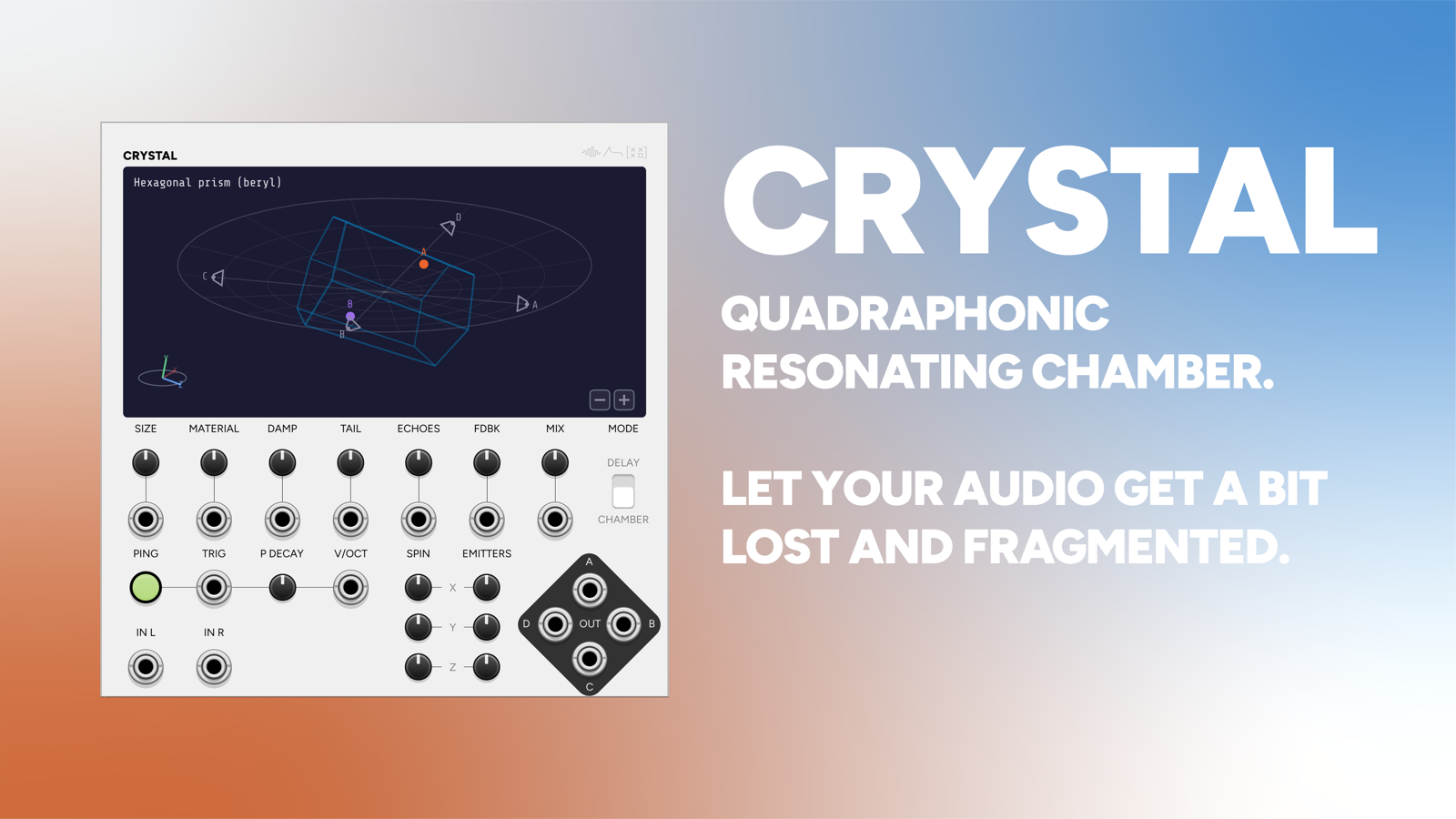 Crystal
 is an echo chamber shaped like a crystal, built so its echoes are heard one by one. Patched before Cistern, those echoes sit inside a room.
-
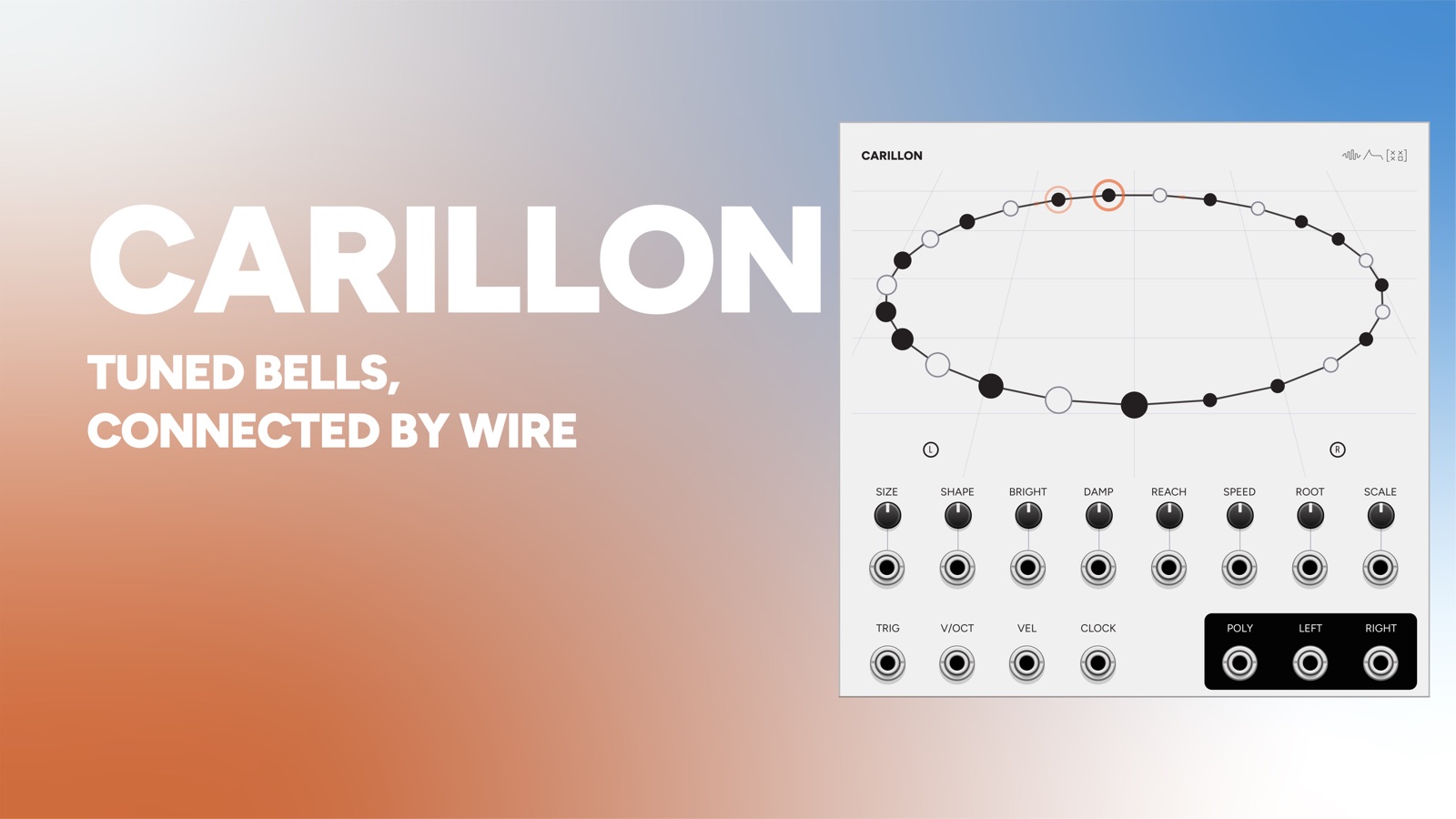 Carillon
Bells want a building. Carillon's two outputs into Cistern's two sources put the tower in the Pantheon.
-
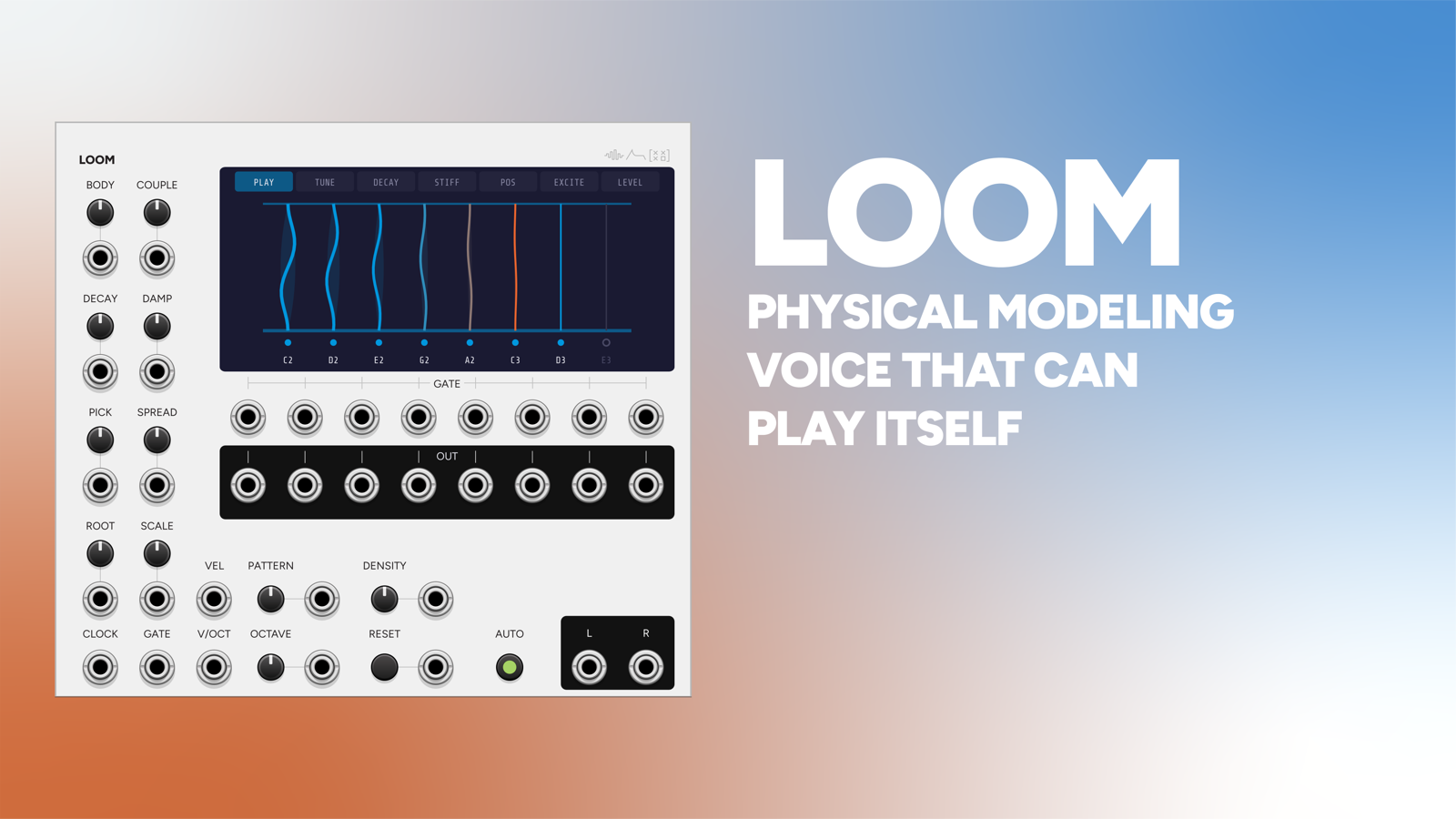 Loom
Two of Loom's string outputs into L and R place two strings at two points in one room.
- Strata
Strata's L and R outputs into Cistern's L and R inputs put the two halves of its mix at two sources in one room.