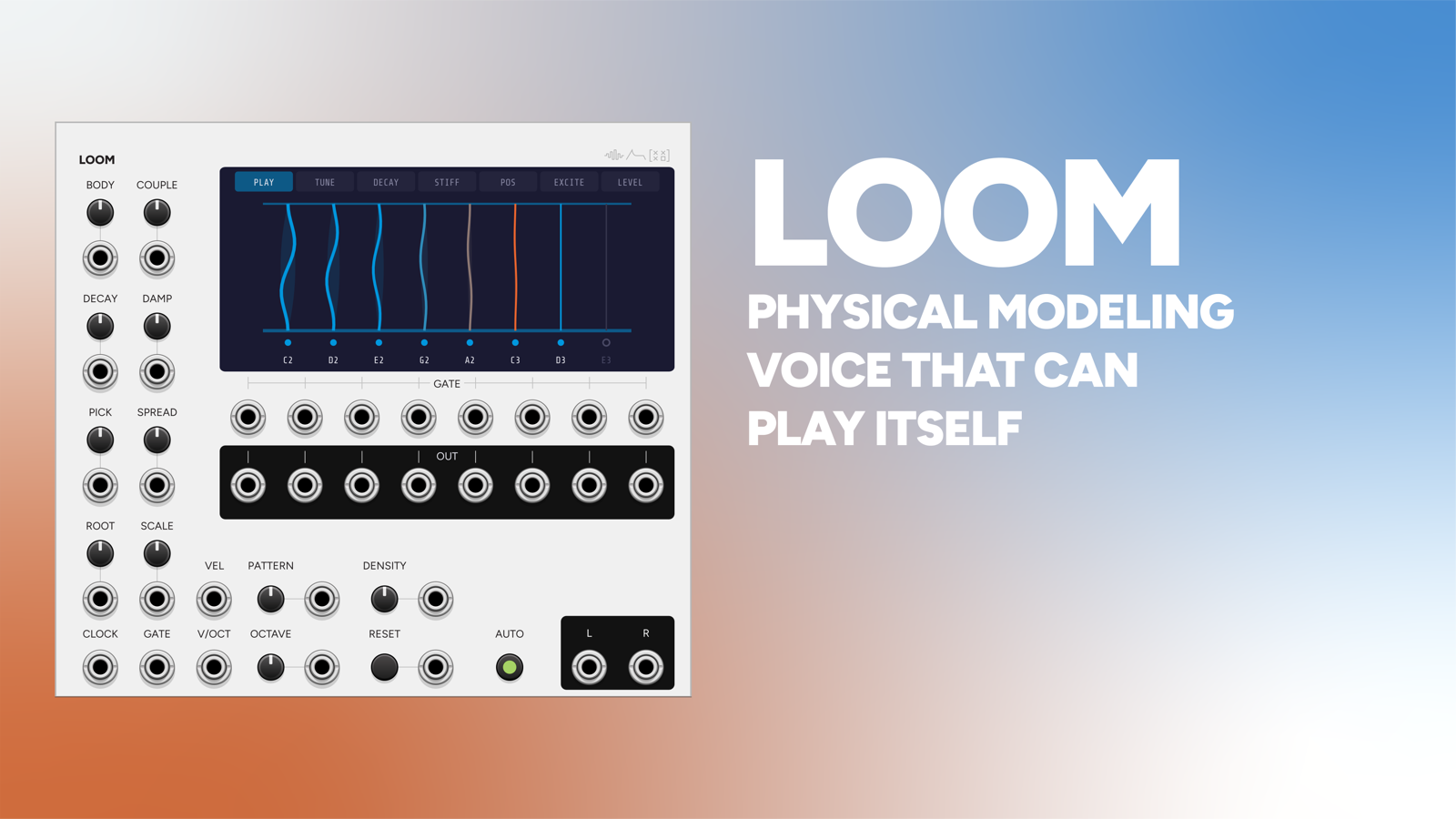
Loom is eight strings sharing a bridge. Each is a digital waveguide, and because they share a bridge, a struck string rings its neighbours. The display is the instrument: strum it with the mouse, or drive the strings from gates. Loom is 28 HP.
Video
A quick guitar patch built with Loom:
The exciter is an axis
EXCITE is a continuous control, not a menu. HAMMER, PLUCK, BOW, and WIND are points along it, and you can sit anywhere between them.
- The bow works everywhere. Bow speed sets loudness, not whether the string speaks, so it holds up across the range.
- WIND is an aeolian harp. The string sings from the airflow, climbing and falling between partials rather than sitting on one note.
- COUPLE is a real bridge. String motion feeds a shared bus and each string takes back a fraction, so playing one wakes the others.
Playing it
Seven display tabs: PLAY strums with the mouse (height sets where along the string you pick), and TUNE, DECAY, STIFF, POS, EXCITE, and LEVEL each edit one attribute per string. For hands-off playing there is a clocked auto-player with eighteen patterns.
Root and scale use the shared convention, so one key change reaches Note, Chance, Arrange and the rest.
Inputs and outputs
- Controls: Body, Couple, Decay, Damp, Pick, Spread, Root, Octave, Scale, Pattern, Density, Auto, Reset.
- Inputs: V/OCT, Gate, Velocity (poly), Clock, Reset, 8 x per-string gate, plus CV for most controls.
- Outputs: Mix L, Mix R, and 8 x per-string audio.
Patch idea
A self-playing harp. EXCITE toward WIND, COUPLE up, a slow AUTO pattern, and a long DECAY. Loom drifts on its own like wind through strings. Take the eight per-string outputs into separate pans for a wide field, or just use Mix L/R into a reverb.
Pair with
-
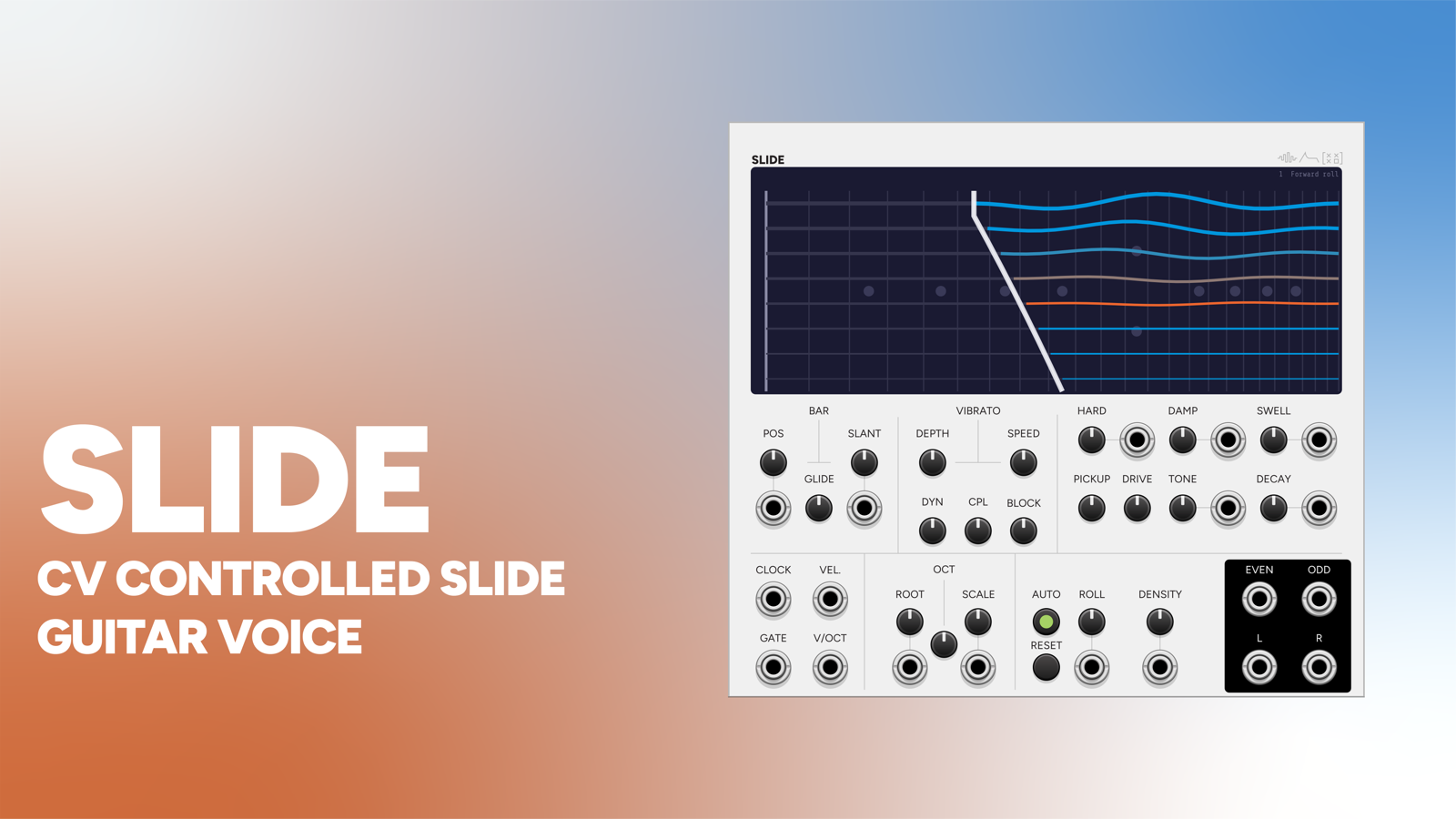 Slide
SlideSlide is Loom's lap-steel sibling: the same waveguide strings, but stopped by a steel bar you slant and slide instead of picked at fixed frets.
-
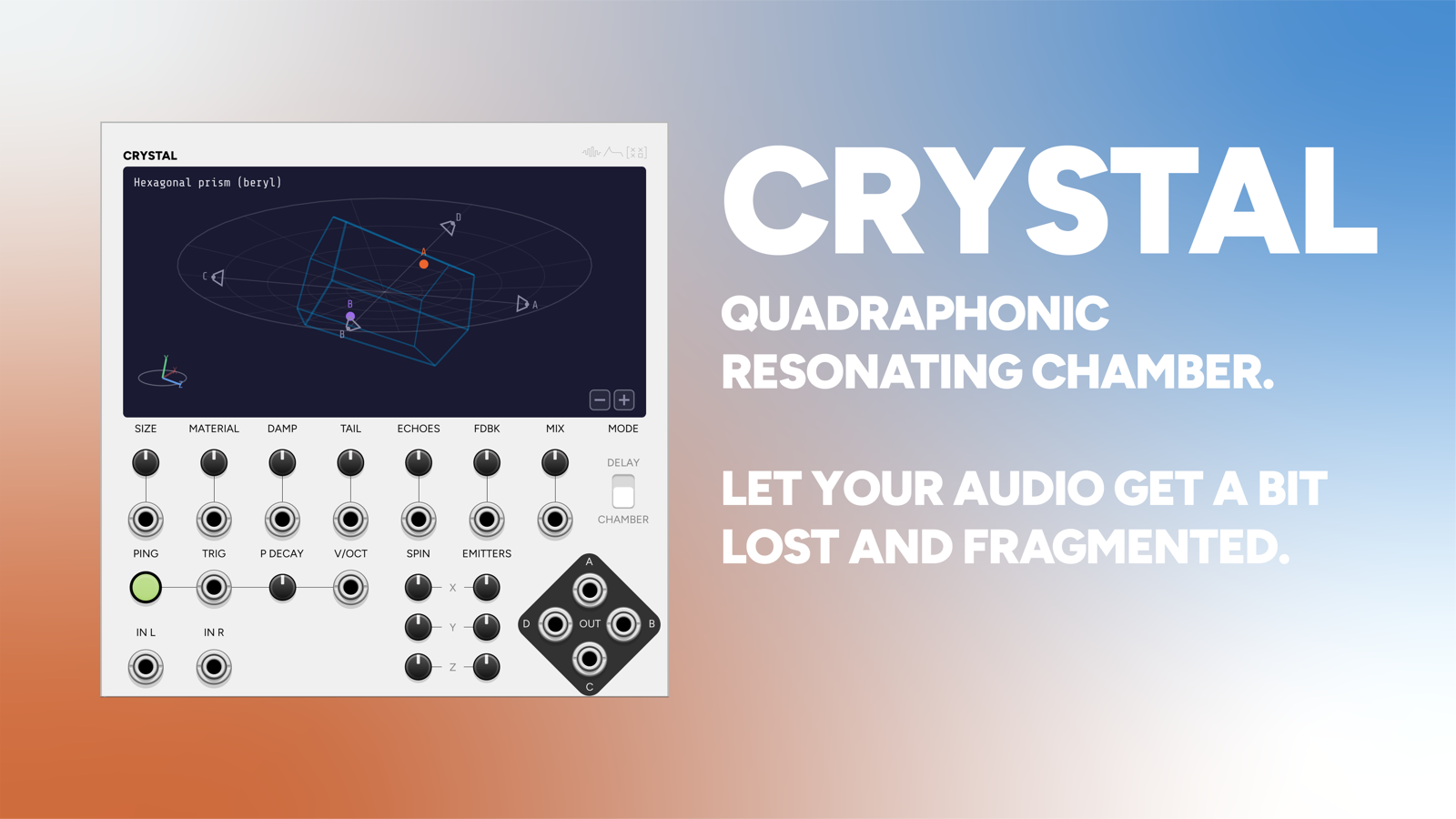 Crystal
Run Loom into Crystal to put its strings inside a 3D resonant room. A physical-model voice in a physical-model space.
-
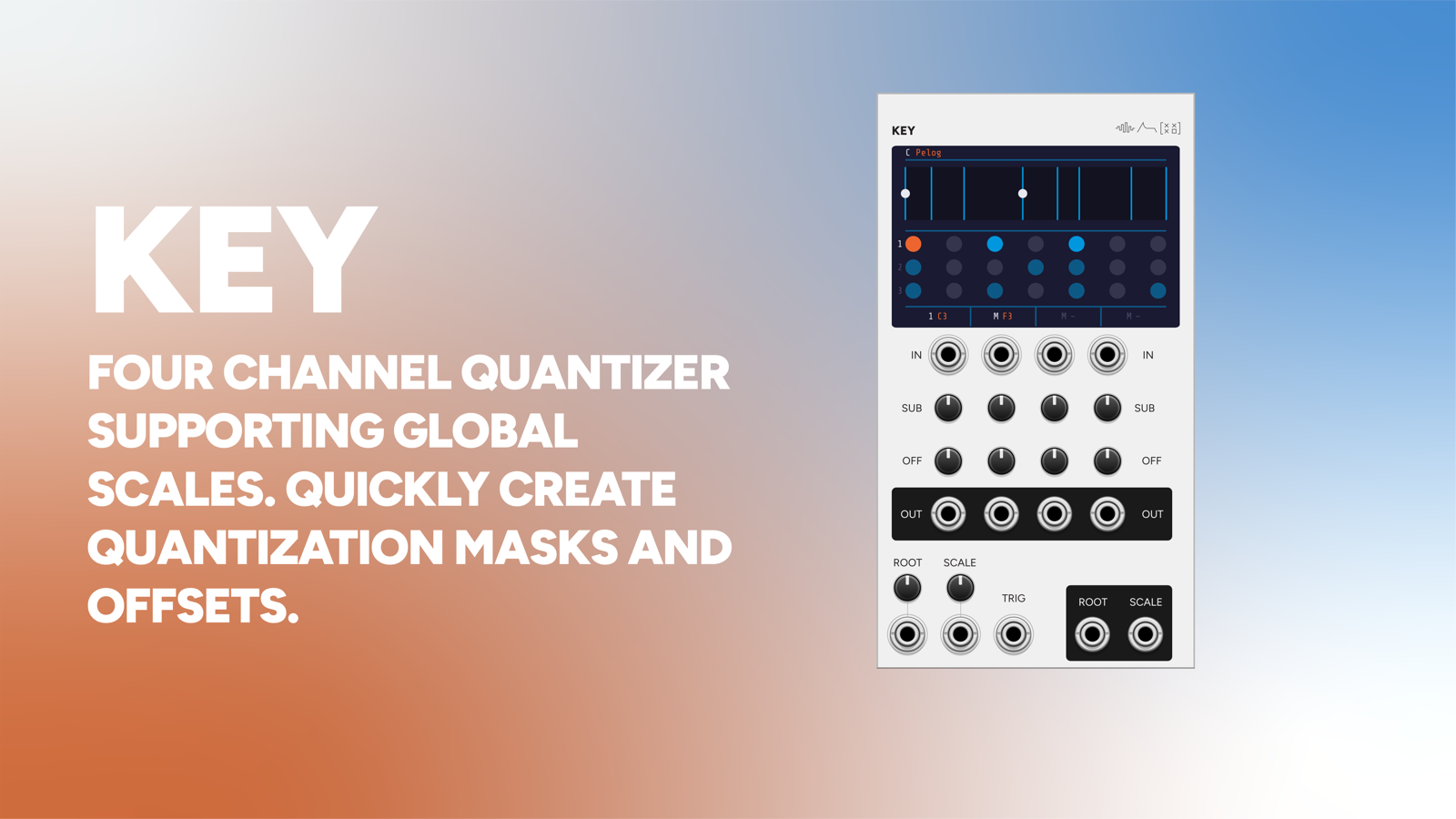 Key
KeyLoom reads the shared Root and Scale, so Key or Arrange can move its key along with everything else in the patch.