Drift is a four-channel LFO for VCV Rack with a chaotic waveform, a control that spreads the four outputs apart in phase, and a stability control that lets each output wander on its own. It is in the VCV Rack Library as part of the Signal Function Set plugin.
Shape and stability
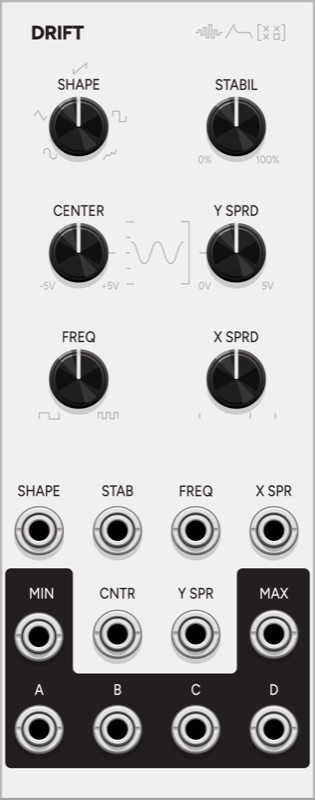
SHAPE morphs continuously from sine through triangle, sawtooth and square to a chaos waveform. The chaos waveform is a smoothed random walk: once per cycle each output picks a small random step and glides toward it, so the value wanders slowly instead of jumping.
STABILITY sets how steady the waveforms are, and higher values are more stable. Below the top of its range, each output is disturbed by its own Lorenz attractor, which nudges that output’s phase, amplitude and speed. The four attractors use slightly different constants, so the four outputs drift apart from one another even when they start in phase. At full stability the outputs follow the waveform exactly.
Rate and phase
FREQUENCY sets the rate, from about 0.03 Hz with the knob fully left to about 10 Hz fully right. A clock at the CLOCK input takes over from the knob: Drift measures the time between rising edges, runs at that rate, and restarts output A on each edge.
All four outputs run from one master phase. PHASE spreads them apart relative to A, and at its maximum the offsets are 0° for A, 90° for B, 180° for C and 270° for D. With PHASE at zero the four outputs move together, unless STABILITY is below its maximum.
Range
CENTER sets a DC offset for all four outputs, from -5V to +5V. SPREAD sets the amplitude from 0V to 5V around that centre, and the outputs are bipolar, so a SPREAD of 5V swings between -5V and +5V.
Inputs and outputs
SHAPE, STABILITY, PHASE, CENTER and SPREAD each have a CV input that adds to the knob. On SHAPE, STABILITY and PHASE, 10V covers the whole knob; on CENTER and SPREAD the CV adds volt for volt. CLOCK is the external clock described above.
A, B, C and D are the four LFO outputs. MIN carries whichever of the four is lowest at each moment and MAX whichever is highest, which gives two more related modulation signals from the same four channels.
In the synthesis guide
- What Is an LFO? Low-Frequency Oscillators
An LFO is an oscillator that runs below the audio range and moves a setting up and down. Sent to pitch, cutoff or level, it produces vibrato, a repeating filter sweep or tremolo.