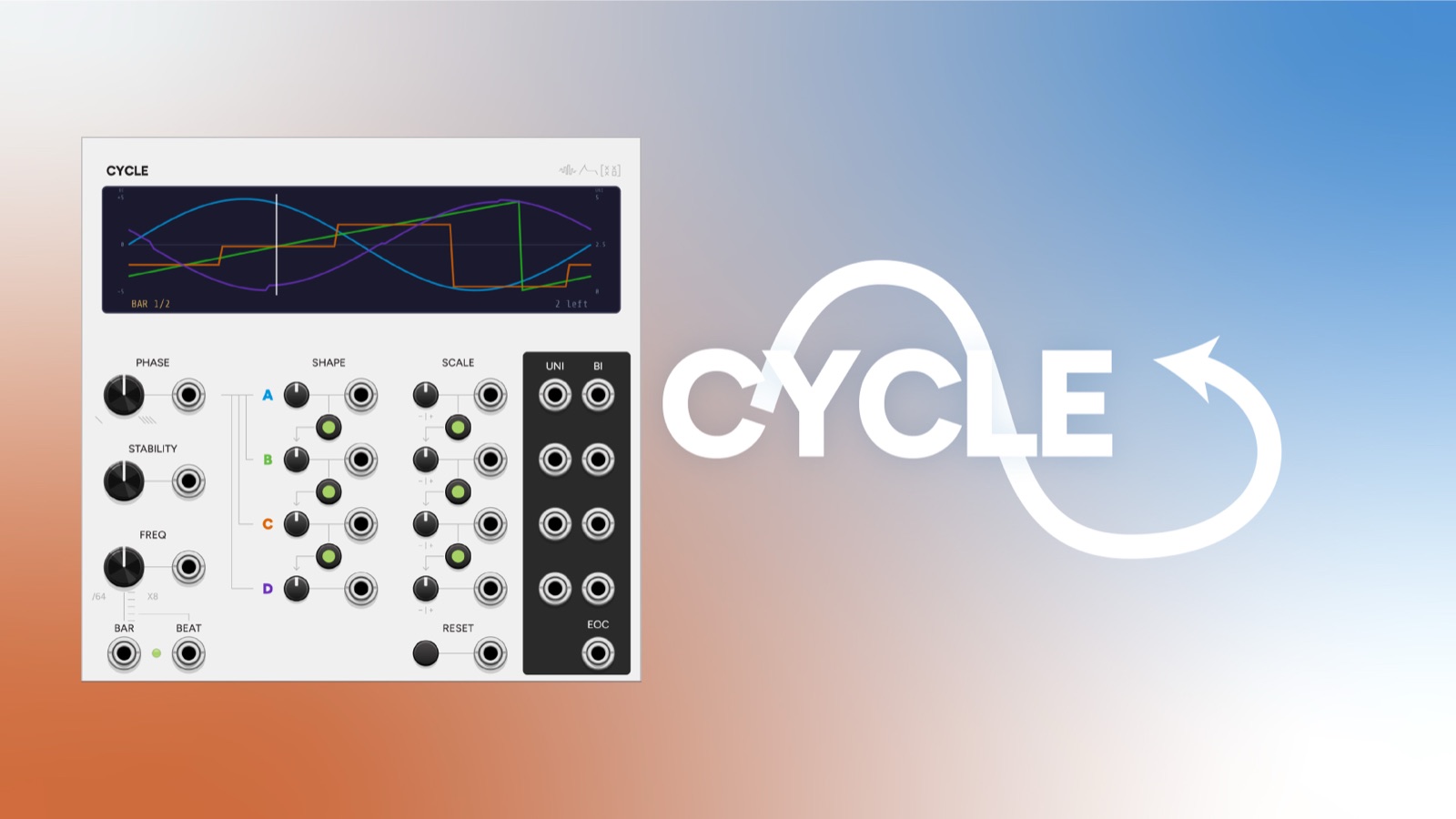
Cycle is a four-channel LFO that thinks in bars, not Hertz. Each of its four outputs (A, B, C, D) runs the same shape but can be spread, scaled, and shaped independently, and the whole bank locks to a musical bar via clock and bar inputs. Unpatched, it free-runs in Hz like any LFO; patched into Meter (or any clock + bar source), it phase-locks to your song so every modulation lands on the grid.
It’s the tempo-synced companion to Drift: same four-voice, phase-fanned idea, but anchored to the bar instead of running free.
26 HP.
How it works
Cycle has two timing modes that switch automatically:
- Free (unpatched). With nothing in BAR, Cycle is an ordinary LFO. FREQUENCY sets the rate from 0.02 Hz to 20 Hz.
- Locked (BAR patched). BAR is the timing authority: Cycle measures the bar length and hard-aligns its cycle to every downbeat, so it can’t drift out of phase no matter how long it runs. FREQUENCY now becomes a musical divider/multiplier: how many bars one cycle spans (or how many cycles fit in a bar).
A single phase runs all four channels. PHASE fans the four outputs out across that cycle, and each channel applies its own SHAPE and SCALE on top.
The shape ring
SHAPE sweeps through a closed loop of waveforms:
sine → triangle → saw → square → staircase → stepped-random → (back to sine)
Because the loop is circular, sweeping past stepped-random morphs smoothly back into sine: there are no end-stops. That’s what makes shape CV (and the link offsets below) so useful: a rising voltage rotates continuously through every timbre and wraps around, rather than slamming into a wall.
Two of the shapes are step-based and react to your clock:
- Staircase: an ascending stair of equal steps. The number of steps follows the bar division (a 4-bar cycle = 4 steps), or, if you patch CLOCK, one step per clock pulse so the stair climbs in real beats.
- Stepped-random: a fresh set of random step voltages each cycle, shared by all four channels so they move together. Step count follows the same grid as the staircase.
Controls
Per channel (×4: A, B, C, D)
| Control | Function |
|---|---|
| SHAPE | Position around the shape ring (sine → … → stepped-random → sine). Wraps. |
| SCALE | Bipolar output depth. Full right = full level; centre = silent; left of centre inverts the wave. |
Global
| Control | Function |
|---|---|
| FREQUENCY | Locked: bars-per-cycle / cycles-per-bar (64, 32, 16, 8, 4, 2, 1, ½, ¼, ⅛: default 1 bar). Free: 0.02-20 Hz. The setting can be changed live. |
| PHASE | Phase spread: fans channels A→D across the cycle for staggered, chasing motion. At zero, all four ride together. |
| STABILITY | 100% = rock-steady. Lower it to introduce Drift-style amplitude wander, so each channel breathes with a little life cycle to cycle. |
| RESET | Button (and CV/trigger input): restart the cycle from the top of the next downbeat. |
Linking & offsets
Adjacent channels can be linked so they share a value, with toggle buttons between the rows: a shape link on the SHAPE column and a scale link on the SCALE column. All six links default to on, so a fresh Cycle starts with A-D fully ganged: turn channel A and the rest follow.
When a channel is linked, its own knob doesn’t go dead: it becomes an offset from the group leader, measured from the knob’s default position:
- SHAPE offsets wrap around the ring. At the default position the follower matches the leader exactly; turn it and the follower rotates around the timbre loop relative to the leader.
- SCALE offsets are bounded (it’s amplitude, not a loop): the follower tracks the leader and you dial in a fixed amount more or less depth.
So you can lock all four channels to one master shape, then nudge each a little for richness: or unlink for four fully independent LFOs.
Inputs
| Input | Function |
|---|---|
| BAR | Downbeat sync. The timing authority: patch this to lock Cycle to a bar grid. |
| CLOCK | Optional. Sets the staircase / stepped-random step grid: one step per pulse. (Feed a subdivision like Meter’s SIXTEENTH.) |
| RESET | Restart the cycle (trigger). |
| FREQUENCY CV | Modulates the rate / division. |
| PHASE CV | Modulates the phase spread. |
| STABILITY CV | Modulates the amount of amplitude wander. |
| Per channel: SHAPE CV | Rotates that channel around the shape ring (wraps). |
| Per channel: SCALE CV | Modulates that channel’s depth. |
Outputs
| Output | Function |
|---|---|
| Per channel: UNI | Unipolar, 0-5 V: for levels, filter cutoff, anything that wants positive-only CV. |
| Per channel: BI | Bipolar, ±5 V: the same wave centred on zero, for pitch, pan, FM. |
| EOC | End-of-cycle trigger: fires each time the cycle completes. Chain cycles, advance a sequencer, or re-trigger envelopes once per loop. |
The display
The screen shows all four channel waveforms over one cycle, each in its colour (A blue, B green, C orange, D purple), with a playhead sweeping the current position. When locked, bar gridlines divide the cycle and a readout tracks your place in it (BAR 2/4, bars remaining, or cycles-per-bar when running fast); unpatched it shows the free-running frequency. Voltage scales label the edges: bipolar (±5 V) on the left, unipolar (0-5 V) on the right: so you can read each output’s range at a glance.
Patch ideas
Whole-patch tempo breathing. Clock Cycle from Meter (BAR + a subdivision into CLOCK). Send the four channels to filter cutoffs, levels, and effect sends across your patch. Everything now modulates in lockstep with the bar: instant cohesion.
Staggered chase. Link all four shapes, turn PHASE up, and the channels fan out into a chasing wave: great for sequential VCAs, panning, or lighting-style sweeps.
Tempo-locked random. Set the shape to stepped-random with a 1-bar cycle and sixteenths into CLOCK. All four channels jump to a new shared random value every sixteenth, perfectly on grid: a sample-and-hold that never loses time.
Inverted pairs. Link A-B scale, then pull B’s SCALE below centre to invert it: two channels that mirror each other for see-saw modulation (open one filter as the other closes).
Generative drift with a leash. Pull STABILITY down for living, wandering amplitudes, but keep BAR patched so the timing stays locked. Organic movement, rigid tempo.
Slow evolving timbres. Set a long division (8-64 bars), feed BI into pitch/FM and UNI into a wavefolder or Overtone’s harmonics. The patch slowly transforms over many bars and resets cleanly at the loop.
Pair with
-
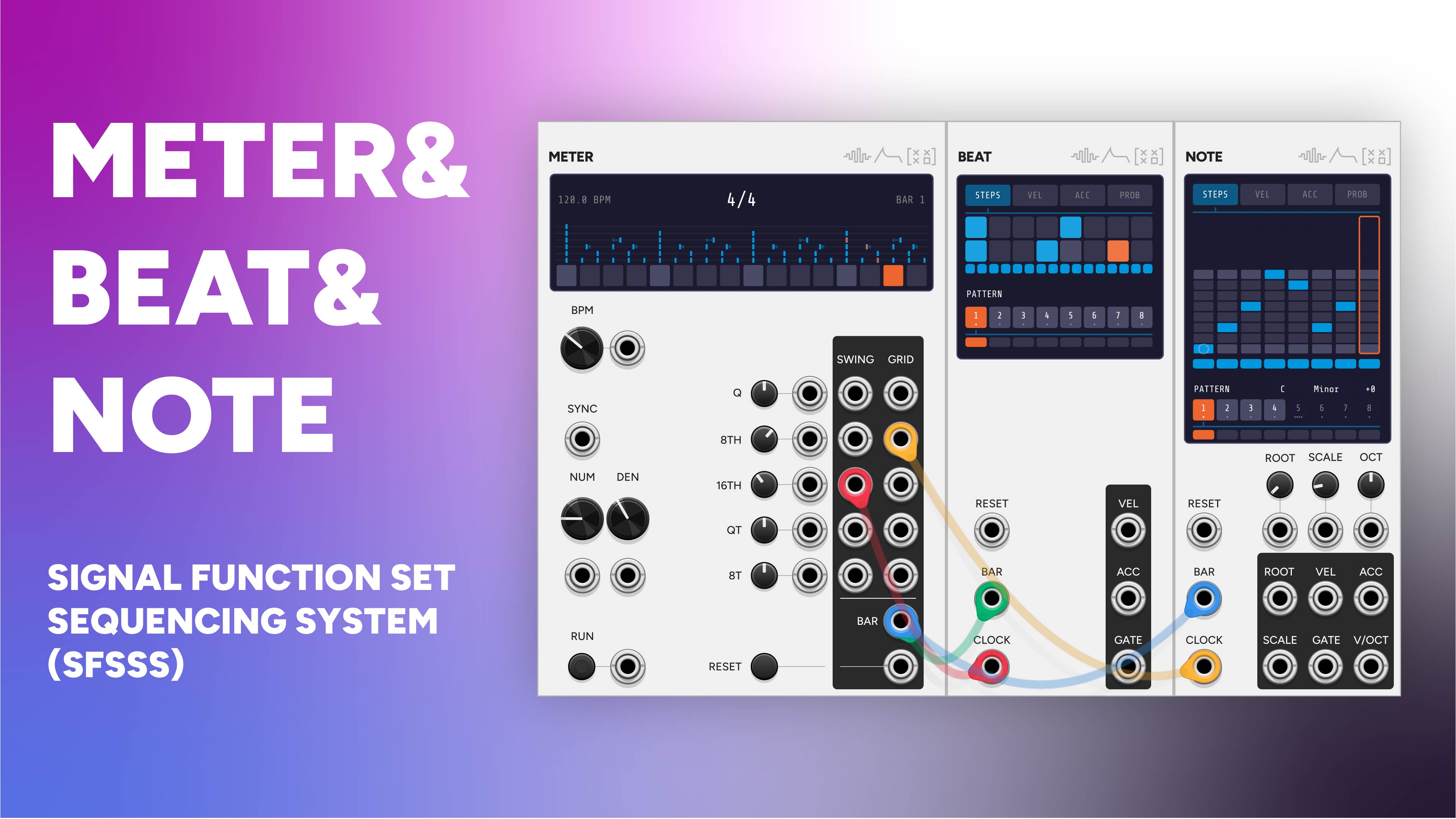 SignalFunctionSet Sequencer System
Clock Cycle from Meter: patch BAR for downbeat sync and a subdivision (e.g. SIXTEENTH) into CLOCK so the staircase steps land on real beats. Now every LFO in the patch breathes in time with the bar.
-
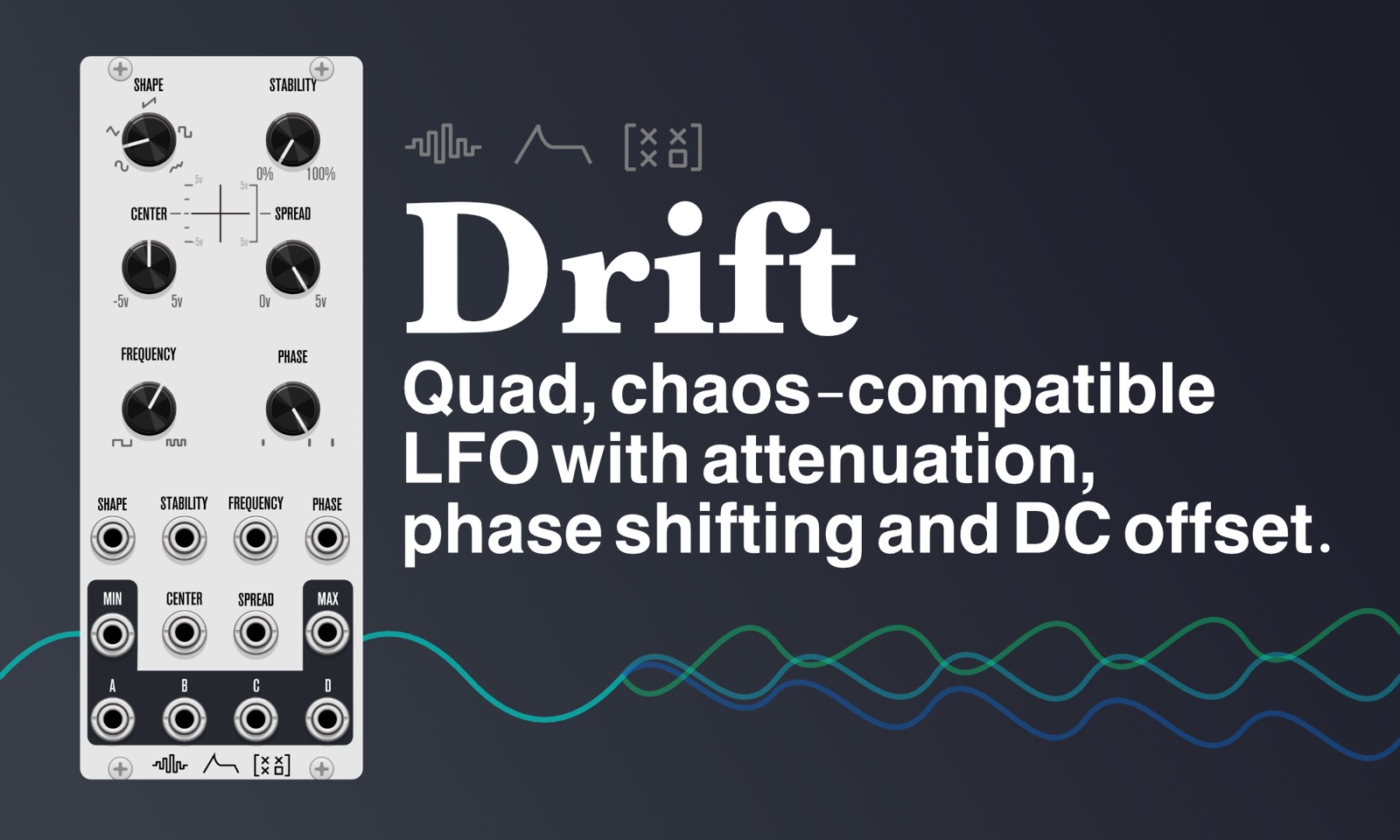 Drift
DriftCycle's free-running sibling. Drift is a phase-shifted quad LFO with Lorenz chaos; Cycle is the same four-channel idea locked to musical bars instead of free Hz.
-
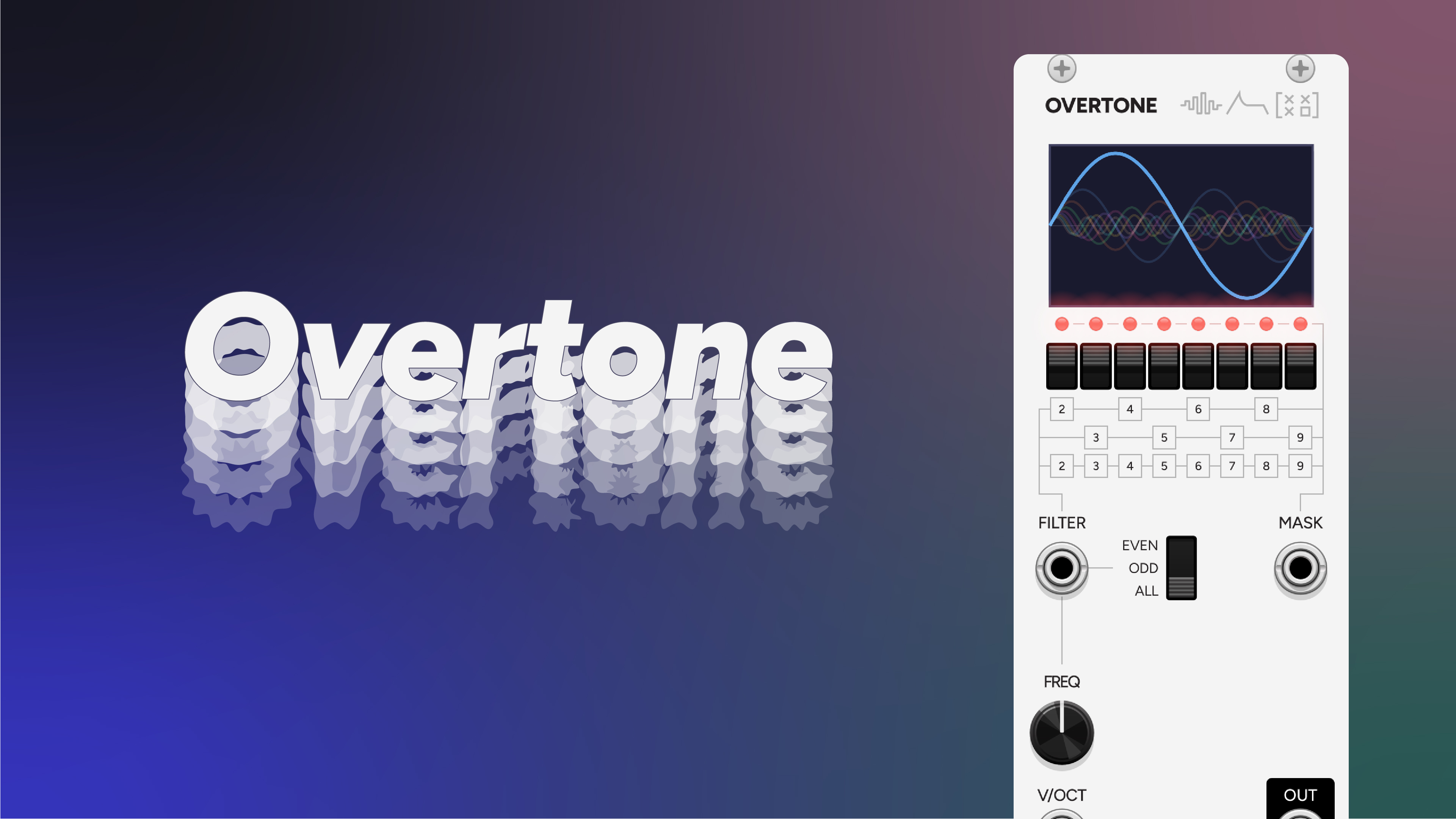 Overtone
Run Cycle's four channels into Overtone's harmonic levels (or Band's per-band levels) for additive timbres that morph in strict tempo.