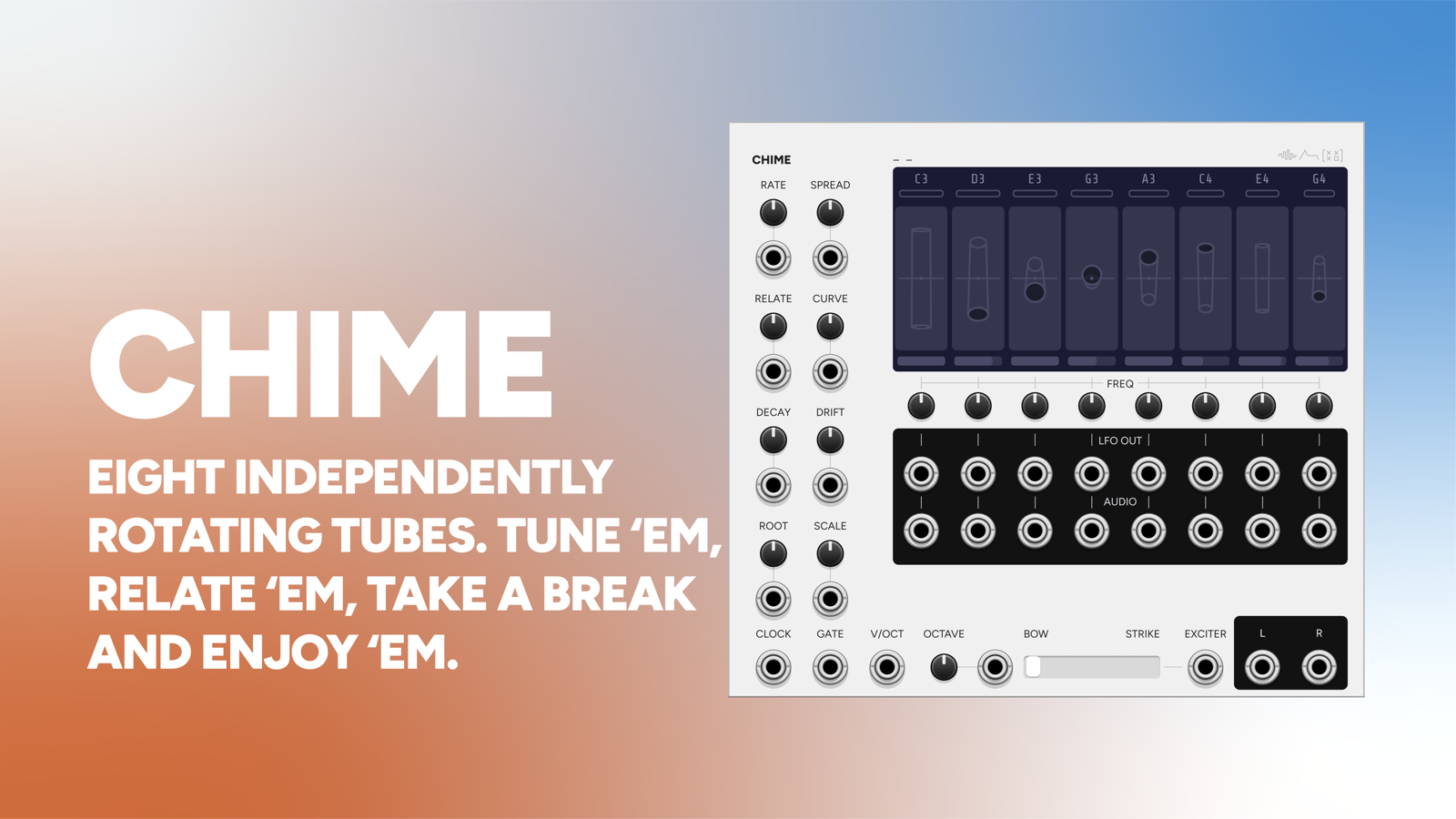
Chime is an eight-note resonating drone machine, after a xylophone whose resonator tubes rotate beneath the bars. Each note has its own slow bidirectional LFO, its “tube rotation”, and the note blooms as its tube swings through centre. Nothing steps. The eight rotations drift against each other, and the pattern is whatever their periods happen to make. Chime is 28 HP.
How it moves
- Excitation is a continuous bow-to-strike blend. Struck notes fire at every centre crossing, twice per rotation.
- RELATE sets how the eight rates relate: ramp, stepped, random, or ripple, where a crossing excites its neighbours and blooms travel down the row.
- SHAPE bends the rotation curve from exponential through linear to logarithmic, so the tube either lingers at the extremes or rushes through centre.
- Per note you set a degree, a weight (strike probability), and an arc width (a narrow arc strikes more often).
- Pitch latches at note boundaries, so retuning never bends a sounding note.
Root and scale use the plugin’s shared convention, so one key change reaches Note, Chance, Arrange and the rest.
Inputs and outputs
- Controls: Rate, Spread, Drift, Relate, Shape, Octave, Excite, Decay, Root, Scale, Reseed, and per note degree, weight, and arc width.
- Inputs: Rate, Spread, Drift, Root, Scale, Reseed, Clock, Excite, Octave, Relate, Shape, Decay.
- Outputs: 8 x tube LFO (±5V), 8 x note audio, Mix L, Mix R, V/OCT (poly), Gate (poly, high while a note blooms).
Patch idea
A generative bell garden. RELATE on ripple, DRIFT up a little so the rotations pull apart, and a long DECAY. Take Mix L/R into a reverb and leave it running. The eight tube LFO outputs are free modulation you can send anywhere, already in time with the blooms you hear.
Pair with
-
 Crystal
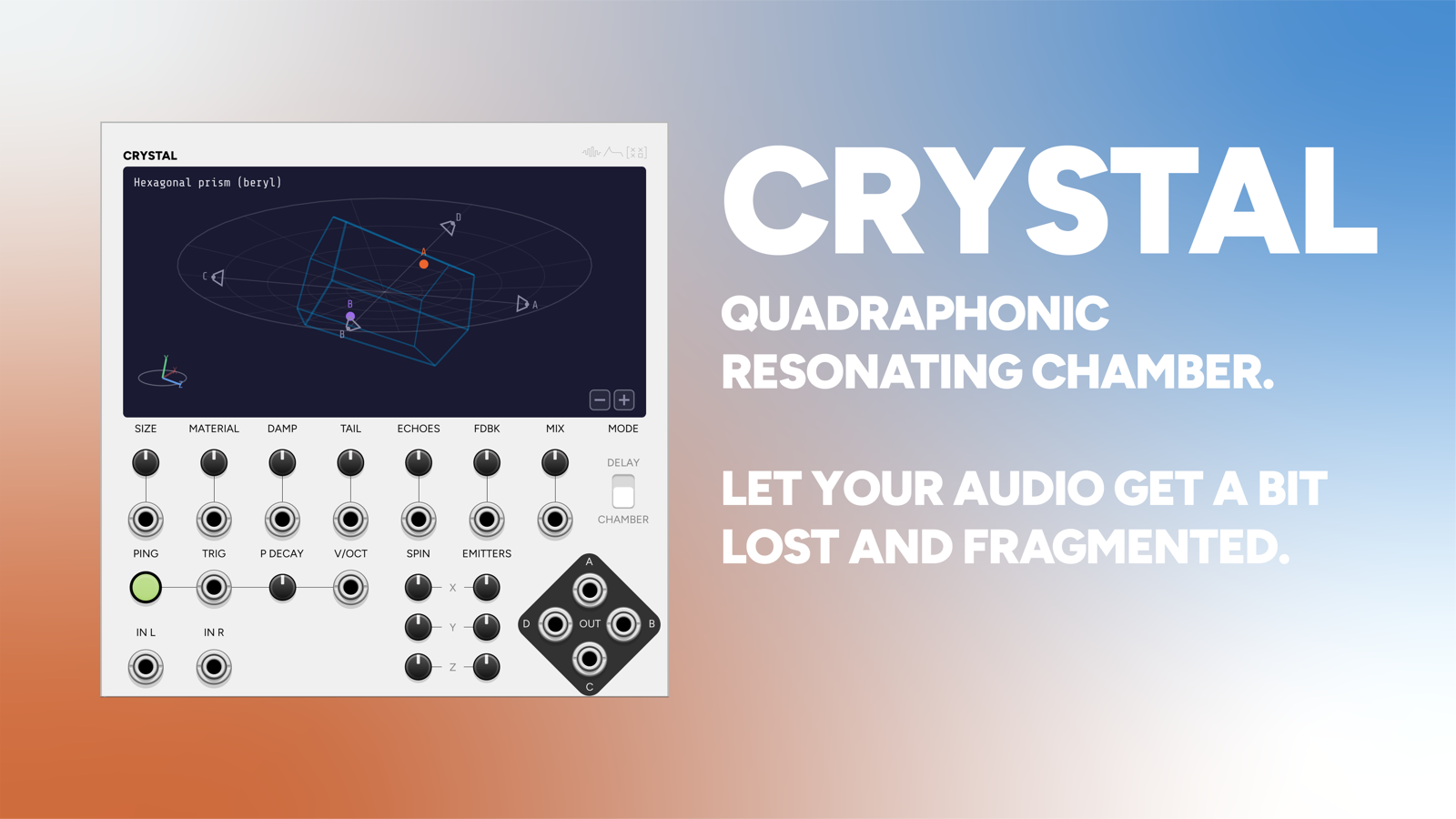
Chime's struck bar is Crystal's built-in exciter. Patch Chime into Crystal and each bloom rings the crystal chamber, or use Chime's tube LFOs to steer the listeners.
-
 Loom
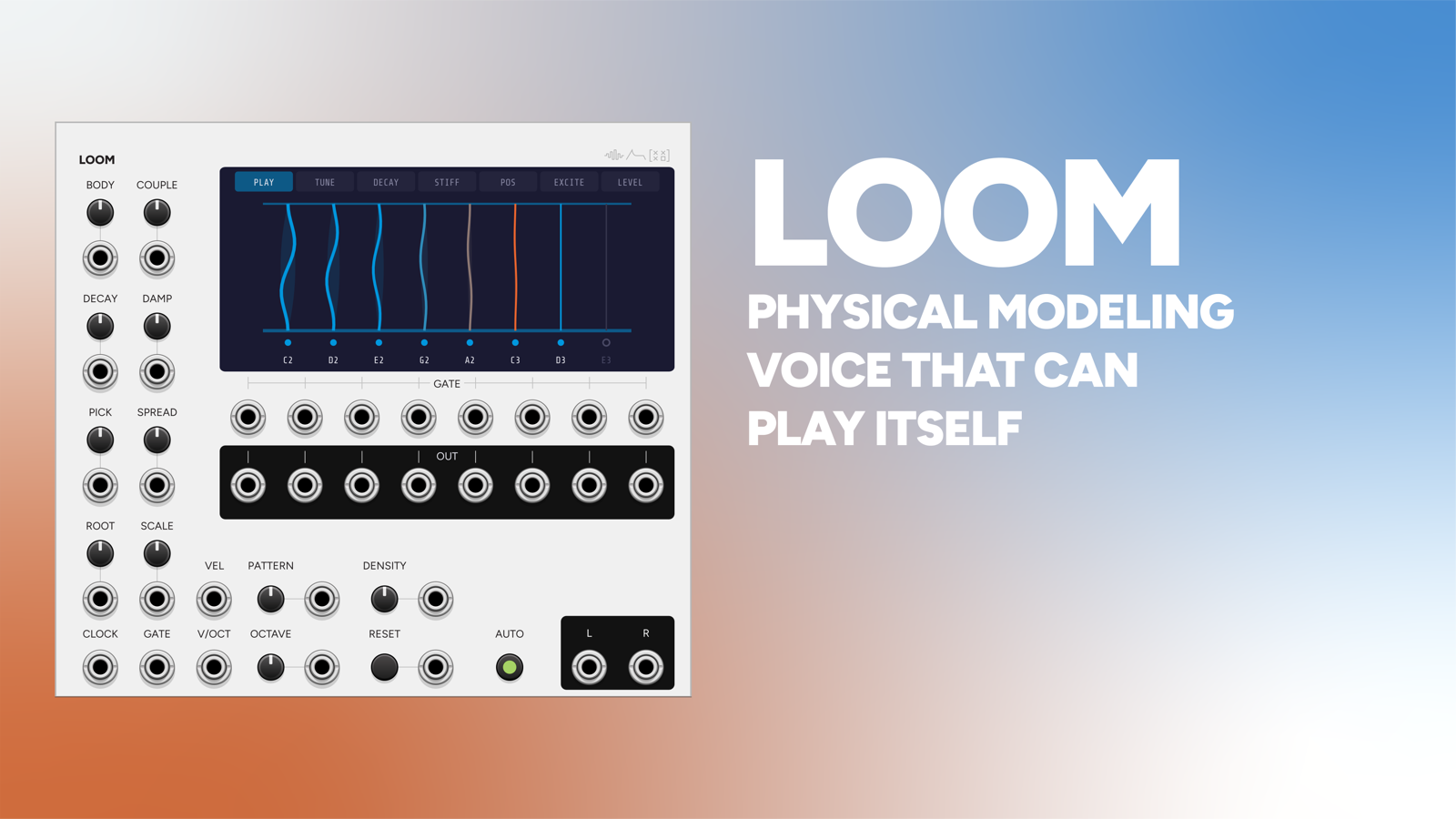
LoomTwo takes on eight resonating voices: Loom's strings share a bridge and are strummed, Chime's tubes rotate and bloom on their own. They layer as a slow ensemble.
-
 Key
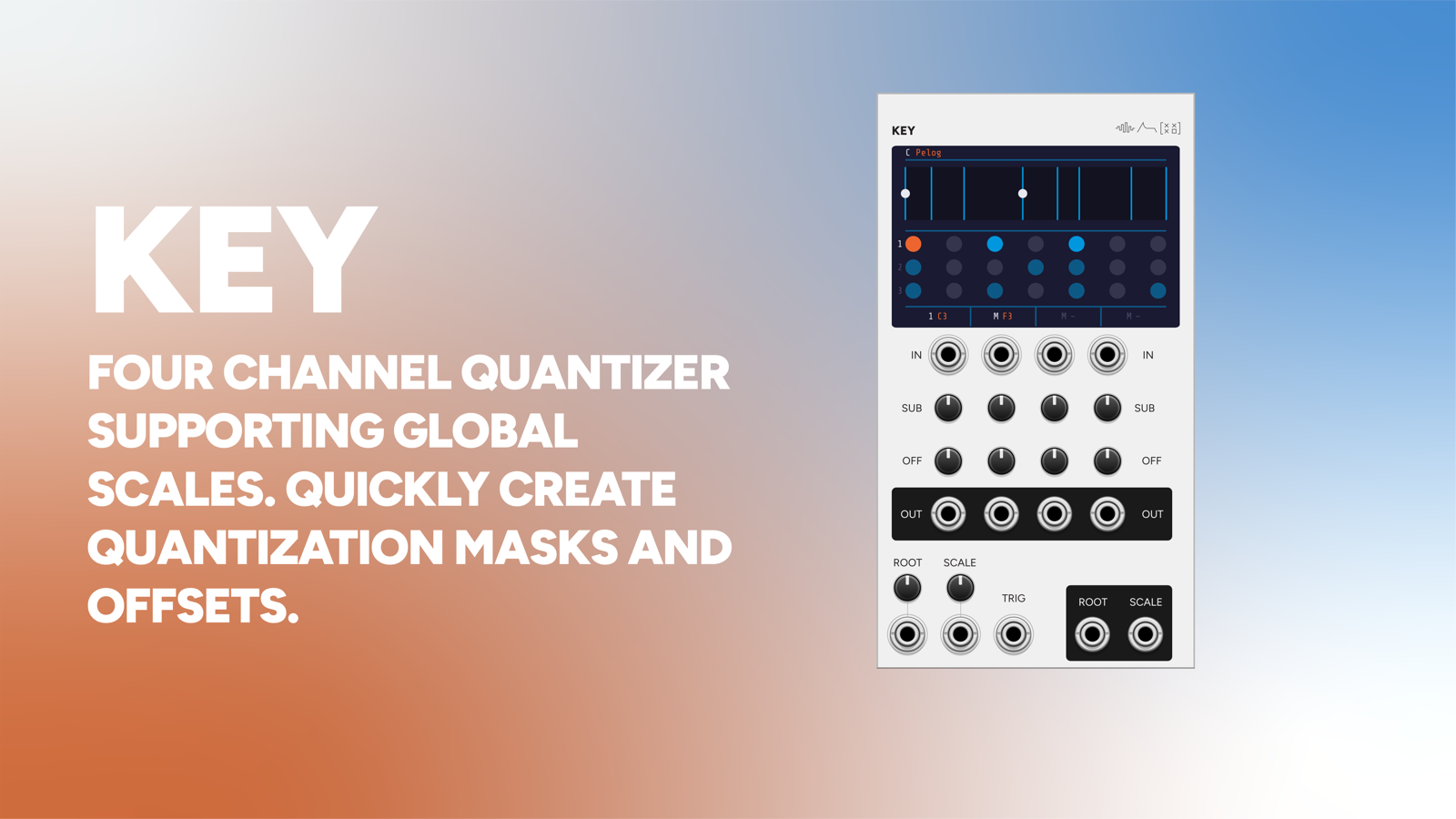
KeyChime reads the shared Root and Scale, so patch Key (or Arrange) into it and its drone follows the same key change as the rest of the rig.