
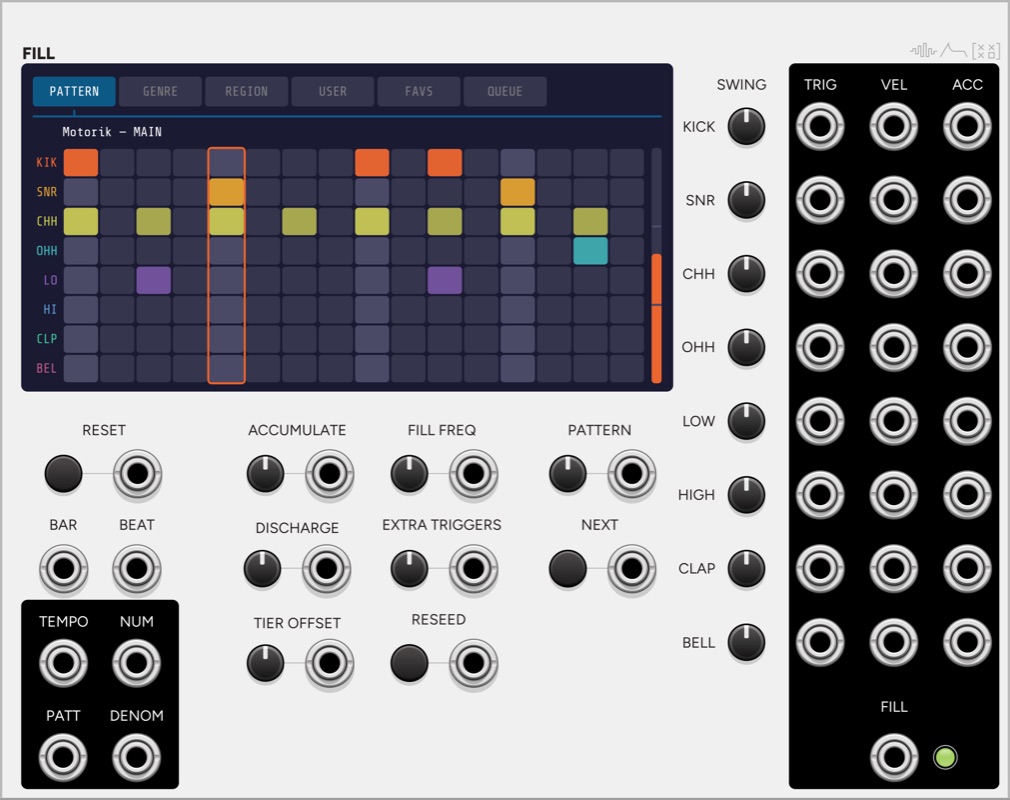
Fill is an eight-channel drum machine that plays a groove from 343 built-in pattern sets and adds its own fills. It is 32 HP and needs an external clock. For a single drum voice that you program by hand, see Beat.
The way the groove changes is driven by an internal value called pressure, which rises a little every bar and is released when a fill plays. Pressure sets the intensity tier (sparse, main or lift) and the amount of a seeded variation layer on top of the pattern. Turning ACCUM up makes pressure rise faster, and turning DISCHARGE up makes each fill release more of it.
Playback follows the clock. Steps fire on CLOCK edges and the bar length is measured between BAR pulses, so Fill stops as soon as the clock stops and stays in time with the rest of the patch.
How often it fills
PHRASE sets how often Fill plays a fill. It sets the phrase length in bars (4, 8 or 16), and a fill plays at the end of each phrase, so PHRASE at 8 gives a fill every eight bars. The intensity tier is latched per phrase, so a whole phrase stays on one tier while pressure rises, instead of changing tier from bar to bar.
Whether fills keep to that grid is a context-menu option (Fills). Synced, the default, plays the fill on the phrase boundary. Free gives each bar a chance of a fill, so fills fall on unpredictable bars.
Patterns
Fill ships with 343 pattern sets across three banks: a canonical set, a General MIDI set, and a disco bank. A five-tab browser (PATTERN, GENRE, REGION, USER, FAVS) finds them, favourites persist across patches, and a pattern queue lets you line up an arrangement by hand.
You can add your own from SignalFunctionSet/patterns/ in your Rack user folder, and .txt exports from drum-patterns.com import natively. EXTRAS is a hard cap on engine-added notes per bar, so the engine can add notes to a pattern without changing it into a different pattern.
The kit
The eight channels are Kick, Snare, Closed hat, Open hat, Low perc, High perc, Clap/rim and Bell, and each has its own off-beat swing.
Inputs and outputs
- Controls: Accumulate, Discharge, Tier offset, Phrase (fill frequency: 4 / 8 / 16 bars), Extras, Set, Reset, Next, Reseed, and per-channel swing.
- Inputs: Clock (required), Bar, Reset, Next, Reseed, plus CV for Phrase (fill frequency), Accum, Discharge, Tier, Set, and Extras.
- Outputs: per channel a gate, velocity, and accent (8 x 3); plus a Fill gate (high during a fill), Set, Num, Den, and BPM.
Patch idea
A steady groove with a fill each phrase. Take Clock and Bar from Meter, set PHRASE to 8 bars, and turn ACCUM low and DISCHARGE high. Fill holds a steady groove and plays a large fill at the end of every eight bars. Patch NUM, DEN and BPM back into Meter, so that a set in an odd meter and at its own tempo sets the meter and tempo for the rest of the patch.
In the synthesis guide
- Trigger Sequencers and Euclidean Rhythms
A trigger sequencer stores only whether each step fires, in a grid with one row per sound. It is the usual way of programming drums.
Pair with
-
 Beat
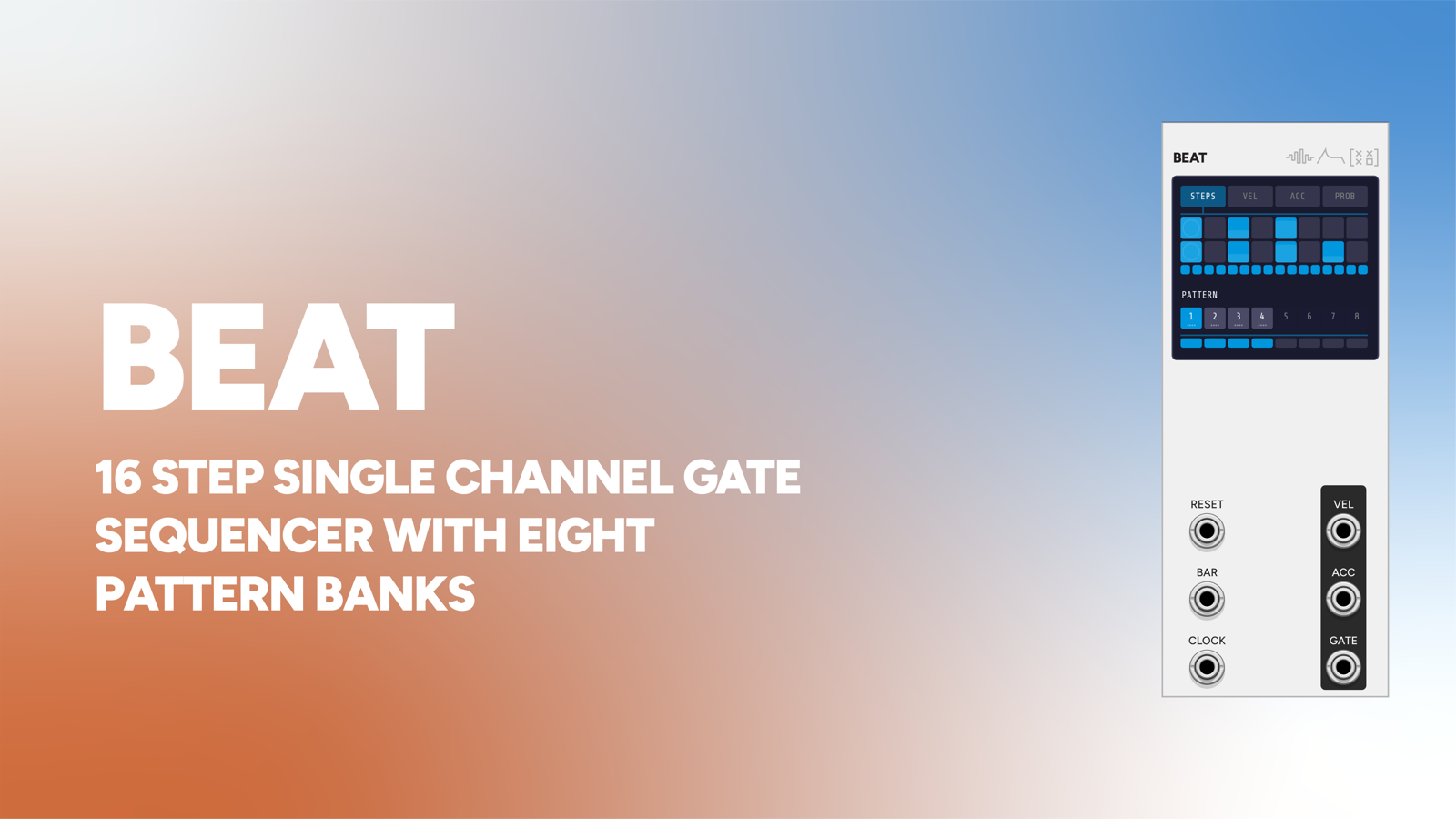
Run Beat's hand-programmed drum voice alongside Fill's generated kit, so one part stays fixed while the rest of the kit varies.
-
 Meter
Fill is clock-driven, so give it Meter's clock and bar. Fill's NUM and DEN outputs feed Meter's time-signature CV, so a set in 5/4 retimes the whole patch.
-
 Signal Function Set Sequencer System
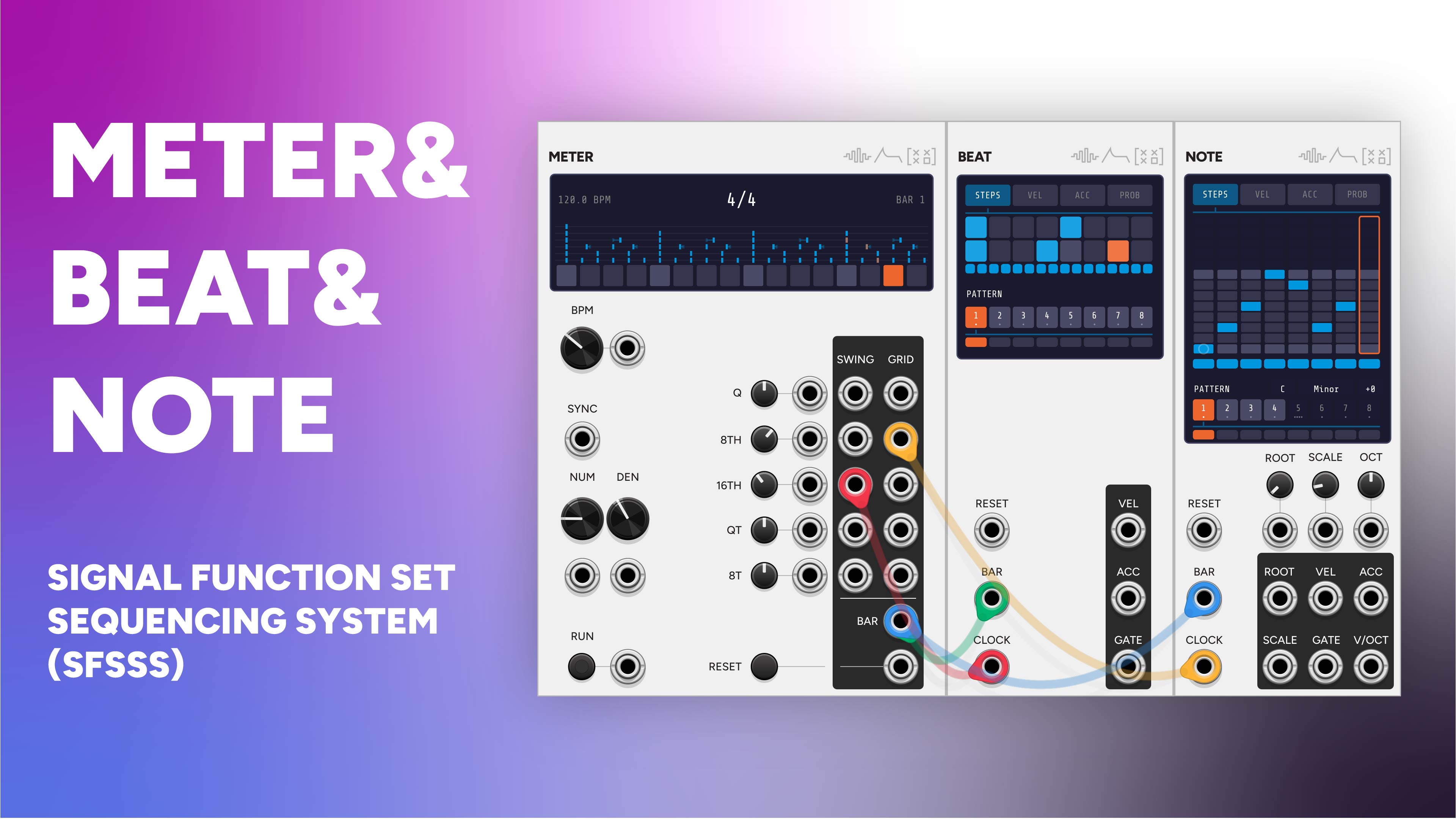
Drop Fill into the sequencer system as the drum kit, with Note and Chance playing pitched parts over the same clock.