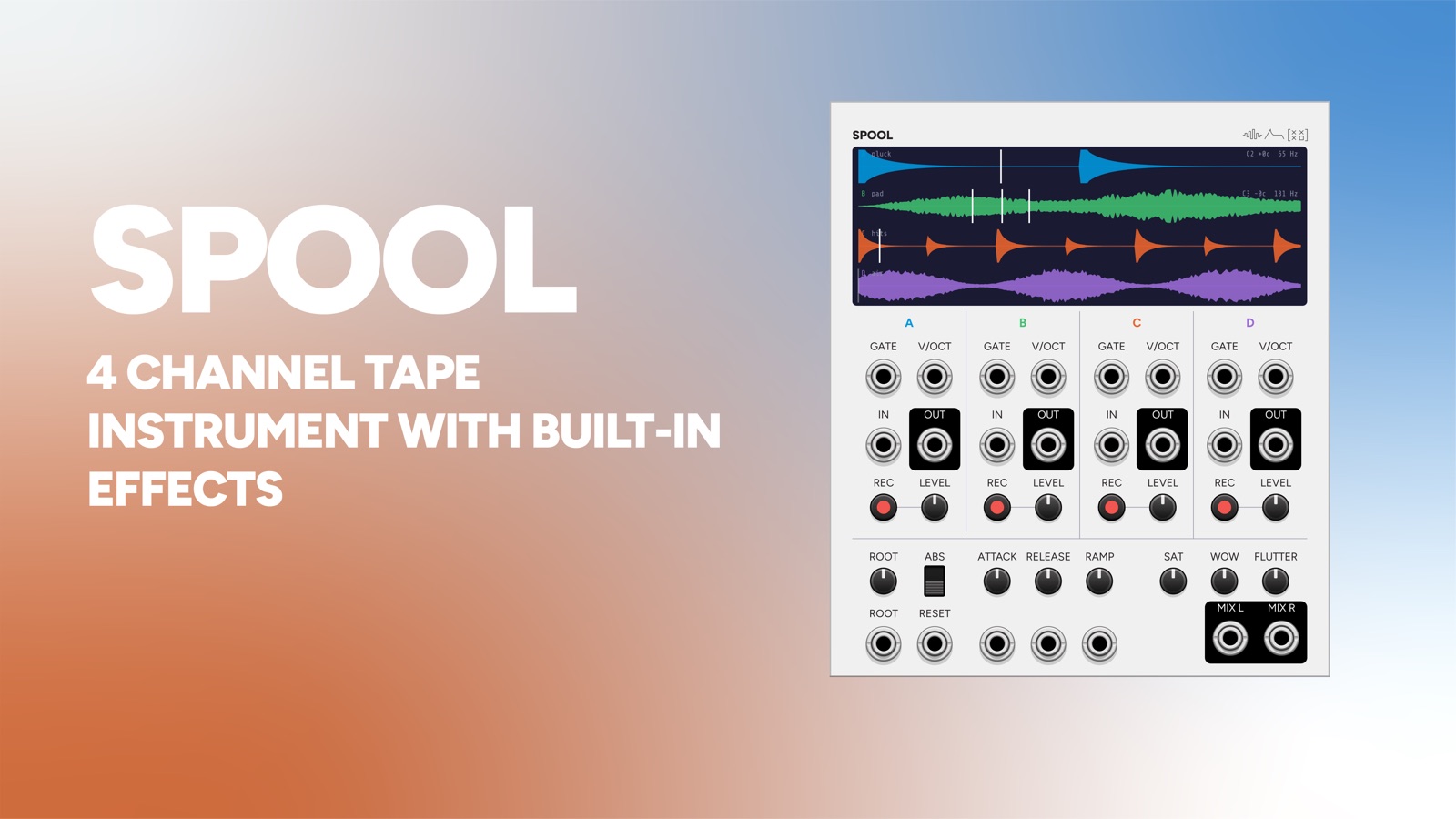
Spool is four short tapes, one transport, and no rewind.
It follows the Mellotron, and departs from it in the one place that matters. A Mellotron springs its tape back the moment the key comes up, so every press starts from the same instant. Here the tape stays where it stopped. Press again and it carries on from there, so a repeated stab walks through the loop rather than replaying the same moment.
22 HP. Four tapes, lettered and coloured A to D.
The tapes
Each tape holds up to five seconds, loaded from a WAV file or recorded in through its own jack. A recording is saved into the patch’s own storage folder, so what you played into it is still there when you reopen the patch.
Five seconds is a tight budget, so it pays to trim a tape before it gets here. SampleStack handles that, and it converts for hardware samplers on the way out.
Each tape has eight playheads. A polyphonic GATE plays chords on one tape: channel N of the gate is a head, and channel N of V/OCT is its pitch.
Where a note starts. The tape keeps a bookmark, and every new note starts there. The bookmark follows the newest head while its gate is held and stops where that head was when the gate fell. The menu will switch this to start at the beginning, which is what a Mellotron does.
What stops the tape is not what stops the sound. The gate stops the tape. The envelope stops the sound, so a long release plays out over stationary tape rather than freezing.
V/OCT is varispeed. It changes how fast the tape runs, so pitch and loop length move together, as they do on any machine with a capstan. An octave down is twice the loop length. ABS switches V/OCT to a note instead: the tape is measured for pitch and retuned to what was asked for, relative to ROOT.
Or pitch only. From 2.21, the context menu has a second mode under V/OCT changes: Pitch only, time-stretched. The transport keeps running at its own speed, so the loop keeps its length, and only the pitch moves, two octaves either way. On a tape that has a pitch, the two read heads that do the shifting are kept a whole number of the tape’s own periods apart, so where one hands over to the other they carry the same waveform at the same phase. That is what stops it warbling, and it is why the pitch detector runs in this mode whether or not ABS is on. A tape with no pitch, a drum loop or a breath, gets a window that changes length at every handover so the two heads do not make a comb filter.
One transport
ATTACK, RELEASE, RAMP, SAT, WOW and FLUTTER are shared, because there is one capstan. Four independent wobbles sound like four machines.
RAMP is the motor getting up to speed, 0 to 60 ms. It scales the playback rate, so a note glides up into pitch on the way in and sags on the way out. It also keeps a tape resumed mid-waveform from clicking.
WOW and FLUTTER are the motor’s speed errors, slow and fast. Wow is two slow components rather than one sine, since a single sine is a vibrato.
Controls
Per tape: Level, Rec.
Shared: Root, Abs, Attack (1 ms to 4 s), Release (5 ms to 8 s), Ramp, Sat, Wow, Flutter.
Inputs
Per tape: Gate (poly), V/Oct (poly), Rec In.
Shared: Root, Reset (poly, one channel per tape), and CV for Attack, Release and Ramp.
Outputs
A, B, C, D, each tape on its own in mono, plus MIX L and MIX R with A at the left and D at the right.
Four tapes with eight heads each is thirty-two voices, so the mix is normalised by the summed envelopes of the heads that are sounding. A chord and a single note sit at about the same level.
Context menu
Load tape 1 to 4, Rewind all tapes, Motor sag, New note starts, V/OCT changes, Pitch detection.
Motor sag is the Mellotron’s own fault, reproduced. Every held key presses another pinch roller onto the same capstan, so more notes means more drag and a chord goes flat.
Pitch detection runs once when the tape is loaded, by default. A tape of a sung or bowed note has vibrato and drift in it, and tracking the pitch continuously flattens that out. Continuous is there for tapes whose pitch genuinely moves.
Patch ideas
Play a take. Record a phrase into tape A, then play it from a keyboard with the bookmark default on. Each press picks up where the last one left off, so the phrase unspools across the performance.
A Mellotron proper. Set new notes to start at the beginning, load a string sample, and keep RELEASE long.
Four tapes, one chord. A four channel gate across the four GATE inputs with different material on each tape. One transport means they wobble together.
Pair with
-
 Record
Record captures the patch, Spool plays it back under a keyboard. Record into a tape and the take becomes an instrument.
-
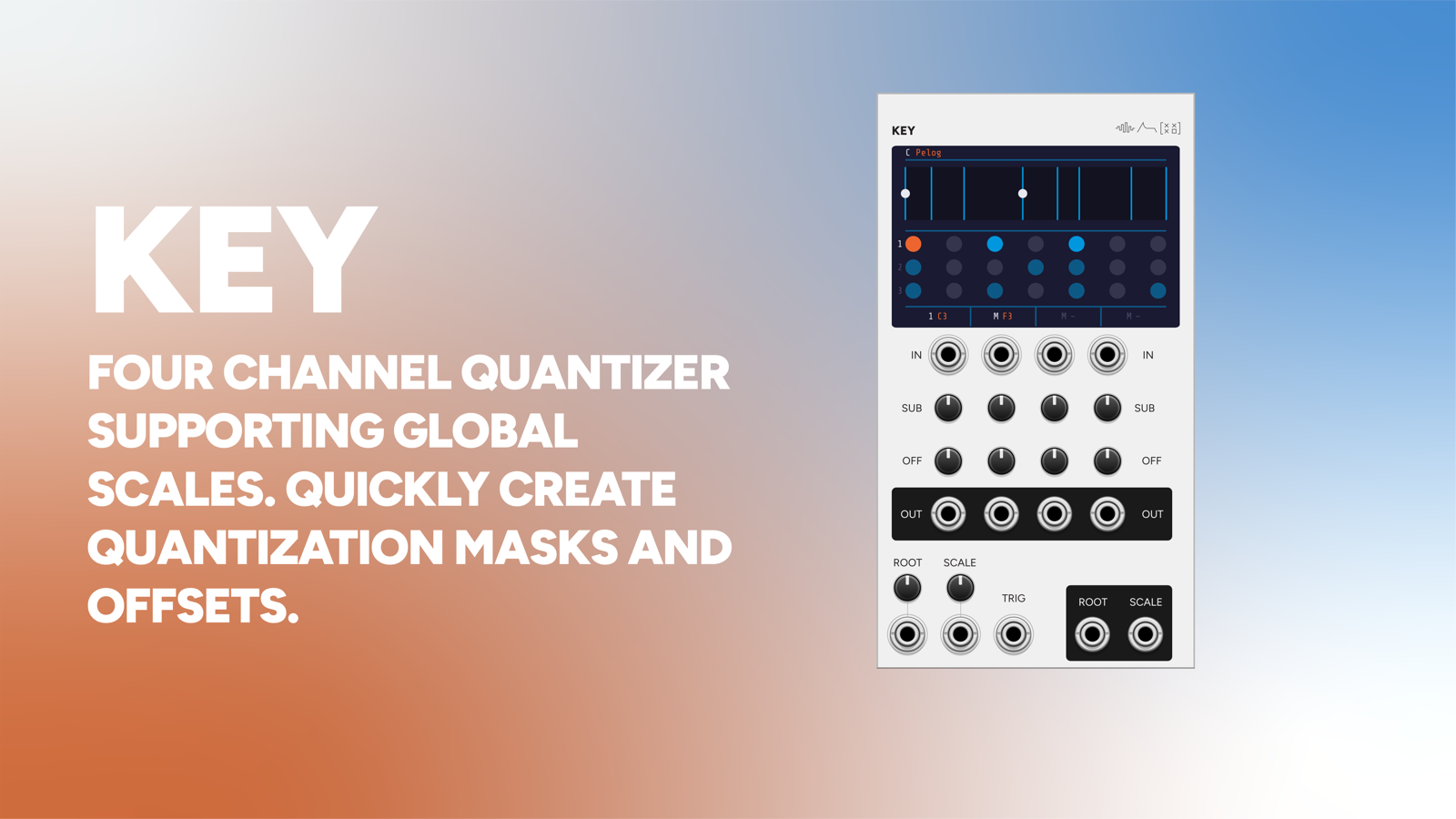 Key
KeySpool's ROOT reads the plugin's key convention, so absolute mode tunes the tapes to whatever key Key is handing out.
-
 Phase
PhaseBoth drift two copies of a loop apart. Phase does it by sleep and rotate, Spool by where you last let go of the gate.