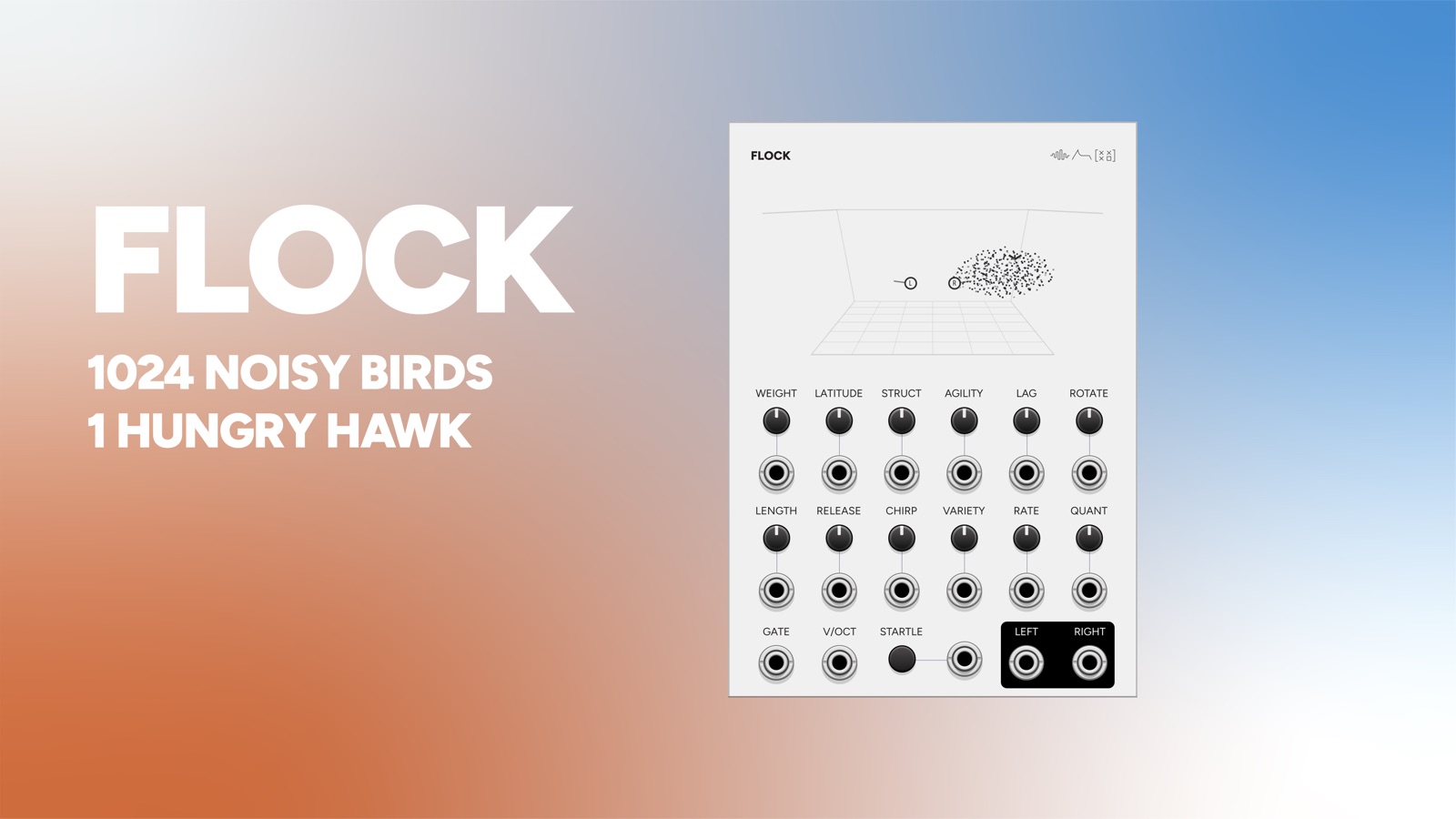

Flock In is the 4 HP expander that sits immediately to the left of Flock. Patch audio into LEFT and RIGHT and the birds sing grains of it instead of sines. Each call reads a short piece of the last few seconds of input, pitched by where the bird is in the flock and by V/OCT. The length, glide, rate and panning of the calls are still set on Flock.
Controls
Each control has a CV input beneath it; plus or minus 5 V covers the knob.
ENV sets the shape of each grain by placing its peak. Near zero the grain has a fast attack and a long decay, like a struck sound, and a quarter of the way up, the default, gives a short attack and a longer decay. Halfway gives a symmetric grain, and near the top the grain rises slowly and ends quickly, like a sound played in reverse. Both halves are smooth curves, so the envelope has no sharp corners at any setting.
REACH is how far back into the buffer the birds may read, 50 ms to 10 s. Birds deep in the flock read further back than birds at the front, so the flock is spread through time as well as space.
FREEZE holds the buffer, from the latch or a gate above 1 V, so the birds keep reading grains from the audio held at that moment.
Inputs
The inputs are LEFT and RIGHT, with RIGHT normalled from LEFT, and CV for ENV, REACH and FREEZE.
Outputs
Flock In has no outputs. It sends the audio to the Flock on its right over the expander bus.
Patch ideas
A voice in the flock. Speak or sing into it with WEIGHT low and LATITUDE small, and the flock scatters your voice into a cloud that follows the keyboard.
Freeze and fly. Play a chord into it, press FREEZE, then send a hawk through with STARTLE on Flock. The grains of the frozen chord scatter in pitch and across the stereo field, then settle again.
In the synthesis guide
- Granular Synthesis: Grains, Envelopes, Clouds
Granular synthesis plays many short sounds called grains, each with its own envelope. The grains can be cut from a recording or generated by an oscillator.
- Sampling: Speed, Pitch, Loops and Reverse
A sampler plays a recording back as an instrument. Changing the playback speed changes the pitch and the length together, and loops let a short recording sustain.