
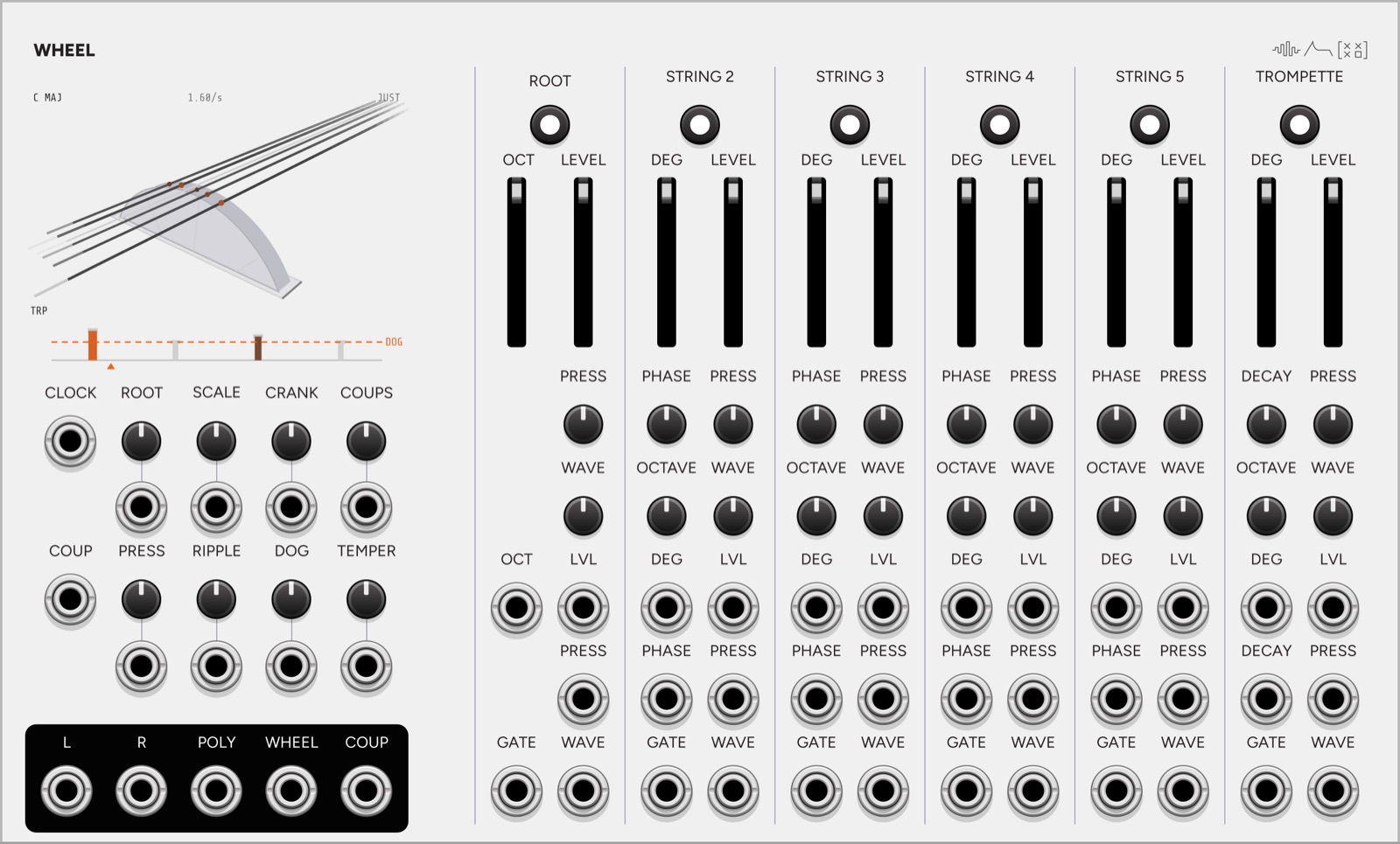
Wheel is a drone instrument after the hurdy-gurdy.
One rosined wheel bows every string at once. That is the whole idea, and everything else follows from it. The wheel is not perfectly round, its rosin is uneven, and it has a seam where it was joined, so every revolution imposes the same ripple of level and brightness on all six voices together.
Six oscillators with six LFOs sound like an organ. Six sharing one slightly irregular modulator sound like one object being played by one person.
42 HP. Five drone voices, the first locked to the root, plus the trompette.
The wheel
CRANK sets the speed in revolutions per second, and that is the tempo of everything: the ripple happens once per turn, and the strokes are counted per turn. Patch CLOCK and one pulse locks one revolution, so the instrument runs in time with the patch.
RIPPLE sets how deeply the wheel’s irregularity reaches the sound. It is a fixed periodic profile rather than noise, which is the point of it: eccentricity as the first harmonic, uneven rosin above that, and a narrow dip where the wheel was joined, in the same place every revolution. It moves level, brightness and rosin noise together, because one wheel is doing all three.
PRESS is how hard the wheel bears on the strings overall. It changes timbre before it changes level, which is what bow pressure does.
The dog
The trompette string crosses a bridge with one loose foot. Accelerate the crank and the foot lifts and rattles. That buzz is the rhythm section, and it is the difference between a hurdy-gurdy and a bagpipe.
Hurdy-gurdy rhythm is counted in strokes per turn of the wheel. Four coups par tour is four wrist accents per revolution.
COUPS divides the turn into one to eight slots. The strip along the foot of the display is that turn unwrapped, one bar per slot, with a playhead running across it. Two separate things take strokes away, and both are visible:
- Bar height is that stroke’s strength, which comes from its position in the bar. The downbeat is hardest, the half turn next, the quarters next, the rest weakest.
- The dashed line across is DOG. A stroke buzzes if its bar clears the line. Raising DOG walks the line up through the bars and removes the weak strokes a tier at a time, so it sweeps from every stroke, to the accented ones, to the downbeat alone.
- Cranking faster grows every bar, so a hard crank makes the dog speak more readily. That is the technique, and you can watch bars rise through the line as you crank.
- The whisker on each bar is stroke-to-stroke jitter. Where a whisker straddles the line, that stroke fires some turns and not others.
- Click a bar to mute that slot. It draws as a stub.
The strip is the pattern, and DOG thins whatever pattern is left. DOG defaults to 0, meaning play the ring exactly.
A coup does not only buzz. The stroke lifts the wheel’s speed briefly, so all five drones swell and brighten with it. That common-mode swell is half of why the accent lands.
The six voices
Each voice is a block three sub-columns wide, with its button on the centre one.
| DEG (OCT on the root) | LEVEL |
| PHASE (DECAY on the trompette) | PRESS |
| OCTAVE | WAVE |
DEG is a scale degree, so the voicing stays in the key whatever the key is. The root voice is locked to the root, so its fader is an octave instead.
WAVE morphs sine, triangle, sawtooth, square. The sawtooth is the anchor: Helmholtz motion on a bowed string is a sawtooth, and morphing toward square reads as more bow pressure.
PRESS is how hard that one string sits on the wheel, which is the cotton wrapping on a real instrument. A string barely touching the wheel is duller, slips, and gives more rosin than tone.
The button puts the string on the wheel, and it is the normalled value of that voice’s GATE input. Unpatched, the button decides and defaults to on. Patched, the gate decides. Either way the string swells onto the wheel rather than switching, because the wheel takes a moment to grip.
There are three ways to quieten a voice and they do three different jobs. LEVEL is the mix. PRESS changes timbre before level. The button takes the string off the wheel entirely.
Tuning
ROOT and SCALE move all six voices together, as a key change does. SCALE reads the plugin’s polyphonic scale bus, so a Scala file or a non-octave scale set on Key arrives intact.
TEMPER snaps every voice to the nearest just ratio against the root, which is how a hurdy-gurdy is tuned by ear.
It will look as though it does nothing on a traditional drone voicing, and that is correct. Equal temperament is exact at the octave and within 2 cents at the fifth, so on a setup of roots, octaves and fifths there is almost nothing for TEMPER to move. It bites on thirds and sixths, by 14 to 16 cents, and on sevenths by 12. The readout says what TEMPER is doing rather than what it is set to: JUST 14c when there is something to move, JUST 0c when there is not, EQUAL when it is off, and SCALE when the key is not twelve-tone equal temperament and the control is inert.
Just intonation is also what makes PHASE work. A twelve-tone equal fifth is 1.4983 rather than 1.5, so the relative phase of two voices rotates through a full cycle about once a second and a static phase offset is inaudible. Snapped to 3/2 it holds still and becomes a real timbral control.
The display
The display is a perspective render of the instrument’s own geometry.
The wheel’s plane is perpendicular to the strings and its axle runs along them, which is the crank shaft running up the instrument’s long axis. That is the only orientation that makes a sound: bowing needs the contact surface to move across the string, and the rim’s velocity lies in the wheel’s plane.
Only the top of the wheel is drawn, because only the top is visible. It stands in a slot in the soundboard and emerges through it.
- A dark string is on the wheel, a light grey one is off. The string does not move; only its weight changes.
- The dot where a string crosses the wheel is the contact point, warming toward orange with that string’s pressure and its own phase of the ripple.
- The strings run off the picture rather than stopping, because they carry on to the tailpiece one way and the pegbox the other.
- Click a string to take it off the wheel or put it back.
The readout along the top gives the key, the crank speed in revolutions per second, and what TEMPER is doing.
Controls
Global: Root, Scale, Crank, Coups, Press, Ripple, Dog, Temper.
Per voice: Degree or Octave, Level, Phase or Decay, Press, Octave, Wave, On.
Inputs
Root, Scale, Crank, Coups, Press, Ripple, Dog and Temper CV, plus CLOCK and COUP. Per voice: Degree, Level, Phase or Decay, Press, Gate, Wave.
COUP in fires a stroke directly, at the hardest strength available, so it clears any setting of DOG.
Outputs
| Output | What it does |
|---|---|
| L / R | The stereo mix. |
| POLY | Six channels, one per voice. Six is the trompette. |
| WHEEL | The ripple as CV, so the rest of the patch can share the wheel’s irregularity. |
| COUP | A trigger every time the dog actually buzzes. |
Context menu
Gate presses the string, on by default. Off makes the gate a plain VCA. Gate press time, 8 ms to 1.2 s, is how long the wheel takes to grip. Wheel: spread, detune, rosin, body, stereo width. Plus all strings on the wheel and every stroke of the turn.
Patch ideas
A traditional drone. Root, fifth, root, octave. Leave TEMPER up, RIPPLE around 0.4, COUPS at 4, DOG at 0. Crank slowly and it breathes; crank harder and the dog comes in on its own.
Locked to the patch. Meter’s BAR out into CLOCK gives one revolution per bar, so the coups become a bar subdivision and the ripple lands on the downbeat.
Played from a sequencer. Six gates into the six GATE inputs, with a slow gate press time, gives strings that swell on and off the wheel rather than switching.
The dog alone. Take the strings off the wheel except the trompette, patch a rhythm into COUP, and the module is a buzzing bridge.
Pair with
-
 Key
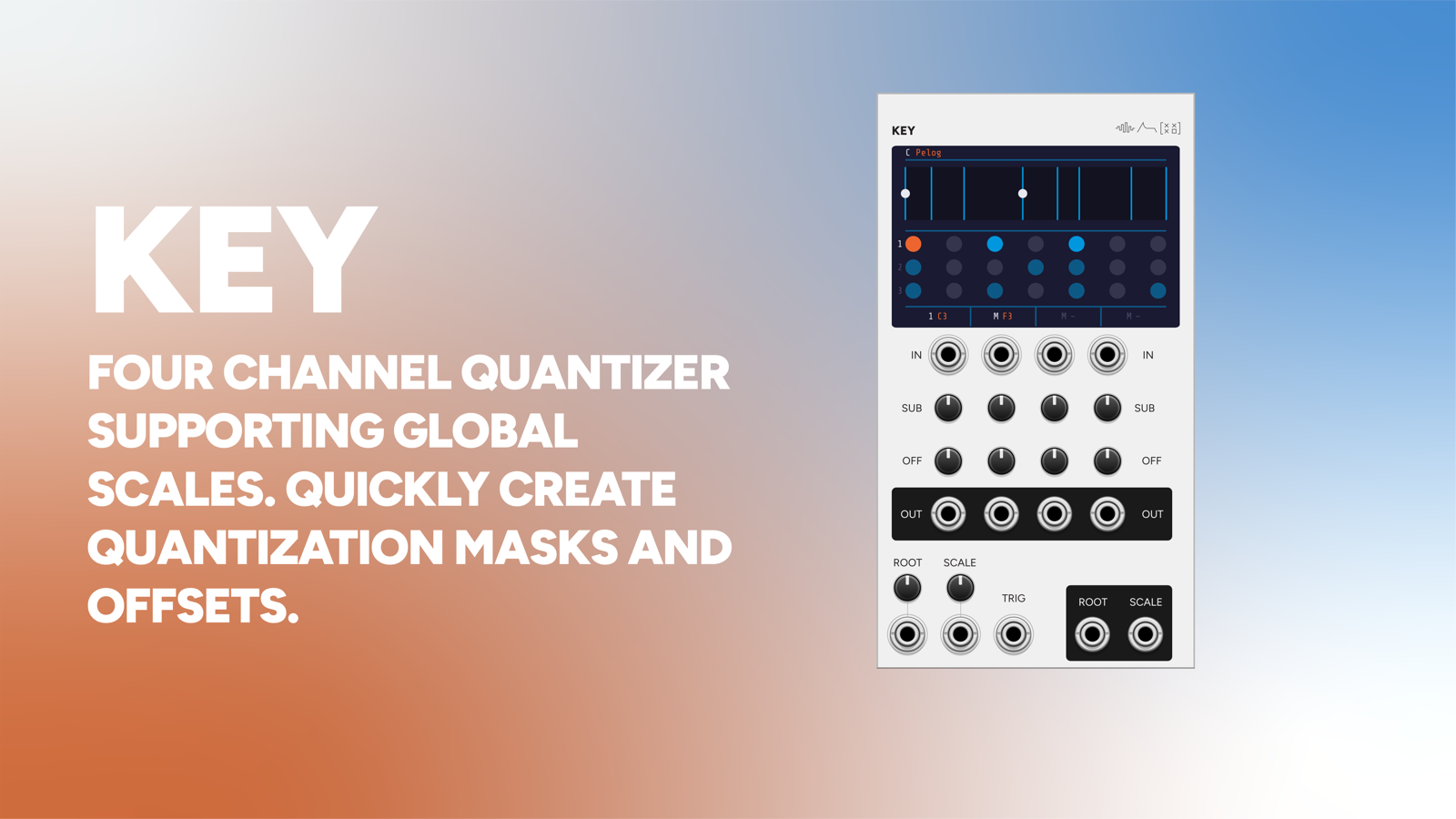
KeyKey sets the root and scale for the whole patch, and Wheel reads the scale bus, so a Scala file or a non-octave scale arrives intact.
-
 Meter
MeterMeter's BAR out into CLOCK gives one revolution per bar, so the coups become a bar subdivision.
-
 Loom
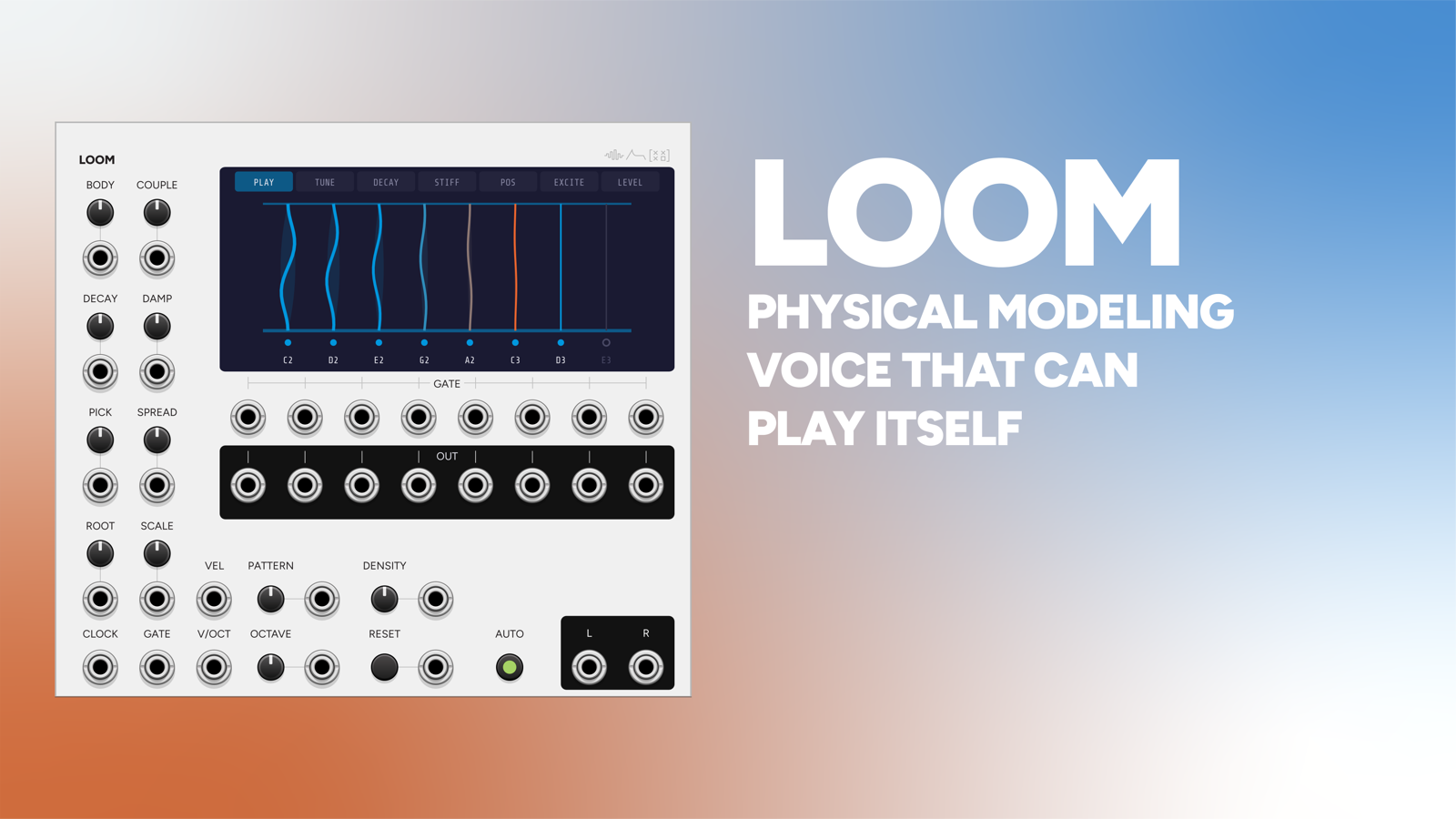
LoomLoom is eight strings sharing a bridge, Wheel is six strings sharing a bow. Two different ways for strings to hear each other.
-
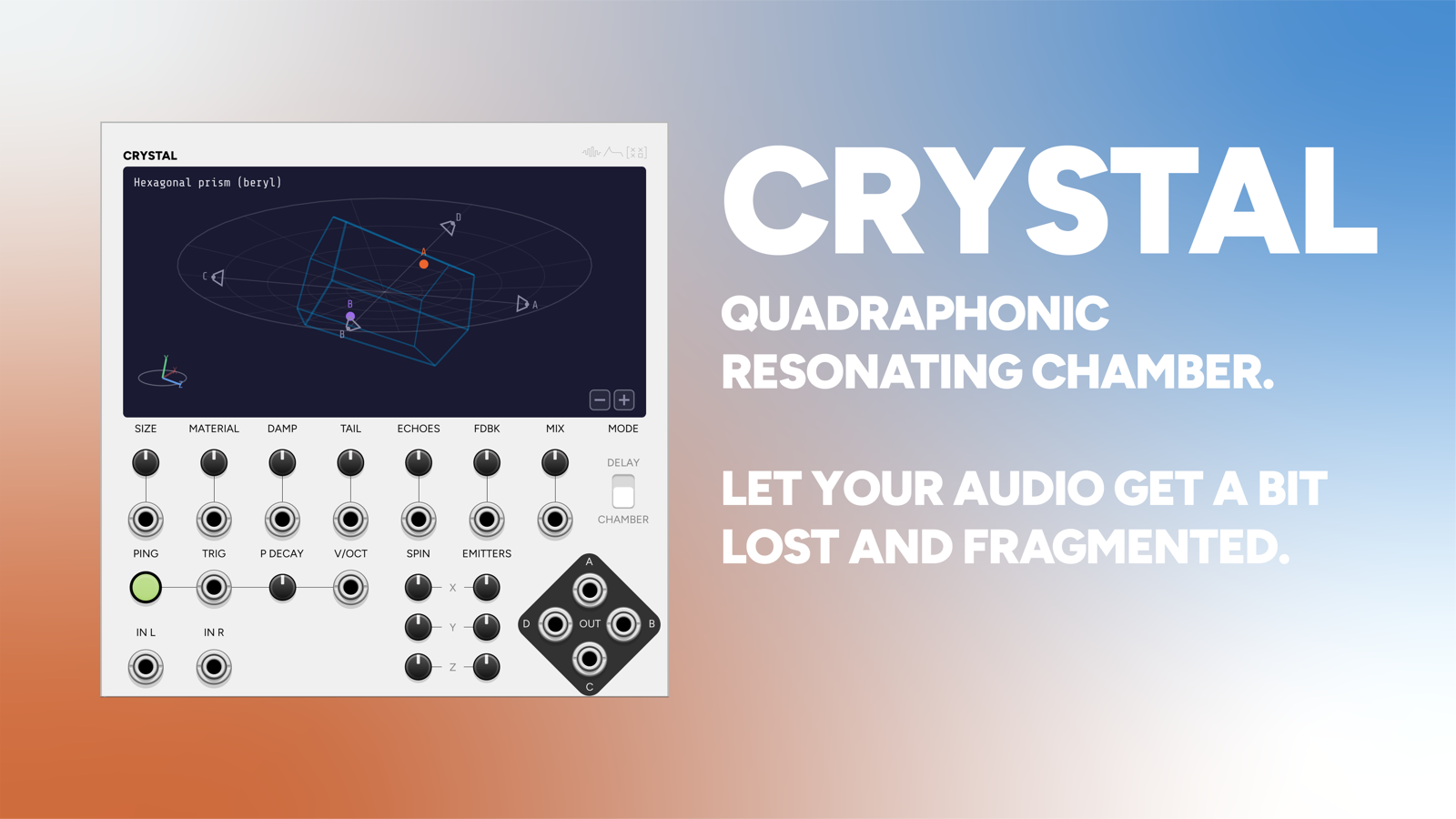 Crystal
A drone wants a room. Crystal gives it four listeners inside one.