Three new modules in 2.20, and two existing ones that changed enough to be worth reading about even if you already have them.
Spool
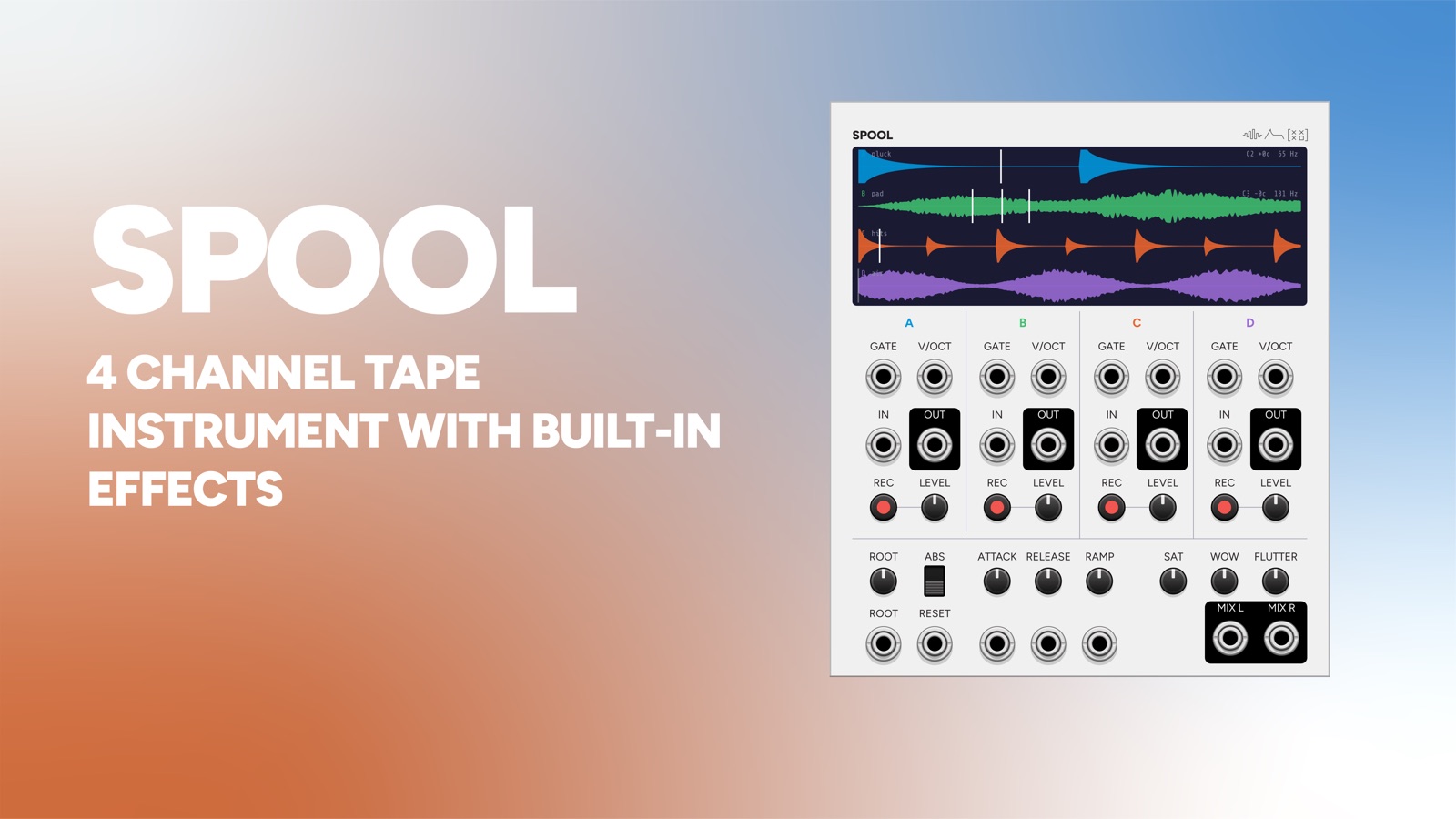
Spool is four short tapes, one transport, and no rewind.
It follows the Mellotron and departs from it in one place. A Mellotron springs its tape back the moment the key comes up, so every press starts from the same instant. Spool leaves the tape where it stopped, so a repeated stab walks through the loop rather than replaying the same moment.
Each tape holds five seconds, loaded from a WAV or recorded in through its own jack, and has eight playheads, so a polyphonic gate plays chords on one tape. V/OCT is varispeed rather than transposition: pitch and loop length move together, as they do on any machine with a capstan. The envelope, saturation, wow and flutter are shared, because there is one capstan.
Field
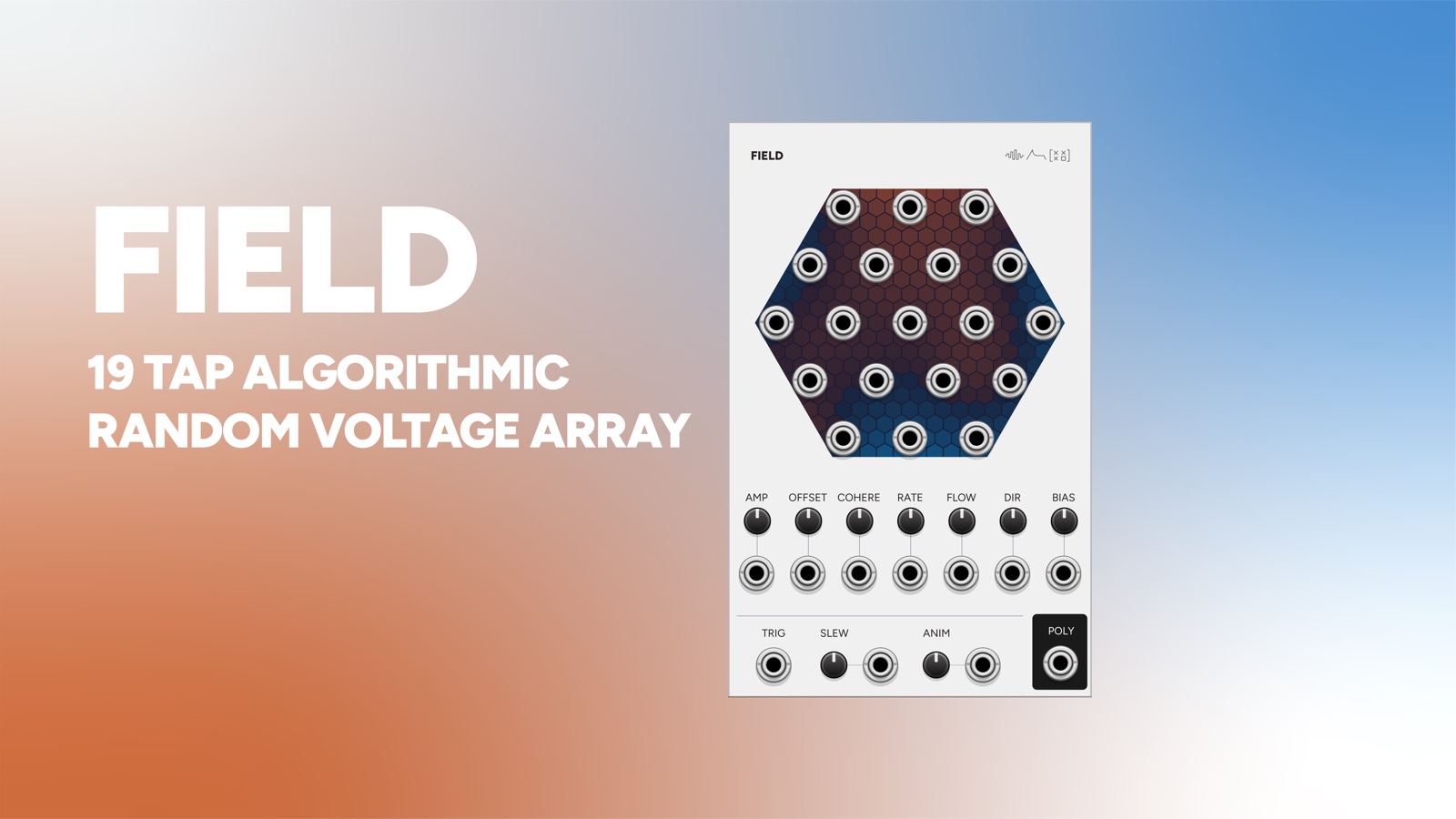
Field is nineteen random voltages that are one thing.
The jacks sit on a hexagonal grid, and under the grid is one smooth random field that each jack reads at its own position. COHERENCE is how far across the grid that surface agrees with itself. At zero you have nineteen unrelated sample-and-holds. Turn it up and the grid becomes weather, and with FLOW and DIR the pattern travels, so the jacks fire in a spatial order.
There is no screen. The plate behind the jacks is tiled with hexagons coloured from the same functions the outputs read, so what you see under a jack is what comes out of it. Eleven animations drive the field, including Gray-Scott reaction-diffusion, a sandpile and a damped wave equation running on the tiling itself.
PolyKit In
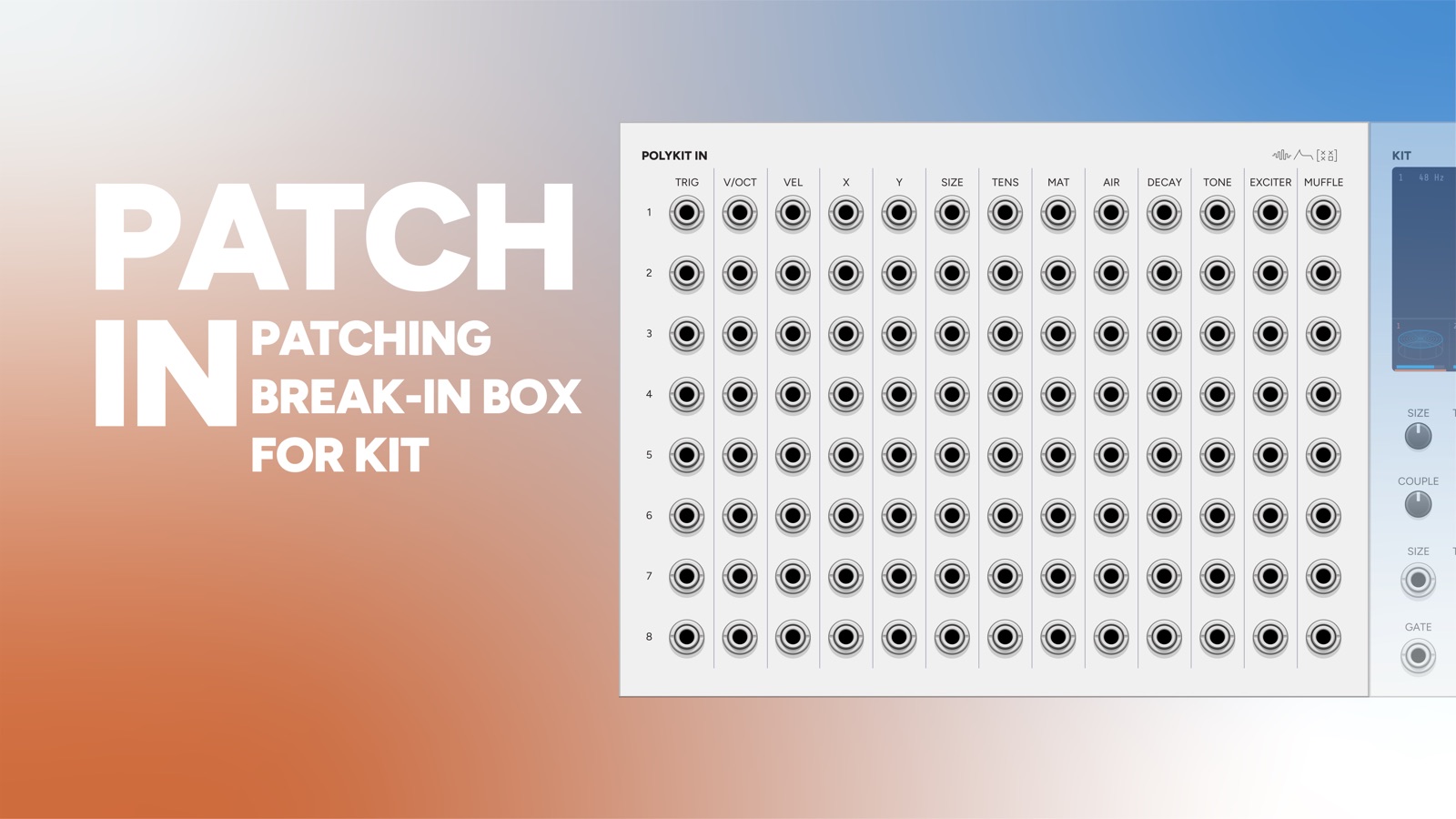
PolyKit In is an expander for Kit: thirteen columns, one per Kit input, by eight rows, one per instrument. It is for racks whose sources are eight modules rather than one polyphonic cable. Every jack is optional, and a patched jack wins over the poly cable for that one input of that one instrument.
Key, rebuilt
Key had a sub-scale selector per channel. It does not any more, because there was nothing left for it to choose: channel 1 is the main scale and channels 2 to 4 are the three sub-scales, which is what the new panel’s column heads say.
Three other changes:
A TRIG per channel, polyphonic. Trigger channel N resamples voice N, so a poly CV and a poly trigger give every voice its own timing.
The inputs normal left to right. One cable in IN 1 feeds all four channels, and a new cable anywhere breaks the chain from that point. One pitch and one clock into channel 1 gives four sample-and-holds of the same line, each with its own sub-scale and offset.
Scala scales past sixty-four degrees. Two testers reported the same class of bug from different directions. A 32-bit constant was filling a 64-bit mask, so on Fokker’s 53-note block the top 40% of the octave was missing from every sub-scale. A 79-note MOS of 159-tET then hit the degree cap itself. The cap is now 256, and a patch saved with a truncated scale re-parses the file on load, so the truncation does not survive the fix.
Kit becomes eight instruments
Kit was one drum. It now holds eight on one panel, each keeping its own settings and its own mic pair, with a row of tabs along the foot of the screen that are the drums themselves, drawn small and ringing when struck.
Channel N of every cable is instrument N. One poly out carries left and right per instrument across sixteen channels, with a stereo mix alongside. A patch saved before this loads as instrument 1 and sounds exactly as it did.
The default kit is Fill’s eight channels in Fill’s order, so a poly cable from Fill plays the right drum on every channel with nothing to map. Four of those presets, Closed hat, Open hat, Clap and Bell, are provisional and do not sound right yet. Everything they need lives below 2 kHz, where the mallet’s contact time and the pickup tilt work against them, and fixing it is engine work rather than preset values.
Smaller things
Loom gets nearest-neighbour voicing, which new instances default to: CV and gate retune and play the closest string rather than striking all eight.
Play reads DecentSampler packs end to end, from 2.19.1. A .dslibrary is a ZIP, and Rack’s unarchiver cannot open one, so Play carries its own and unzips the pack itself. Every .dspreset in a bundle now loads as its own instrument, where before it took whichever one the filesystem happened to name first and said nothing about the rest.
The browser thumbnails are the module now. Sigma, Chime, Kit, Trace and Spool build a real instance outside the engine, run it with a note held or a kit struck, and let the live display code draw it.
Everything is free on the VCV Rack Library. Browse the full set at VCV Rack Modules.